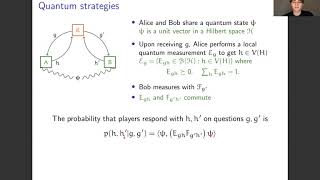
Quantum Isomorphism Is Equivalent to Equality of Homomorphism Counts from Planar Graphs
Explore quantum isomorphism and its equivalence to homomorphism counts from planar graphs, delving into quantum strategies, permutation matrices, and bilabel graphs.
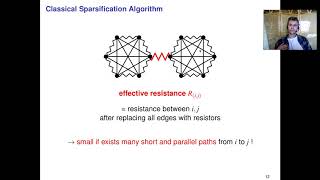
Quantum Speedup for Graph Sparsification, Cut Approximation and Laplacian Solving
Explore quantum algorithms for graph sparsification, cut approximation, and Laplacian solving, offering speedups over classical methods in these fundamental graph problems.
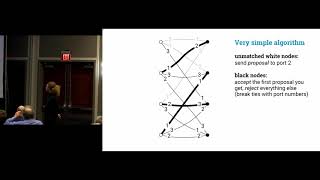
Lower Bounds for Maximal Matchings and Maximal Independent Sets
Explore lower bounds for maximal matchings and independent sets in distributed settings, using round elimination techniques and the LOCAL model.
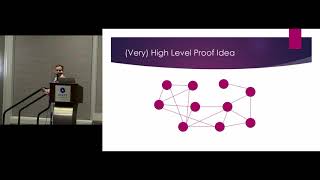
Random K-Out Subgraph Leaves Only O-N-K- Inter-Component Edges
Explore efficient graph partitioning techniques, focusing on random k-out subgraphs and their impact on inter-component edges. Learn about applications in connectivity and dense graph analysis.
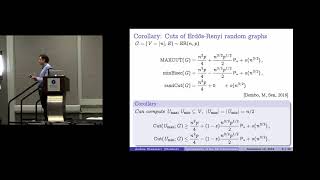
Optimization of the Sherrington-Kirkpatrick Hamiltonian
Explore the optimization of the Sherrington-Kirkpatrick Hamiltonian, covering stochastic block models, random graphs, and algorithmic insights for solving complex optimization problems.
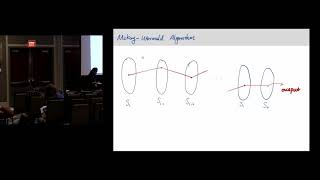
Fast Uniform Generation of Random Graphs with Given Degree Sequences
Explore efficient algorithms for generating random graphs with specified degree sequences, focusing on rejection and switching methods.
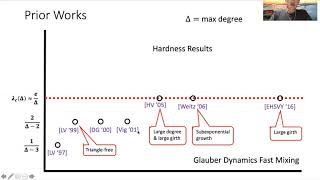
Spectral Independence in High-Dimensional Expanders and Applications to the Hardcore Model
Explore spectral independence in high-dimensional expanders and its application to the hardcore model, focusing on Glauber dynamics, complexity phase transitions, and future research directions.
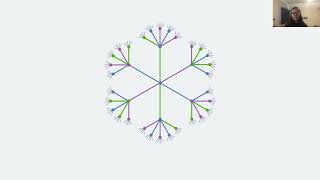
Explicit Near-Fully X-Ramanujan Graphs
Explore finite graphs resembling infinite ones, focusing on Ramanujan graphs and spectral properties. Learn about matrix-weighted polynomials and permutation-based approaches.
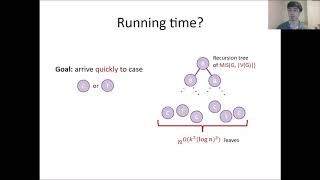
Independent Set on P_k-Free Graphs in Quasi-Polynomial Time
Explore efficient algorithms for solving the Independent Set problem on P_k-Free Graphs, including novel approaches and complexity analysis.
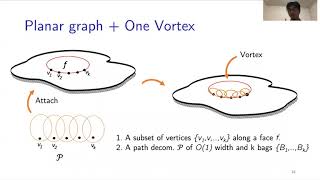
On Light Spanners, Low-Treewidth Embeddings and Efficient Traversing in Minor-Free Graphs
Explore efficient graph traversal techniques using light spanners and low-treewidth embeddings, with applications to minor-free graphs and approximation algorithms.
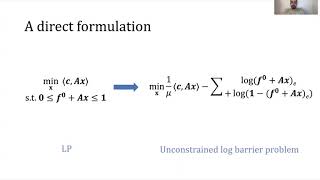
Circulation Control for Faster Minimum Cost Flow in Unit-Capacity Graphs
Explores advanced techniques for optimizing minimum cost flow in unit-capacity graphs, focusing on circulation control methods to enhance efficiency and reduce computational complexity.
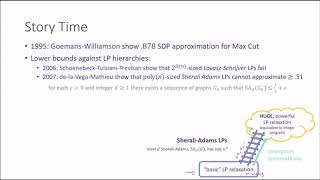
Subexponential LPs Approximate Max-Cut
Explore subexponential linear programs for approximating Max-Cut, comparing LPs and SDPs, and examining refutation in pseudorandom graphs. Gain insights into combinatorial optimization techniques.
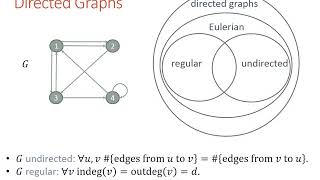
High-Precision Estimation of Random Walks in Small Space
Explore advanced techniques for estimating random walks in limited space, covering pseudorandom generators, graph algorithms, and Laplacian systems for efficient problem-solving.
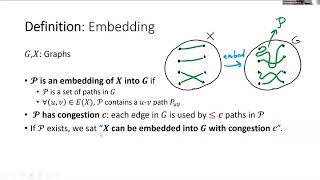
A Deterministic Algorithm for Balanced Cut with Applications to Dynamic Connectivity, Flows, and Beyond
Explore deterministic algorithms for balanced cut, with applications in dynamic connectivity and network flows. Learn about two-way reduction, competition games, and embedding techniques.
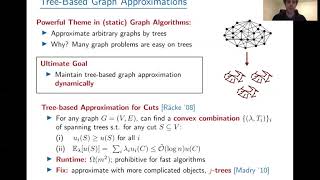
Fast Dynamic Cuts, Distances and Effective Resistance via Vertex Sparsifier
Explore dynamic graph algorithms and vertex sparsification techniques for efficient computation of cuts, distances, and resistance in evolving networks.
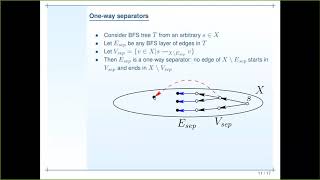
Near-Optimal Decremental SSSP in Dense Weighted Digraphs
Explore near-optimal algorithms for maintaining shortest paths in dense weighted digraphs as edges are deleted, focusing on efficient update times and approximation techniques.
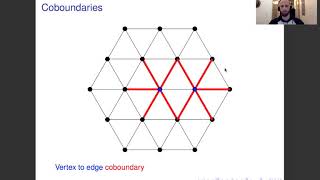
Decodable Quantum LDPC Codes Beyond the Square Root Distance Barrier Using High Dimensional Expander
Explore quantum LDPC codes using high dimensional expanders, surpassing distance barriers. Learn about CSS codes, geometric complexes, and LSV constructions for improved quantum error correction.
Breaking the Attack Graph - How to Leverage Graphs to Strengthen Security in a Domain Environment
Explore how defenders can leverage graph-based thinking to strengthen security in domain environments, adapting to sophisticated attackers and enhancing prevention, detection, and investigation strategies.
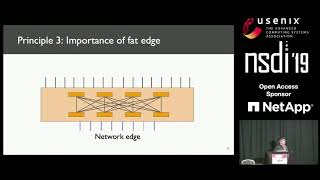
Understanding Lifecycle Management Complexity of Datacenter Topologies
Explores lifecycle management complexity of datacenter topologies, comparing Clos and expander graphs. Introduces FatClique, a new topology combining wiring simplicity and expandability, with insights on deployment and expansion costs.
Social Network Analysis - A Scary Primer
Explore unconventional data fusion techniques to analyze social networks, revealing insights from digital footprints and real-world sensors. Learn about graph theory and its applications in personal data analysis.
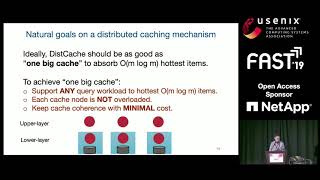
DistCache - Provable Load Balancing for Large-Scale Storage Systems with Distributed Caching
Innovative distributed caching mechanism providing provable load balancing for large-scale storage systems. Partitions hot objects and adaptively routes queries, enabling linear cache throughput increase with node count.