
Probabilistic Programming Interfaces for Random Graphs: Markov Categories, Graphons, and Nominal Sets - POPL 2024
Explore semantic models of probabilistic programming languages over graphs, connecting graphons to equational theories through Markov categories, measure-theoretic probability, and nominal sets.
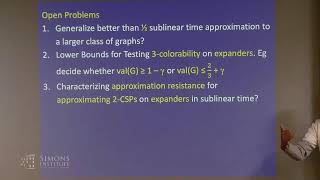
Sublinear Time Algorithms for Max-Cut Approximation on Expander Graphs
Explore random walks on graphs to achieve better-than-1/2 approximation for max-cut on expanding and clusterable graphs, using sublinear time algorithms.
Linear and Sublinear Algorithms for Graphlet Sampling
Explore efficient algorithms for graphlet sampling, including linear and sublinear preprocessing techniques, with applications to semi-streaming and MPC settings.
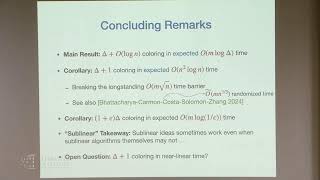
Sublinear Insights: A Faster Classical Algorithm for Edge Coloring
Explores a novel randomized algorithm for near-linear time graph edge coloring, improving on decades-old methods. Discusses implications for Vizing's theorem and dense graph coloring efficiency.
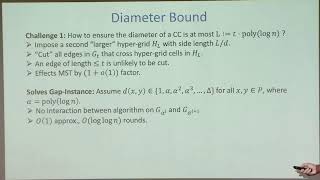
Massively Parallel Algorithms for High-Dimensional Euclidean Minimum Spanning Tree
Efficient distributed algorithms for clustering high-dimensional data using Euclidean Minimum Spanning Tree, achieving constant factor approximation in O~(loglogn) rounds of MPC model.
Continuous Security and Governance in the Cloud Using a Graph-Based CMDB
Explore Reddit's implementation of a graph-based CMDB for cloud security governance, including visibility gains, implementation journey, and the power of centralized configuration data aggregation.
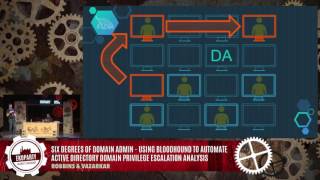
Six Degrees of Domain Admin
Explora cómo la teoría de grafos revoluciona la escalada de privilegios en Active Directory, revelando relaciones ocultas y optimizando tanto ataques como defensas en redes empresariales.

Origami Software from Scratch
Explore the journey of creating origami software, from basic geometry to complex algorithms, with interactive visualizations and insights into mathematical foundations and user-friendly design.
CypherDog 2.0 - Attackers Think in Graphs, Managements Needs Metrics
Explore CypherDog 2.0, a tool bridging the gap between attacker mindsets and management metrics, enhancing cybersecurity strategies and decision-making processes.
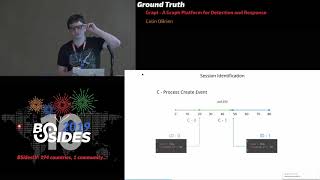
Grapl - A Graph Platform for Detection and Response
Explore a graph-based platform for enhanced cybersecurity detection and response, covering node relationships, log analysis, and advanced investigation techniques.
Planar Graphs Have Bounded Queue-Number
Explore the theory of planar graphs and their bounded queue-number property, including history, extensions, and applications in graph theory.
Near Optimal Massively Parallel Graph Connectivity
Explore efficient parallel algorithms for graph connectivity, focusing on near-optimal solutions and innovative techniques for large-scale graph processing.
Expander Graphs - Both Local and Global
Explore expander graphs, their local and global properties, construction methods, and applications in this concise IEEE talk by experts in the field.
Inapproximability of Clustering in Lp Metrics
Explores computational complexity of clustering in Lp metrics, discussing approximation algorithms, hardness of approximation, and key concepts like Johnson Coverage Hypothesis.
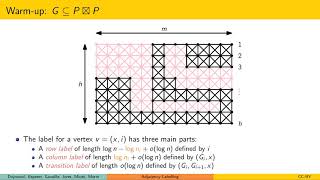
Adjacency Labelling for Planar Graphs - and Beyond
Explore adjacency labelling for planar graphs, covering universal graphs, labeling schemes, and the Strong Graph Product. Learn about binary search trees and their applications in graph theory.
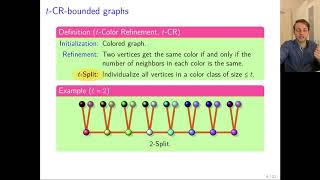
Isomorphism Testing for Graphs Excluding Small Minors
Explore graph isomorphism algorithms for graphs excluding small minors, covering decompositions, t-CR-bounded graphs, and quasipolynomial-time solutions in this advanced theoretical computer science talk.
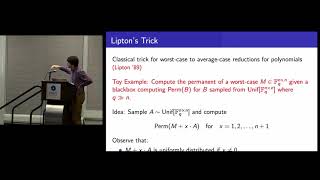
The Average-Case Complexity of Counting Cliques in Erdos-Renyi Hypergraphs
Explore average-case complexity of counting cliques in Erdos-Renyi hypergraphs, covering proof techniques, random KQ accounting, and binary expansions.
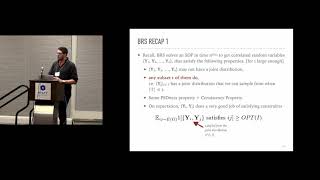
Approximating Constraint Satisfaction Problems on High Dimensional Expanders
Explore high-dimensional expanders and their role in approximating constraint satisfaction problems, with insights on natural collections and general expanders.
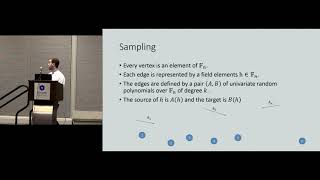
Sampling Graphs Without Forbidden Subgraphs and Unbalanced Expanders With Negligible Error
Explore efficient graph sampling techniques and unbalanced expanders, focusing on avoiding forbidden subgraphs and achieving negligible error rates in computational applications.
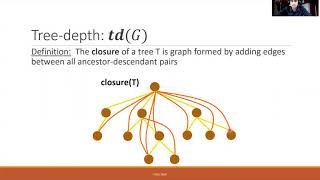
Tree-Depth and the Formula Complexity of Subgraph Isomorphism
Explore tree-depth's impact on subgraph isomorphism complexity, examining special cases, formula complexity, and graph minor approximation in this theoretical computer science talk.
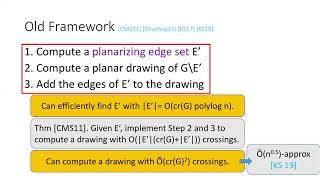
Towards Better Approximation of Graph Crossing Number
Explores advanced techniques for approximating graph crossing numbers, focusing on new frameworks and theorems for both general and bounded-degree graphs.