
OpenGL and CUDA-Based Tessellation
Explore advanced tessellation techniques using CUDA to overcome OpenGL limitations, enabling higher-order surfaces, custom UV coordinates, and trimming curves for improved visual quality in graphics rendering.
Lessons and Outlook for ML Parameterization of Sub Grid Atmospheric Physics From the Vantage of Emulating Cloud Superparameterization - Mike Pritchard
Exploring machine learning for atmospheric physics parameterization, focusing on cloud superparameterization emulation. Discusses challenges, strategies, and lessons learned in applying ML to climate modeling.
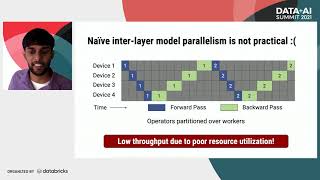
Efficient Large-Scale Language Model Training on GPU Clusters
Explores advanced techniques for efficient large-scale language model training on GPU clusters, discussing parallelism methods, novel scheduling, and performance optimization to achieve unprecedented model sizes and training speeds.
Kubernetes as a Substrate for ATLAS Compute
Exploring Kubernetes' potential for ATLAS experiment computing, including batch processing, GPU resource management, and interactive analysis clusters for high-energy physics research.
Kubernetes for GPU-Powered Machine Learning Workloads in Academia - Lecture
Optimizing Kubernetes for GPU-powered machine learning in academia: architecture, challenges, and successes with NVIDIA DGX A100 machines, open-source integration, and research applications.
Introducing Chapel: A Programming Language for Productive Parallel Computing from Laptops to Supercomputers
Explore Chapel, a programming language for efficient parallel computing across devices. Learn key features and applications in aerodynamics, data science, and atmospheric research.
Docker Containers for Machine Learning on Specialized AI Hardware
Explore Docker's role in scaling machine learning across heterogeneous systems with multiple processors, including GPUs and AI accelerators. Learn about container benefits and future trends in multi-processor ML workloads.
Serving Machine Learning Models at Scale Using KServe
Explore KServe's Multi-Model Serving solution for scalable machine learning deployment. Learn design, implementation, and benchmarks for efficient model serving across frameworks.
Building a Multi-Cluster Privately Hosted LLM Serving Platform on Kubernetes
Explore the architecture and challenges of building a cloud-agnostic LLM serving platform on Kubernetes, including control plane, dataplane, and serverless inference using KEDA for auto-scaling.
How We Power the Largest AI Deployments on the Planet - Running Virtual Clusters at Scale
Explore challenges and solutions for managing large-scale Kubernetes clusters on bare metal, focusing on security, GPU provisioning, and scalability for AI workloads at CoreWeave and Loft Labs.
Training Foundation Model Workloads on Kubernetes at Scale with MCAD
Explore how IBM's Vela supercomputer uses MCAD to queue custom resources for large-scale AI training on Kubernetes, enabling flexible frameworks and fault tolerance across hundreds of GPUs.
Keep HPC Running - SRE's Guide to Supporting GPUs on Kubernetes
Learn best practices for SRE teams supporting GPU-enabled Kubernetes clusters for HPC and AI workloads, including key metrics, monitoring tools, and operational strategies.
Training Large Language Models on Kubernetes
Explore challenges and best practices for training Large Language Models on Kubernetes, including optimization techniques, resource management, and benchmarks comparing K8s to bare metal environments.
Overcoming GPU Shortages with Virtual Kubelets and Distributed Cloud
Explore innovative solutions to GPU shortages using virtual Kubelets and distributed cloud technology, with practical demonstrations and expert insights.
Running Distributed TensorFlow on DC/OS
Learn to run distributed TensorFlow on DC/OS, addressing challenges in large-scale machine learning. Explore framework design, live demo, and practical implementation for efficient model training on your infrastructure.
Adapting Kubernetes for Machine Learning Workflows
Explore how Bloomberg adapted Kubernetes for machine learning, addressing multi-tenancy, data security, and hardware acceleration in their AI-driven financial services platform.
Distributed Deep Learning on Apache Mesos with GPUs and Gang Scheduling
Explore distributed deep learning on Apache Mesos, leveraging GPU clusters for efficient model training in self-driving cars, trip forecasting, and fraud detection at UBER.
Perspective in 3D - Vector Math and Ray Tracing for Financial Data Analysis
Explore vector math, ray tracing, and creative engineering as Perspective's expression language is repurposed for 3D graphics, blending financial analysis with game engine concepts.
Co-Location of CPU and GPU Workloads for High Resource Efficiency in Kubernetes
Explore efficient co-location of CPU and GPU workloads in Kubernetes, including QoS class creation, cgroup management, gang scheduling, and utilization evaluation for improved resource efficiency.
Multi-Cloud Machine Learning Data and Workflow with Kubernetes
Explore building a multi-cloud ML platform using Kubernetes for autonomous vehicles, addressing data management, scheduling, and hardware support across diverse environments.
Auto-scalable Microservices for Machine Learning - UnifyID Case Study
Scaling Machine Learning backend for 1M+ users: GPU-intensive computations, containerization on EC2, horizontal scaling, uniform API for ML microservices, and addressing production deployment challenges.