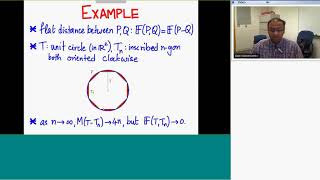
Bala Krishnamoorthy: Linear Programming in Geometric Measure Theory
Explore geometric measure theory through linear programming, examining integral currents, simplicial flat norm, and polyhedral approximation. Discover applications in median shape analysis.
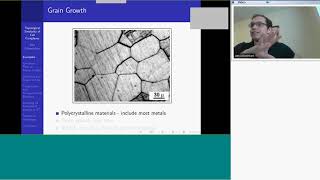
Benjamin Schweinhart - Statistical Topology of Random Cell Complexes, and Applications
Explore statistical topology of random cell complexes, covering curvature flow, grain growth, graph limits, and computational evidence for steady state hypothesis.
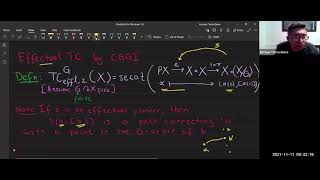
Enrique Torres-Giese - Sequential Motion Planning Assisted by Group Actions
Sequential motion planning with group actions: exploring effectual and effective TC, orbital topological complexity, and their relationships. Calculations for actions on orientable surfaces and spheres included.
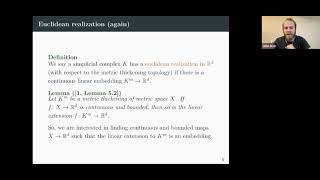
Johnathan Bush - Maps of Čech and Vietoris–Rips Complexes into Euclidean Spaces
Explore simplex-preserving maps in Čech and Vietoris–Rips complexes, their applications, and the challenge of finding such maps from various domains to Euclidean spaces.
Jürgen Jost - Geometry and Topology of Data
Explore geometric and topological approaches to data analysis, focusing on ball intersections, curvature concepts, and convexity in metric spaces.
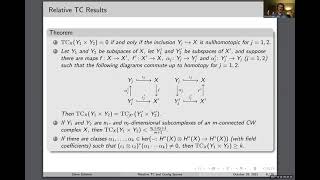
Steve Scheirer - Relative Topological Complexity and Configuration Spaces
Explore relative topological complexity and configuration spaces in this advanced algebraic topology talk, covering definitions, results, and applications.
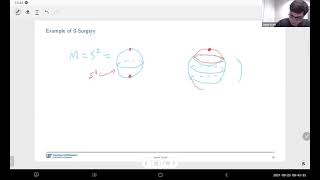
Jamie Scott - Applications of Surgery to a Generalized Rudyak Conjecture
Exploring applications of surgery theory to Rudyak's conjecture, discussing generalizations to topological complexity, and examining cases for simply connected codomains.
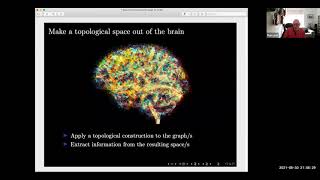
An Application of Neighborhoods in Directed Graphs in the Classification of Binary Dynamics
Explore graph theory applications in classifying binary dynamics, focusing on vertex neighborhoods and their use in analyzing neuronal network activity, with insights from the Blue Brain Project.
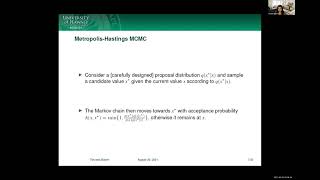
Farzana Nasrin - Random Persistence Diagram Generator
Explore a method for generating random persistence diagrams using parametric models and Markov chain Monte Carlo algorithms, with applications in material science and topology.
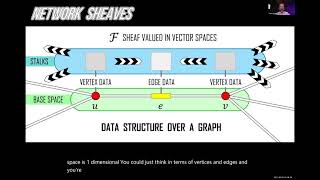
Robert Ghrist - Laplacians and Network Sheaves
Explore cellular sheaves, Laplacians, and network dynamics in algebraic topology. Learn about sheaf cohomology computation and applications in decentralized methods.
Basic Homotopy Theory by Samik Basu
Explore fundamental concepts in homotopy theory, including maps, CW complexes, equivalences, and fibrations. Gain insights into key computations and sequences in this foundational area of topology.
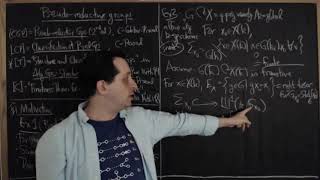
Pseudo-Reductive Groups by Brian Conrad
Explore pseudo-reductive groups with Brian Conrad, covering definitions, properties, and key theorems in this advanced mathematics lecture on algebraic group theory.
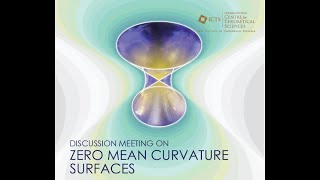
Zero Mean Curvature Surfaces in Euclidean and Lorentz-Minkowski 3-Space - Lecture 1
Explore zero mean curvature surfaces in Euclidean and Lorentz-Minkowski spaces, covering fundamental concepts, variations, stability, and examples of minimal surfaces with diverse properties and geometries.
The Transfer in Algebraic K-Theory and THH
Explore algebraic K-theory transfers, their applications in A-theory, and connections to THH. Gain insights into fundamental questions and trace methods in this advanced mathematics lecture.
Emergent Network Geometry
Explore emergent network geometry, from complex networks to quantum spacetime, revealing hidden structures and applications in diverse fields like neuroscience and collaboration networks.
Chad Giusti - Topology, Convexity, and Neural Networks
Explore topology in neuroscience, focusing on receptive fields, neuron convexity, and geometric features. Discover connections between neural networks and mathematical concepts.
High Dimensional Expanders
Explore high-dimensional expanders, their mathematical properties, and applications in theoretical computer science. Learn about coboundary and spectral expansion, and their implications for complex structures.
The Slices of Hermitian K-Theory
Explore Hermitian K-theory's slices, their construction, and applications in algebraic geometry. Gain insights into Milnor's conjecture on quadratic forms through this advanced mathematical lecture.
Ricci Curvature and Functional Inequalities for Interacting Particle Systems
Explore entropic Ricci curvature bounds and their applications to interacting particle systems, focusing on functional inequalities and convergence rates to equilibrium in nonnegative curvature scenarios.
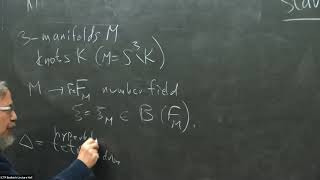
From Knots to Number Theory II
Explore connections between quantum knot invariants and number theory, covering topics like hyperbolic topology, Kashaev invariant, and quantum modularity. No prior knowledge required.
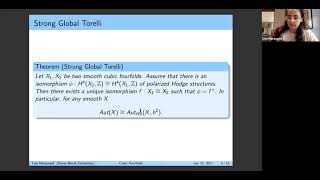
Involutions of a Cubic Fourfold
Explore involutions of cubic fourfolds, covering hyperkähler manifolds, period domains, and evolution types. Delve into geometry, rationality, and related mathematical concepts.