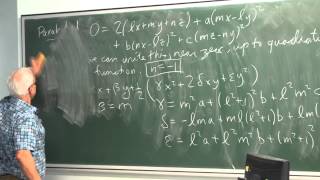
Curvature for General Algebraic Surfaces - Differential Geometry Lecture 29
Explore curvature formulas for general algebraic surfaces, extending from paraboloids to general quadrics. Learn to compute curvatures for hypersurfaces in affine space.
The Rational Number Line and Irrationalities - Famous Math Problems 19b
Geometric approach to modeling the continuum using the rational number line. Explores properties, projective view, and introduces irrationalities through Euclidean geometry and polynomial equations.
The Most Fundamental Problem in Mathematics - Famous Math Problems 19a
Explore the fundamental problem of modeling the continuum in mathematics, examining its historical significance, practical applications, and implications for various mathematical areas.
Euler's Relation Between Vertices, Edges, and Faces of Platonic Solids - Famous Math Problems 15
Explore Euler's famous formula relating vertices, edges, and faces of Platonic solids. Discover its historical context, proof, and significance in modern topology.
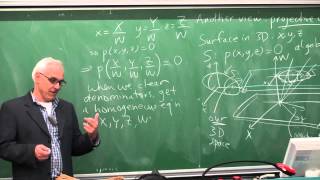
More General Surfaces in Differential Geometry - Lecture 22
Explores advanced surface types in differential geometry, including ruled and developable surfaces, minimal surfaces, algebraic surfaces, and projective constructions, with historical context and mathematical insights.
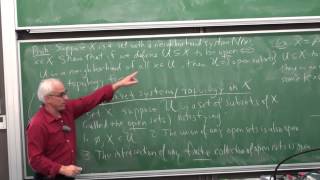
Topological Spaces and Manifolds - Differential Geometry Lecture 24
Explore topological spaces and manifolds through neighborhood systems and open sets. Learn key concepts, solve problems, and understand the foundations of continuous space theory in modern mathematics.
Differential Geometry Problems Tutorial - Lecture 21
Detailed solutions for three differential geometry problems: rational parametrization of cissoid, parametrization of a specific conic, and finding the evolute of y=x^n. Enhances problem-solving skills in advanced geometry.
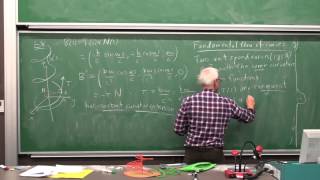
The Frenet-Serret Equations - Example of a Helix - Differential Geometry Lecture 19
Detailed exploration of a helix as an example of Frenet Serret equations, discussing curvature, torsion, and the Fundamental theorem of curves. Introduces osculating, normal, and rectifying planes.
Quadratic Curvature for Algebraic Curves - Differential Geometry Lecture 14
Explores quadratic curvature for algebraic curves, extending from parabolas to general conics. Discusses connections between curvature and foci, emphasizing the power of formulas in differential geometry.
Curvature for the General Parabola - Differential Geometry Lecture 13
Explores curvature of general parabolas using projective geometry, focus-directrix definition, and local behavior. Introduces formulas for parabola curvature as a foundation for understanding curvature of general curves.
Duality, Polarity and Projective Linear Algebra in Differential Geometry - Lecture 10
Explore projective geometry's impact on differential geometry, focusing on conics, projective linear algebra, and duality between points and lines in the projective plane.
Duality, Polarity and Projective Linear Algebra - Differential Geometry Lecture 11
Explores projective geometry, quadratic forms, and pole-polar duality in relation to the unit circle. Connects these concepts to Lorentz/Einstein/Minkowski geometry and Apollonius' work.
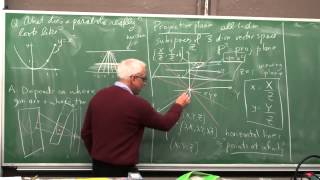
Projective View of Conics and Quadrics - Differential Geometry Lecture 9
Explore projective geometry's application to conics and quadrics, using homogeneous coordinates to unify the study of algebraic curves and surfaces in plane and space.
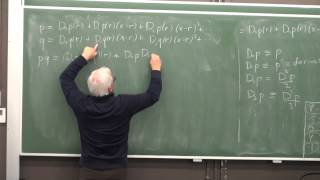
The Differential Calculus for Curves - Lagrange's Algebraic Approach - Lecture 4
Explore Lagrange's algebraic approach to differential calculus, focusing on polynomial functions and Taylor approximations. Learn about tangent lines, conics, and sub-derivatives without limits or real numbers.
The Rotation Problem and Hamilton's Discovery of Quaternions - Part 2 - Famous Math Problems 13b
Explore 3D rotations, their composition, and algebraic representation. Learn about Euler's theorem, vector operations, and the foundations for understanding quaternions in graphics and rocket science.
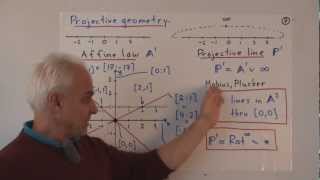
Extended Rational Numbers in Practice - Real Numbers and Limits
Explore extended rational numbers, their applications in mathematics, and connections to projective geometry. Gain insights into graphing polynomials, parametrizing circles, and visualizing infinity in novel ways.
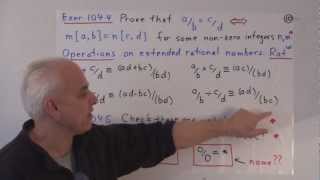
Rational Number Arithmetic with Infinity - Extended Rational Numbers and Limits
Explore arithmetic operations on integral points, extended rational numbers, and the intriguing concept of 0/0. Gain insights into projective geometry and homogeneous coordinates in this mathematical journey.
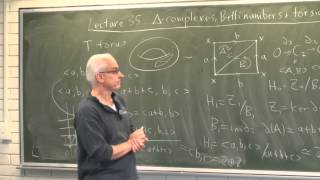
Delta Complexes, Betti Numbers, and Torsion in Algebraic Topology
Explore homology groups of torus and projective plane using delta-complexes. Learn about Betti numbers and torsion in algebraic topology, with practical computations and insights into fundamental concepts.
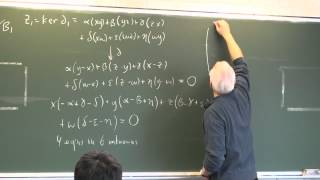
More Homology Computations in Algebraic Topology - Lecture 2
Explore homology computations for the 2-sphere using tetrahedron and delta-complex models. Learn how linear algebra applies to topological problems and simplify calculations with semi-simplicial complexes.
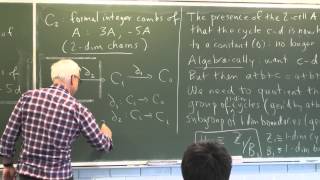
Introduction to Homology in Algebraic Topology - Part 2
Explores cycles, boundaries, and homology in algebraic topology, focusing on graph modifications and using commutative group theory to analyze formal combinations of geometric elements.
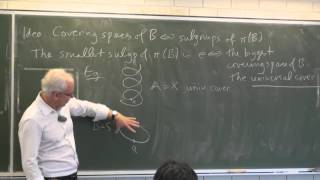
Universal Covering Spaces in Algebraic Topology
Explore fundamental groups, covering spaces, and universal covers. Learn about helical coverings, two-fold coverings, and connections between geometry and topology in this advanced algebraic topology lecture.