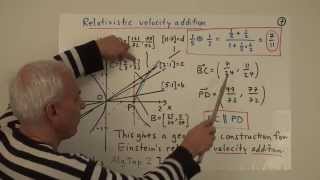
Relativistic Velocity and Core Circles in Rational Geometry - Lecture 4
Exploring relativistic velocity and core circles in rational geometry, extending Paul Miller's protractor concept to projective quadrance and comparing Euclidean and relativistic geometries.
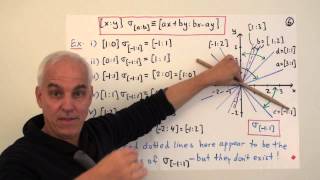
Isometry Groups of the Projective Line - Rational Geometry Math Foundations 138
Explore isometry groups of the projective line, focusing on rotations and reflections. Learn about symmetry, group theory, and their algebraic relationships in a concrete, accessible way.
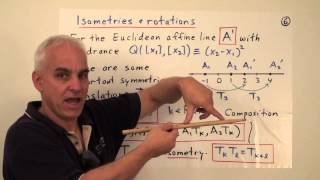
Algebraic Structure on the Euclidean Projective Line - Rational Geometry Math Foundations 137
Explores algebraic structure on the Euclidean projective line, covering projective formulas, isometries, rotations, and their compositions. Connects to chaos theory and complex number multiplication.
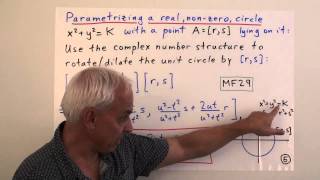
The Projective Line, Circles and the CQQ Theorem - Part 2
Explores advanced geometry concepts including general circles, complex numbers, and the Cyclic Quadrilateral Quadrea theorem, emphasizing projective parametrization and transformations in the complex plane.
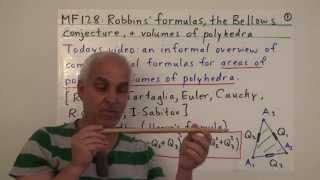
Robbins' Formulas, Bellows Conjecture, and Polyhedra Volumes - Rational Geometry Math Foundations 128
Explore modern developments in polygon area formulas, cyclic pentagon theories, and 3D generalizations of Heron's formula. Discover connections between quadrances, polyhedra volumes, and algebraic geometry.
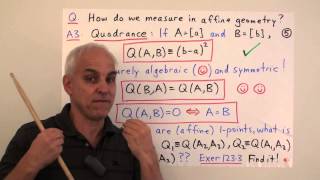
Affine One-Dimensional Geometry and the Triple Quad Formula - Math Foundations 123
Explore the Triple Quad Formula, a fundamental theorem in mathematics, through affine geometry. Learn its derivation, significance, and applications in measuring point separation and collinearity.
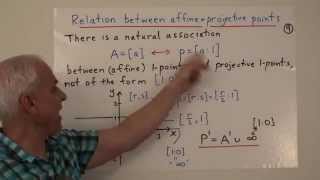
Mathematical Space and Basic Duality in Geometry - Rational Geometry Math Foundations 122
Exploring fundamental concepts of mathematical space, including the duality between affine and projective views, Cartesian geometry, and the relationship between affine and projective lines.
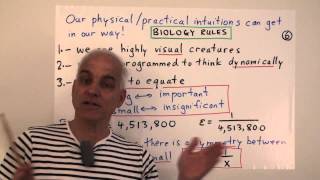
The Continuum, Zeno's Paradox, and the Price We Pay for Coordinates - Math Foundations 117
Exploring the continuum, Zeno's paradoxes, and the shift from geometry to arithmetic in mathematics, challenging our intuitions and biological constraints.
The Chromatic Algebra of 2x2 Matrices - Part 2
Explores chromatic algebra of 2x2 matrices, focusing on subalgebras, complexions, dot products, and the four-dimensional Dihedrons algebra. Compares to quaternions and highlights unique properties.
The Chromatic Algebra of 2x2 Matrices - Wild Linear Algebra B41
Explore chromatic algebra in 2x2 matrices, covering subalgebras, complexions, trace, determinant, and characteristic polynomials. Introduces unique dot products on 2x2 matrices.
Simple Groups, Lie Groups, and the Search for Symmetry - Part 2
Explores the evolution of group theory in mathematics, from number theory to symmetry in geometry, covering simple groups, tessellations, and Lie groups. Highlights key mathematical objects and the classification of finite simple groups.
Historical Development of Group Theory - From Number Theory to Geometry
Explore the historical development of group theory, from its roots in number theory and algebra to its impact on geometry, covering key concepts and influential mathematicians.
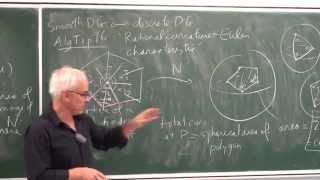
Gauss's View of Curvature and the Theorema Egregium - Differential Geometry Lecture 35
Explores Gauss's curvature concept, Theorema Egregium, and discrete curvature in polyhedra. Covers Gauss-Rodrigues map, paraboloids, and the Gauss-Bonnet theorem for a comprehensive look at differential geometry.
Circles and Spheres via Dot Products - Part 1
Explore circles using dot products in linear algebra. Learn two approaches: quadratic and bilinear equations. Discover applications to tangents, pole/polar duality, and classical theorems in projective geometry.
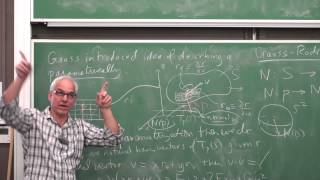
Gauss, Normals and Fundamental Forms in Differential Geometry - Lecture 34
Explore Gauss's approach to differential geometry, including parametric surface descriptions, fundamental forms, and the Gauss-Rodrigues map. Learn about Gaussian curvature and its applications in surface analysis.
Complex Numbers and Curves in 19th Century Mathematics
Explore complex numbers, algebraic curves, and their intersection with projective geometry and topology. Discover how these concepts revolutionized 19th-century mathematics and laid the foundation for modern algebraic geometry.
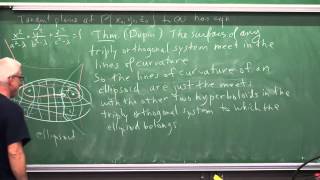
Differential Geometry: Meusnier, Monge, and Dupin's Work on Surfaces - Lecture 33
Explore Dupin's discoveries in differential geometry, including triply orthogonal surfaces, lines of curvature, and the Dupin indicatrix, with applications to ellipsoids and confocal systems.
Applications of the Dot Product to Planar Geometry - Part 1
Explore how the dot product shapes planar Euclidean geometry, introducing linear functionals, normal vectors for lines, and geometric projections in linear algebra.
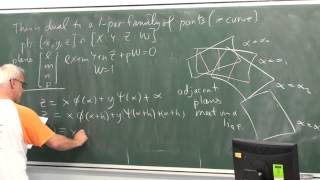
Meusnier, Monge and Dupin - Differential Geometry - Lecture 32
Explore Monge's contributions to differential geometry, including descriptive geometry, theorems, and studies on curves, surfaces, and lines of curvature in this advanced mathematics lecture.
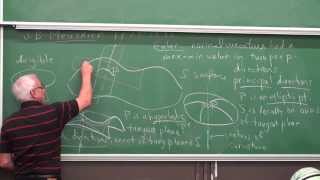
Meusnier, Monge and Dupin - Differential Geometry - Lecture 1
Explores the contributions of French geometer Meusnier to differential geometry, focusing on curvature, asymptotic directions, and umbilic points, with applications of Rational Trigonometry.
Examples of Curvatures of Surfaces - Differential Geometry Lecture 30
Explore curvature formulas for surfaces through examples like spheres, ellipsoids, and cubic surfaces. Learn to calculate mean and Gaussian curvatures using linear algebra and characteristic coefficients.