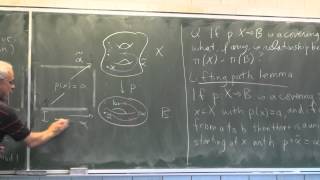
Covering Spaces and Fundamental Groups - Algebraic Topology Lecture 28
Exploring covering spaces and fundamental groups, focusing on torus examples and key lemmas to understand relationships between covering spaces and base spaces.
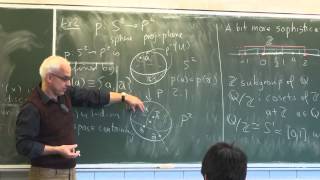
Covering Spaces in Algebraic Topology
Explore covering spaces in algebraic topology, including fundamental groups, line-circle coverings, sphere-projective plane relations, and torus knots. Visualize complex topological concepts through practical examples.
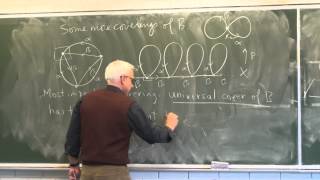
Covering Spaces and 2-Oriented Graphs - Algebraic Topology
Explore covering spaces through wedge of circles, examining graphs with labeled edges. Learn about universal covering spaces and their fundamental groups in algebraic topology.
Free Abelian Groups and Non-Commutative Groups - Algebraic Topology Review 4
Explore free abelian groups and their role in algebraic topology. Learn about the Fundamental Theorem of Finitely Generated Commutative Groups and non-commutative groups, including cosets and normal subgroups.
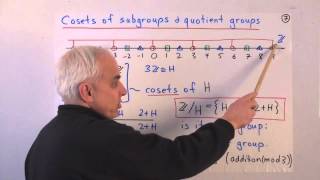
Commutative Groups: Isomorphisms, Homomorphisms, Cosets and Quotient Groups - Lecture 3
Explore commutative groups, isomorphisms, homomorphisms, cosets, and quotient groups. Learn the fundamental structure theorem and its applications in understanding group theory concepts.
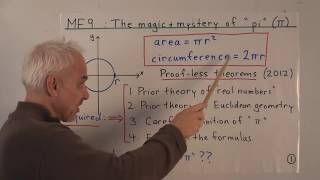
The Magic and Mystery of Pi - Real Numbers and Limits
Explore the history, formulas, and philosophical implications of pi, from ancient calculations to modern computations, challenging traditional views on its nature and role in mathematics.
Introduction to Topology in Mathematics History
Explore topology's historical development, from Euler's polyhedron discoveries to Poincaré's insights. Learn about key concepts like Euler characteristic, Riemann surfaces, and surface classification in this mathematical journey.
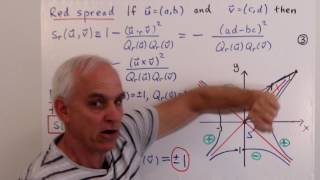
Colored Spreads and Generalizations in Rational Trigonometry - Lecture 2
Explore colored spreads in planar geometries, visualizing red and green spreads using cross products and determinants. Learn about generalized dot products and Pythagoras' theorem in different geometries.
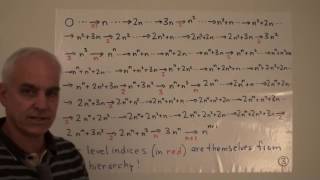
Limit Levels and Self-Similarity in Successor-Limit Hierarchy - Data Structures Math Foundations 184
Explore self-similarity in successor-limit hierarchy, examining limit levels and computational challenges. Insights for programmers on pure mathematics at extreme numerical heights.
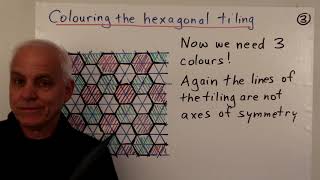
Regular Colourings of Regular Tilings - Elementary Mathematics K-6 Explained - Lecture 39
Explore symmetry and patterns through regular colourings of plane tilings. Learn about reflection, translation, and rotation while creating visually pleasing designs. Ideal for developing spatial awareness and creativity in young learners.
The Perspective Image of a Square - Number Theoretic Approach - Lecture 18d
Explores the number theoretic aspects of perspective images of squares, including algebraic solutions, quadratic equations, and harmonic ranges, with applications to spheres and algebraic theorems.
Perspective Image of a Square - More Projective Geometry - Lecture 18b
Explore advanced projective geometry concepts, including perspective images, vanishing points, and Desargues' theorem, with applications in 2D and 3D space.
The Perspective Image of a Square - Famous Math Problems 18a
Explore projective geometry concepts like quadrilaterals, quadrangles, duality, and cross ratios in relation to perspective images of squares. Novel approach using planar vector cross products.
Extending Archimedes' Parabolic Area Formula to Cubics - Algebraic Calculus
Extending Archimedes' parabolic area formula to cubics using Algebraic Calculus and projective geometry. Explores unique aspects of cubic functions and their areas without relying on infinite processes.
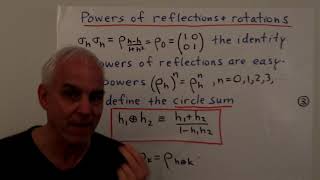
Half-Slope and the Full Group of Euclidean Isometries - WildTrig: Intro to Rational Trigonometry
Explore half-slopes in planar reflections and rotations, circle sums, and translations to understand Euclidean isometries. Gain insights into rational trigonometry and algebraic approaches to geometry.
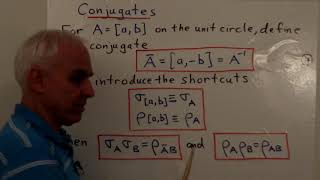
The Geometry of Euclidean Reflections and Rotations - Grounded Case
Explore Euclidean reflections and rotations using rational geometry. Learn about complex number multiplication, group structures, and a visual notation for describing transformations.
A Generalized Central Limit Conjecture for Convex Bodies
Explore a generalized central limit theorem for convex bodies, its connection to the KLS conjecture, and implications for asymptotic convex geometry in this advanced mathematics lecture.

Scale Adjacency, Sharps and Flats - Mathematics of Music
Explore the mathematical foundations of musical scales, key signatures, and notation systems, connecting music theory to geometry and the circle of fifths for a deeper understanding of harmonics.
Complex Monge-Ampère Operators and Functional Hermitian Intrinsic Volumes
Explore geometric construction of Monge-Ampère operators on finite convex functions, examining their properties and related valuations as functional versions of Hermitian intrinsic volumes.
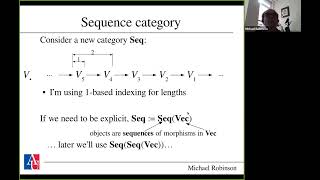
The Snake Lemma and Indecomposable Chain Maps
Explore the snake lemma's connecting homomorphism through vector space chain complexes, using Escolar and Hiraoka's representation to simplify proofs and reveal key indecomposable chain maps.
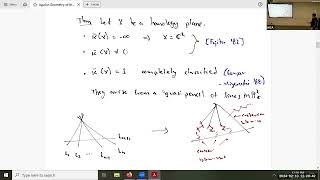
Bridging the Gap Between Homology Planes and Mazur Manifolds
Explore the connection between homology planes and Mazur manifolds, focusing on Kirby-Ramanujam spheres and their implications in complex surfaces and 4-manifolds.