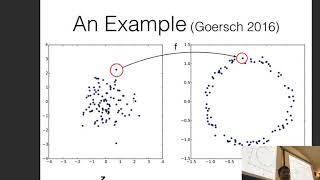
Neural Nets for NLP - Latent Random Variables
Explore latent random variables in neural networks for NLP, covering variational autoencoders, discrete latent variables, and applications in language processing and text generation.
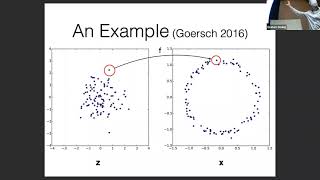
CMU Advanced NLP 2021 - Latent Variable Models
Explore advanced NLP concepts like variational autoencoders, discrete latent variables, and their applications in natural language processing tasks.

How Generative Models Work - Understanding Neural Networks and Auto Encoders
Explore various generative models, their inner workings, and see a live demo of StyleGAN creating new images in RunwayML. Learn about neural networks and auto-encoders.
All Things VQGAN - Variational AutoEncoder and VQ-VAE with Codebook Explanations - Part 2
Explore Variational AutoEncoders and Vector Quantized VAE, focusing on codebook explanations. Learn how these advanced techniques improve upon traditional autoencoders for better image generation and representation.
Generative Models Application in High Energy Physics
Explore generative models in high-energy physics, focusing on applications and techniques for data analysis and new physics discovery in particle collider experiments.
Generative Models in High Energy Physics
Explore generative models in high-energy physics, focusing on applications for data analysis and new physics discovery. Learn techniques to handle large datasets and improve experimental outcomes.

BigGAN and Other Generative Models
Explore BigGAN and BigBiGAN generative models, their functionality in RunwayML, and learn about image reconstruction techniques in this informative video on advanced AI-powered image generation.
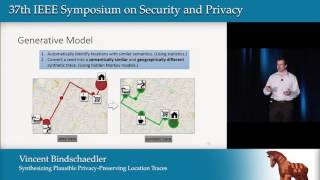
Synthesizing Plausible Privacy-Preserving Location Traces
Explore techniques for generating synthetic location data that preserves privacy while maintaining statistical similarity to real human mobility patterns, enhancing protection against inference attacks.
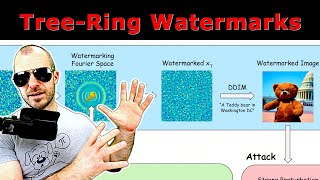
Tree-Ring Watermarks - Fingerprints for Diffusion Images That Are Invisible and Robust
Explores a novel watermarking technique for diffusion models that embeds invisible, robust fingerprints in generated images, discussing its implementation, effects, and potential applications beyond copyright protection.
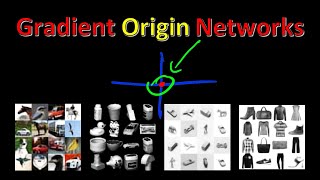
Gradient Origin Networks - Paper Explained with Live Coding
Explore Gradient Origin Networks: a novel implicit generative model for efficient latent representation learning, with live coding demonstration and in-depth explanation of the paper's key concepts.

SinGAN - Learning a Generative Model from a Single Natural Image
Unconditional generative model learns from a single image to create diverse, high-quality variations. Uses pyramid of GANs to capture patch distribution at multiple scales, enabling flexible image generation and manipulation.
Optimal Transport for Machine Learning - Gabriel Peyre, Ecole Normale Superieure
Explore optimal transport in machine learning, covering Kantorovitch's formulation, entropic regularization, and applications in generative models and GANs. Gain insights into cutting-edge advances in data science.

Unsupervised Learning - Autoencoding the Targets
Explore unsupervised learning and generative models, covering topics like latent space interpolation, style transfer, super resolution, and autoencoders. Gain insights into advanced machine learning concepts and techniques.
Normalizing Flows - Priyank Jaini
Explore normalizing flows, density estimation, and autoregressive models. Learn about change of variables, increasing triangular maps, and neural autoregressive flows.
Sample-Complexity of Estimating Convolutional and Recurrent Neural Networks
Explore sample-complexity in estimating neural networks, focusing on CNN and RNN architectures. Learn about generative models, minimax analysis, and key results through theoretical proofs and practical experiments.
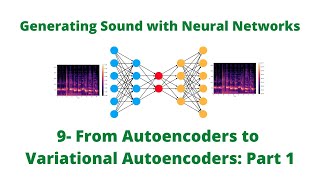
From Autoencoders to Variational Autoencoders - Improving the Encoder
Explore the transformation from autoencoders to variational autoencoders, focusing on improved encoding using multivariate normal distributions for enhanced generative capabilities in AI and sound processing.
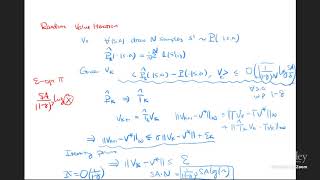
Planning and Markov Decision Processes - Part 2
Explore advanced concepts in reinforcement learning, including generative models, sample complexity, value equations, and linear programming, with experts from leading institutions.
Generative Models
Explore generative models in deep learning, covering theoretical perspectives, hacker models, information flow, and provable algorithms for learning classifiers and phylogenetic reconstruction.
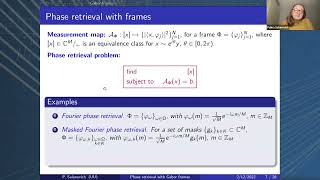
STFT Phase Retrieval - Robustness and Generative Priors - IPAM at UCLA
Explore STFT phase retrieval, focusing on robustness and generative priors. Learn about stable reconstruction techniques, application of generative models, and reducing required measurements in imaging and acoustics applications.
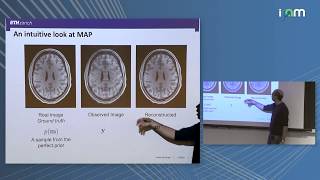
On Bayesian Models with Networks for Reconstruction and Detection
Explore Bayesian models with neural networks for MRI reconstruction and outlier detection in medical imaging, focusing on network-based priors and generative modeling approaches.
Inverse Problems under a Learned Generative Prior - Lecture 1
Explores inverse problems using generative priors, comparing to sparsity models. Covers theory, algorithms, and applications in compressive sensing and phase retrieval, with focus on deep learning approaches.