Differentiable Simulations for Enhanced Sampling of Rare Events
Explore deep learning applications in molecular simulations, including surrogate functions, sampling complex distributions, and time-propagation of differential equations. Learn about active learning, generative models, and reaction path finding.
Designing DNA with Tunable Regulatory Activity Using Discrete Diffusion
Explore DNA Discrete Diffusion (D3) for engineering regulatory DNA sequences with targeted functional activity levels. Learn about its advantages, evaluation metrics, and applications in functional genomics.

gRNAde: Geometric Deep Learning for 3D RNA Inverse Design
Explore gRNAde, a geometric deep learning pipeline for 3D RNA inverse design. Learn about its architecture, use cases, and advantages over traditional methods in RNA sequence design.
Models, Inference and Algorithms: Lightning Talks on Machine Learning and Computational Biology
Discover cutting-edge research presentations on machine learning in healthcare, protein modeling, chemical space exploration, and DNA sequence generation from leading researchers at MIT, Harvard, and Broad Institute.
Model Calibration Techniques for Discriminative and Generative Tasks
Explore techniques for aligning confidence predictions with output probabilities in both discriminative and generative models, from basic classification to advanced TrOCR methods.
Denoising Diffusion Probabilistic Models and Generative Moment Matching Networks - Lecture 17
Delve into diffusion models and DDPMs, exploring progressive data refinement techniques and generative moment matching networks using Maximum Mean Discrepancy for distribution analysis.
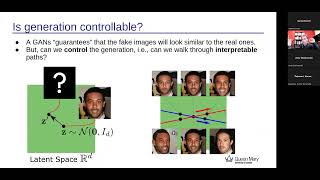
Generative Models: Controllable Generation and Learning
Dive into advanced generative AI models with Prof. Patras, exploring controllable generation techniques and learning mechanisms for creating more precise and manageable AI-generated content.
Towards Understanding Generalization Properties of Score-Based Losses
Explore score-based losses as alternatives to maximum likelihood in generative models, examining their statistical efficiency and connections to diffusion algorithms for improved model design.
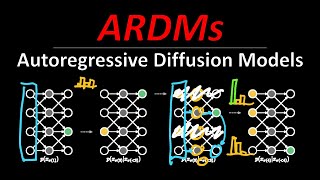
Autoregressive Diffusion Models - Machine Learning Research Paper Explained
Explore Autoregressive Diffusion Models, a novel approach combining autoregressive and diffusion models for efficient, order-agnostic generation and compression of text and image data.
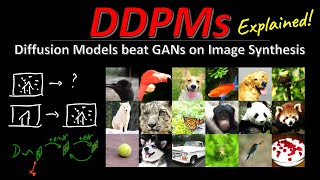
Diffusion Models Beat GANs on Image Synthesis - Machine Learning Research Paper Explained
Explore how Diffusion Models outperform GANs in image synthesis, with improved architecture, classifier guidance, and better sample quality while maintaining distribution coverage.

Stable Diffusion and Friends - High-Resolution Image Synthesis via Two-Stage Generative Models
Explore the evolution of generative image models with Stable Diffusion co-creator Robin Rombach, covering GANs, Transformers, and latent Diffusion models for high-resolution image synthesis and creative applications.
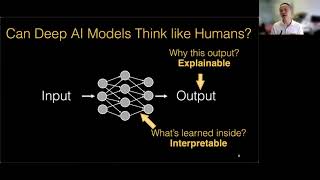
Human-Centric AI for Computer Vision and Machine Autonomy - ICCV'21 Tutorial
Explore human-centric AI in computer vision, covering explainable models, interpretable neural networks, and interactive machine learning for improved AI systems and autonomous machines.
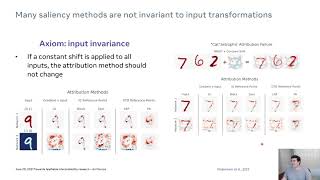
Towards Falsifiable Interpretability Research in Machine Learning - Lecture
Explore techniques for falsifiable interpretability in machine learning, focusing on saliency, individual neurons, and populations. Learn to build stronger hypotheses for more robust research.
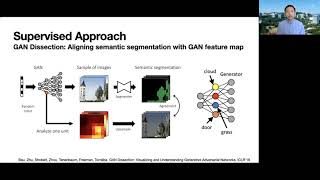
Interpreting Deep Generative Models for Interactive AI Content Creation
Explore deep generative models for AI content creation, covering image generation, latent space manipulation, and interactive techniques. Learn about challenges and applications in this cutting-edge field.
CMU Neural Nets for NLP - Models with Latent Random Variables
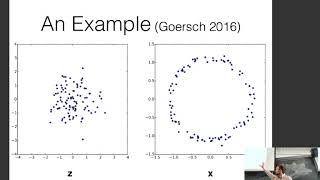
Explore neural network models with latent random variables for NLP, covering VAEs, generative models, and techniques for discrete latent variables and controllable text generation.

Neural Nets for NLP - Latent Variable Models
Explore latent variable models in NLP, covering variational autoencoders, discrete variables, and practical applications. Gain insights into generative modeling and advanced neural network techniques.
CMU Advanced NLP 2022 - Latent Variable Models
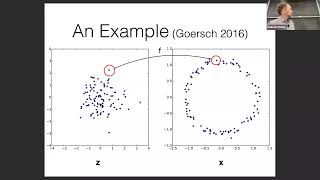
Explore advanced NLP concepts: latent variables, variational autoencoders, and their applications in natural language processing. Gain insights into generative models and feature learning.
Neural Nets for NLP 2021 - Multilingual Learning
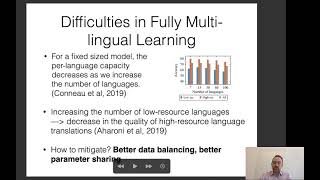
Explore multilingual learning in NLP, covering models, data balancing, parameter sharing, and cross-lingual transfer techniques for improved language processing across diverse languages.

Neural Nets for NLP - Models with Latent Random Variables
Explore neural network models with latent random variables for NLP, covering variational autoencoders, discrete latent variables, and their applications in language processing.
Neural Nets for NLP 2021 - Adversarial Methods
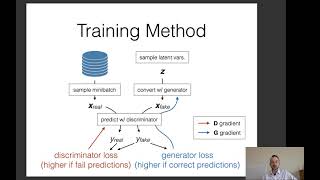
Explore generative adversarial networks, adversarial feature learning, and adversarial attacks in NLP. Learn cutting-edge techniques for robust and domain-invariant neural network models in natural language processing.
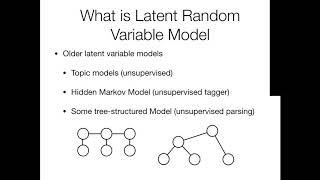
Neural Nets for NLP - Models with Latent Random Variables
Explore neural network models with latent random variables, covering variational autoencoders and their applications in NLP. Learn about generative vs. discriminative models and handling discrete latent variables.