
Deep Generative Modeling
Explore deep generative modeling, including autoencoders, VAEs, GANs, and diffusion models. Learn about latent variables, training techniques, and recent advances in generative AI.
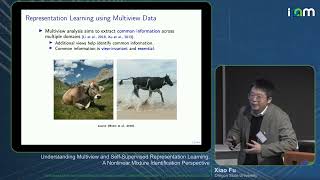
Multiview and Self-Supervised Representation Learning - Nonlinear Mixture Identification
Explore nonlinear mixture identification in multiview and self-supervised representation learning. Gain insights into extracting essential information from high-dimensional data for improved AI applications.
Tutorial on Deep Learning I
Explore deep learning foundations, from neural networks to advanced techniques, with insights on feature representation, optimization, and practical applications in computer vision and audio processing.

BYOB - Build Your Own Bot
Learn to build conversational agents with frameworks, NLP techniques, and best practices. Explore intent recognition, dialogue management, and generative models while avoiding common pitfalls in chatbot development.
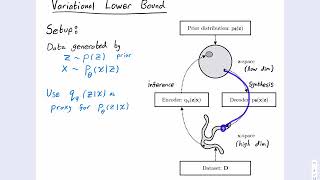
Variational Autoencoders
Explore generative models, autoencoders, and variational techniques in deep learning. Learn about architecture, optimization, and practical applications of variational autoencoders.

Diffusion Models - Paper Explanation - Math Explained
Comprehensive explanation of diffusion models, covering theory, architecture, math derivation, algorithms, improvements, and results. Includes comparisons to other methods and references to state-of-the-art applications.
VQ-GAN - PyTorch Implementation
Implement Vector Quantized Generative Adversarial Networks (VQGAN) using PyTorch, covering encoder, decoder, codebook, discriminator, and transformer stages for high-resolution image synthesis.
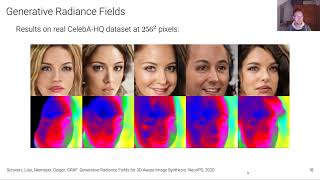
Generative Neural Scene Representations for 3D-Aware Image Synthesis
Explore 3D-aware image synthesis using generative neural scene representations, covering GRAF, GIRAFFE, and CAMPARI models for advanced computer vision applications.
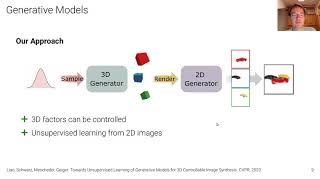
Towards Unsupervised Learning of Generative Models for 3D Controllable Image Synthesis
Explores unsupervised learning for 3D-controllable image synthesis, disentangling latent factors like viewpoint and object pose from raw images to create novel, consistent scenes.
Compositional Models - Complexity of Representation and Interference
Explore compositional models, their representation complexity, and interference effects. Delve into data-driven approaches, feedforward/feedback mechanisms, and hierarchical structures in generative modeling.
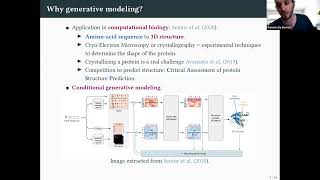
Convergence of Denoising Diffusion Models Under the Manifold Hypothesis
Explores theoretical analysis of denoising diffusion models, providing convergence results for data distributions on lower-dimensional manifolds or empirical distributions, with quantitative bounds on Wasserstein distance.
Machine Learning Papers in Virtual Reality - IEEE VR 2022
Cutting-edge machine learning research in VR, covering topics like stereoscopic photography, adversarial attacks, 360° depth estimation, scanpath generation, autism screening, and projector deblurring.
Generating Approximate Ground States of Molecules Using Quantum Machine Learning
Explore quantum machine learning for generating molecular ground states, focusing on potential energy surfaces and efficient state preparation using variational quantum circuits and neural networks.

Deep Generative Modeling - MIT 6.S191 Lecture 4
Explore deep generative modeling, including autoencoders, VAEs, GANs, and recent advances. Learn about latent variables, training techniques, and applications in AI-driven content creation and data analysis.
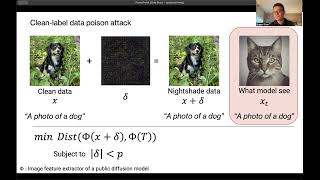
Nightshade: Prompt-Specific Poisoning Attacks on Text-to-Image Generative Models - Session 335
Explore poisoning attacks on text-to-image models, focusing on the Nightshade technique's ability to manipulate AI-generated images through targeted data manipulation.
Optimizing Kubernetes Cluster Scaling for Advanced Generative Models
Explore advanced techniques for scaling Kubernetes clusters to support complex generative models, leveraging tools like Flyte, MLflow, and Kubeflow for efficient deployment and management.

Fine-tuning Flow and Diffusion Generative Models
Explore reward fine-tuning for dynamical generative models through stochastic optimal control, featuring a novel Adjoint Matching algorithm for improved consistency and realism.
Discrete Flow Matching for High-Dimensional Discrete Data Generation
Explore Discrete Flow Matching for generating high-dimensional discrete data. Learn about probability paths, sampling techniques, and improved generative perplexity in AI applications.
Lab 3 - De Novo Generation Explanation
Explore de novo molecule generation techniques with experts Emmanuel Bengio and Julien Roy in this recorded session from the 2024 Machine Learning for Drug Discovery Summer School.
Generative Models of Molecular Structures - Day 3
Explore generative models for molecular structures, focusing on applications in drug discovery and computational chemistry.
Metric Flow Matching for Smooth Interpolations on the Data Manifold
Explore Metric Flow Matching for smooth interpolations on data manifolds. Learn about conditional paths, Riemannian metrics, and geodesic interpolants. Discover applications in LiDAR navigation and cellular dynamics modeling.