New Approaches in Simulation of Transition Paths - IPAM at UCLA
Explores tensor methods for simulating chemical transition processes, focusing on compressing high-dimensional PDE functions and introducing a novel tensor-network generative modeling approach without optimization.
Tutorial on Deep Learning I
Explore deep learning foundations, from neural networks to advanced techniques, with insights on feature representation, optimization, and practical applications in computer vision and audio processing.

BYOB - Build Your Own Bot
Learn to build conversational agents with frameworks, NLP techniques, and best practices. Explore intent recognition, dialogue management, and generative models while avoiding common pitfalls in chatbot development.
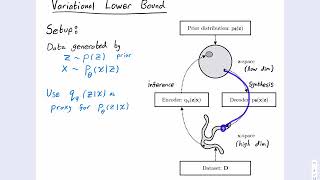
Variational Autoencoders
Explore generative models, autoencoders, and variational techniques in deep learning. Learn about architecture, optimization, and practical applications of variational autoencoders.

Diffusion Models - Paper Explanation - Math Explained
Comprehensive explanation of diffusion models, covering theory, architecture, math derivation, algorithms, improvements, and results. Includes comparisons to other methods and references to state-of-the-art applications.
VQ-GAN - PyTorch Implementation
Implement Vector Quantized Generative Adversarial Networks (VQGAN) using PyTorch, covering encoder, decoder, codebook, discriminator, and transformer stages for high-resolution image synthesis.
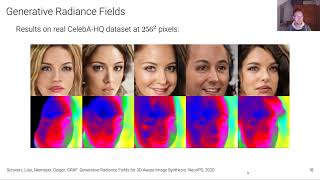
Generative Neural Scene Representations for 3D-Aware Image Synthesis
Explore 3D-aware image synthesis using generative neural scene representations, covering GRAF, GIRAFFE, and CAMPARI models for advanced computer vision applications.
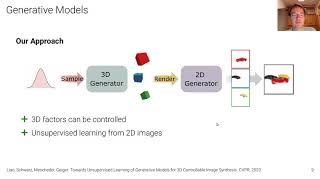
Towards Unsupervised Learning of Generative Models for 3D Controllable Image Synthesis
Explores unsupervised learning for 3D-controllable image synthesis, disentangling latent factors like viewpoint and object pose from raw images to create novel, consistent scenes.
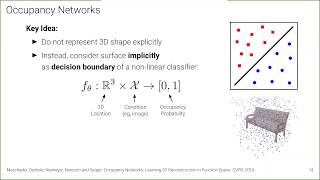
Learning 3D Reconstruction in Function Space
Explore neural implicit models for 3D reconstruction, covering occupancy networks, texture fields, and differentiable rendering. Gain insights into cutting-edge techniques and recent advancements in the field.
Compositional Models - Complexity of Representation and Interference
Explore compositional models, their representation complexity, and interference effects. Delve into data-driven approaches, feedforward/feedback mechanisms, and hierarchical structures in generative modeling.
Generative AI: Disruptions and Implications for Institutions, Enterprises and Society
Explore the impact of generative AI on institutions, enterprises, and society. Learn about deployment, scalability, sustainability, and governance of this powerful technology.
ChatGPT, Stable Diffusion, and the Future of Open Source AI
Explore the impact of generative AI on open source ethics, data usage, and individual rights, with insights from a leading AI scientist on the future of this technology.
Generative AI and Stable Diffusion - Lightning Talks
Explore cutting-edge AI topics: generative models, Stable Diffusion, and Intel's optimizations for PyTorch 2.0 in these concise, informative lightning talks.

Generative AI in Cybersecurity: Attackers vs. Defenders - Who Has the Upper Hand?
Explore the impact of generative AI on cybersecurity, privacy, and elections. Experts discuss potential threats, government's role, and the balance between AI attackers and defenders.
Generative AI and Its Impact on Communication, Collaboration, and Creation
Exploring the impact of generative AI on communication, collaboration, and creativity, discussing its potential benefits and risks, and examining strategies for responsible implementation.
Wicked Problem: AI and the Future of Everything - Challenges and Opportunities
Explore the complex challenges and potential of AI's rapid growth, including regulation, societal risks, and its impact on various sectors, with insights from leading experts.
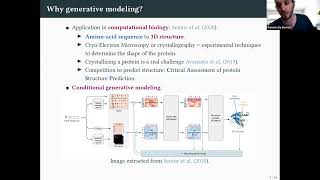
Convergence of Denoising Diffusion Models Under the Manifold Hypothesis
Explores theoretical analysis of denoising diffusion models, providing convergence results for data distributions on lower-dimensional manifolds or empirical distributions, with quantitative bounds on Wasserstein distance.
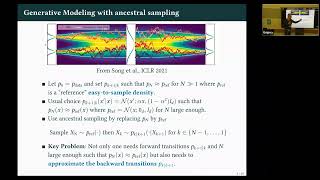
From Denoising Diffusion Models to Transport for Generative Modeling and Inference
Explore advanced generative modeling techniques, from denoising diffusion models to transport-based approaches, focusing on diffusion Schrödinger bridge and its numerical approximation for improved inference.
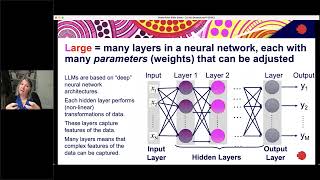
Large Language Models Are Not Necessarily Generative AI - Karin Verspoor, PhD
Explore the distinctions between Large Language Models and generative AI, understanding their architectures, applications, and specific challenges in natural language processing.
Transforming Data Processing with Kubernetes - Journey Towards a Self-Serve Data Mesh
Explore Intuit's use of Kubernetes with Data Mesh principles to transform data processing, enabling efficient management of 100,000+ pipelines and fostering a collaborative data culture for improved decision-making.
Limitations and Future Vision of Generative Music AI
Explore limitations of generative music AI, including deep learning challenges, music representation issues, and research procedures. Discover potential solutions and future directions in this field.