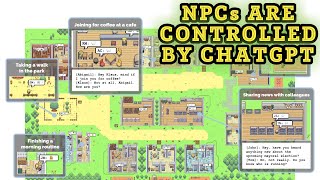
ChatGPT Powered NPCs in Sandbox RPG Game Smallville - Generative Agents Interactive Simulacra
Explore a groundbreaking AI-powered sandbox RPG where ChatGPT agents simulate human behavior, interact, form relationships, and create emergent narratives in a virtual town called Smallville.
Optimal Transport for Machine Learning - Gabriel Peyre, Ecole Normale Superieure
Explore optimal transport in machine learning, covering Kantorovitch's formulation, entropic regularization, and applications in generative models and GANs. Gain insights into cutting-edge advances in data science.
Unsupervised Doodling and Painting with Generative Agents
Explore unsupervised learning in generative art, reinforcement learning agents as image creators, and the potential of AI in artistic tools and creative processes.

Unsupervised Learning - Autoencoding the Targets
Explore unsupervised learning and generative models, covering topics like latent space interpolation, style transfer, super resolution, and autoencoders. Gain insights into advanced machine learning concepts and techniques.
Normalizing Flows - Priyank Jaini
Explore normalizing flows, density estimation, and autoregressive models. Learn about change of variables, increasing triangular maps, and neural autoregressive flows.
Sample-Complexity of Estimating Convolutional and Recurrent Neural Networks
Explore sample-complexity in estimating neural networks, focusing on CNN and RNN architectures. Learn about generative models, minimax analysis, and key results through theoretical proofs and practical experiments.
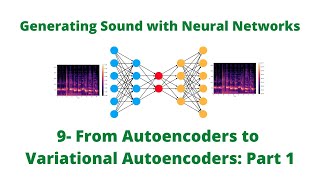
From Autoencoders to Variational Autoencoders - Improving the Encoder
Explore the transformation from autoencoders to variational autoencoders, focusing on improved encoding using multivariate normal distributions for enhanced generative capabilities in AI and sound processing.
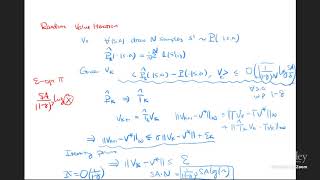
Planning and Markov Decision Processes - Part 2
Explore advanced concepts in reinforcement learning, including generative models, sample complexity, value equations, and linear programming, with experts from leading institutions.
Generative Models
Explore generative models in deep learning, covering theoretical perspectives, hacker models, information flow, and provable algorithms for learning classifiers and phylogenetic reconstruction.
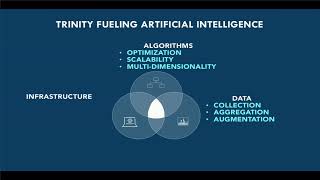
The AI Trinity - Data + Algorithms + Infrastructure
Explore the AI trinity: data, algorithms, and infrastructure. Learn about named entity recognition, active learning, crowdsourcing, data augmentation, and neural rendering models.
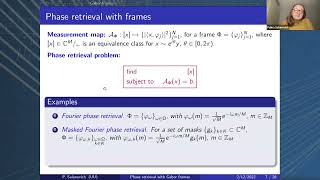
STFT Phase Retrieval - Robustness and Generative Priors - IPAM at UCLA
Explore STFT phase retrieval, focusing on robustness and generative priors. Learn about stable reconstruction techniques, application of generative models, and reducing required measurements in imaging and acoustics applications.
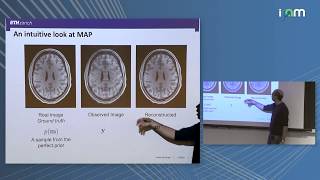
On Bayesian Models with Networks for Reconstruction and Detection
Explore Bayesian models with neural networks for MRI reconstruction and outlier detection in medical imaging, focusing on network-based priors and generative modeling approaches.
Inverse Problems under a Learned Generative Prior - Lecture 1
Explores inverse problems using generative priors, comparing to sparsity models. Covers theory, algorithms, and applications in compressive sensing and phase retrieval, with focus on deep learning approaches.
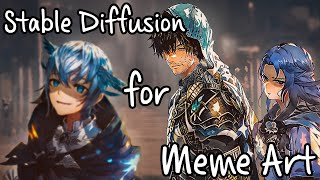
Using Stable Diffusion and DreamBooth to Create Meme Art
Learn to create meme art using Stable Diffusion and DreamBooth, focusing on Final Fantasy XIV characters. Explore techniques for character generation, image masking, and composition to produce unique digital artwork.
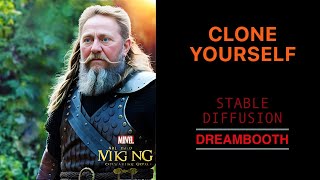
Stable Diffusion Dreambooth Made Easy - Clone Yourself in AI Art
Learn to clone yourself in AI art using Stable Diffusion Dreambooth. This tutorial covers image training, testing, and creation using free tools like Google Colab and Automatic1111.
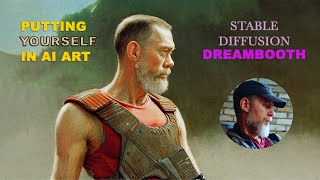
Put Yourself Into a Universe of Art - Using Your Images in Dreambooth Stable Diffusion
Learn to create personalized AI art using Dreambooth and Stable Diffusion. This tutorial covers image processing, model training, and generating custom artwork with your own images, all for free using Google Colab.
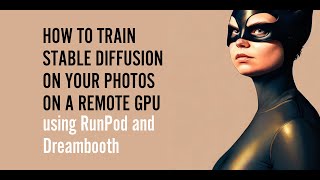
How to Train Stable Diffusion on Your Photos on a Remote GPU - Using RunPod and Dreambooth
Learn to train Stable Diffusion on personal photos using RunPod and Dreambooth, covering setup, image preparation, and troubleshooting for custom AI-generated art.
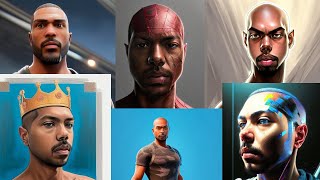
How to Make AI Art - DreamBooth and Stable Diffusion Tutorial with Prompting Tips and Demo
Learn to create AI art using DreamBooth and Stable Diffusion. Master prompt engineering, fine-tuning models, and generating custom images with step-by-step guidance and practical tips.

Deep Generative Modeling
Explore deep generative modeling, including autoencoders, VAEs, GANs, and diffusion models. Learn about latent variables, training techniques, and recent advances in generative AI.

Generate Studio Quality Realistic Photos With Kohya LoRA Stable Diffusion Training - Full Tutorial
Comprehensive guide to generating studio-quality AI photos using Kohya LoRA Stable Diffusion training, covering installation, parameter settings, dataset preparation, and advanced techniques for optimal results.
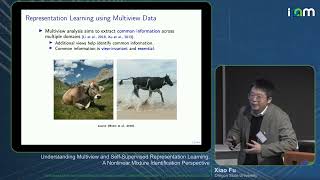
Multiview and Self-Supervised Representation Learning - Nonlinear Mixture Identification
Explore nonlinear mixture identification in multiview and self-supervised representation learning. Gain insights into extracting essential information from high-dimensional data for improved AI applications.