
Introduction to Deep Learning
Deep Learning is subset of machine learning focused on extracting patterns from data using neural networks and use those patterns to inform the learning tasks.
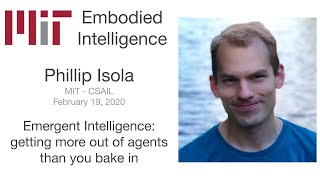
MIT EI Seminar - Phillip Isola - Emergent Intelligence- Getting More Out of Agents Than You Bake In
Explore emergent intelligence in AI through unsupervised learning, generative modeling, and self-assembling agents. Discover surprising outcomes beyond explicit programming in representation, video generation, and creature development.
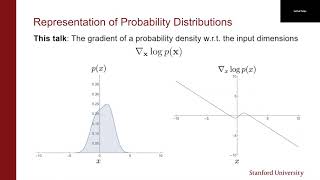
Generative Modeling by Estimating Gradients of the Data Distribution - Stefano Ermon
Explore generative modeling through gradient estimation of data distributions, covering deep energy-based models, score matching, and innovative sampling techniques for improved AI generation.
Lab-in-the-Loop De Novo Antibody Design - What Are We Missing From Machine Learning?
Explore lab-in-the-loop de novo antibody design, focusing on computational aspects. Discover generative modeling, computational oracles, and active learning in molecular systems research.
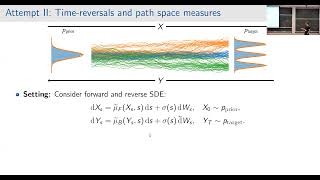
A Dynamical Systems Perspective on Measure Transport and Generative Modeling
Explore measure transport and generative modeling through a dynamical systems lens, gaining insights into advanced machine learning concepts and their applications.

Generative Modeling Is Awesome - Blender Experiments
Explore generative modeling in Blender with step-by-step guidance on creating unique 3D art using modifiers, geometry nodes, and remeshing techniques for stunning visual results.
Generative Modeling Crash Course for Blender - Geometry Nodes
Explore advanced geometry nodes techniques for generative modeling in Blender, covering displacement, mapping, texturing, and mesh manipulation for creating complex 3D designs efficiently.

DiffDock: Diffusion Steps, Twists, and Turns for Molecular Docking
Explore DiffDock, a novel diffusion-based approach to molecular docking that outperforms traditional and deep learning methods in predicting ligand-protein binding structures for drug design.
MFBind - A Multi-Fidelity Approach for Evaluating Drugs in Generative Modeling
Explore MFBind, a multi-fidelity approach integrating docking and binding free energy simulations for improved drug discovery generative modeling. Learn its advantages over current methods.
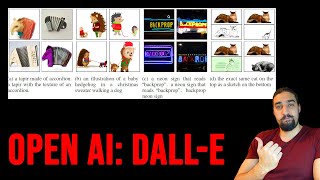
DALL-E - Zero-Shot Text-to-Image Generation - Paper Explained
Explore OpenAI's DALL-E: a groundbreaking AI model that generates images from text descriptions, combining concepts in plausible ways and showcasing emergent image-to-image capabilities.
Generative Model-Based Text-to-Speech Synthesis
Explore cutting-edge generative modeling techniques for text-to-speech synthesis, covering recent advancements, probabilistic approaches, neural network models, and future directions in speech technology.
Unsupervised Doodling and Painting with Generative Agents
Explore unsupervised learning in generative art, reinforcement learning agents as image creators, and the potential of AI in artistic tools and creative processes.
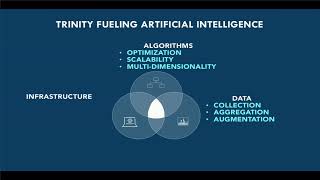
The AI Trinity - Data + Algorithms + Infrastructure
Explore the AI trinity: data, algorithms, and infrastructure. Learn about named entity recognition, active learning, crowdsourcing, data augmentation, and neural rendering models.
New Approaches in Simulation of Transition Paths - IPAM at UCLA
Explores tensor methods for simulating chemical transition processes, focusing on compressing high-dimensional PDE functions and introducing a novel tensor-network generative modeling approach without optimization.
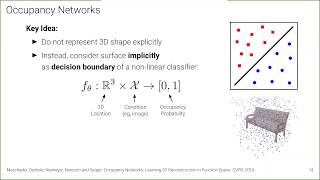
Learning 3D Reconstruction in Function Space
Explore neural implicit models for 3D reconstruction, covering occupancy networks, texture fields, and differentiable rendering. Gain insights into cutting-edge techniques and recent advancements in the field.
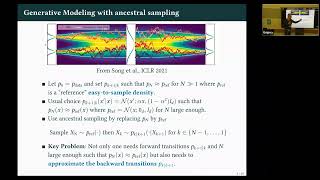
From Denoising Diffusion Models to Transport for Generative Modeling and Inference
Explore advanced generative modeling techniques, from denoising diffusion models to transport-based approaches, focusing on diffusion Schrödinger bridge and its numerical approximation for improved inference.
Do Quantum Computers Have Applications in Machine Learning and Combinatorial Optimization
Explores quantum computing's potential in machine learning and optimization, discussing recent developments, comparative power, limitations, and future prospects in these fields.
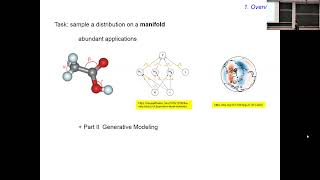
Non-Euclidean Generative Modeling
Explore advanced generative modeling techniques beyond Euclidean spaces with Georgia Tech's Molei Tao, delving into innovative approaches for complex data structures.
Symmetries in Machine Learning for Materials Science
Exploring machine learning techniques incorporating crystallographic symmetries for materials science, enhancing property prediction and discovery of new materials and meta-materials.
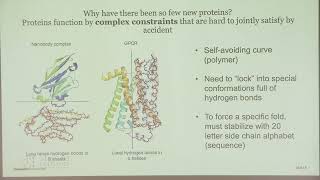
Illuminating Protein Space with Generative Models
Explore generative modeling for protein design, focusing on building learning systems that can generalize, scale, and create fit-for-purpose protein complexes on demand.
Diffusion Forcing: Next-token Prediction Meets Full-Sequence Diffusion
Explore Diffusion Forcing, a novel training paradigm combining next-token prediction and full-sequence diffusion for enhanced sequence generation and decision-making in AI applications.