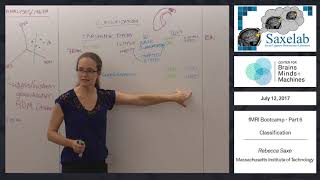
FMRI Bootcamp - Classification
Explore fMRI classification analysis techniques, including training vs testing, generalization, and hierarchical logic, with insights on visual stream processing.
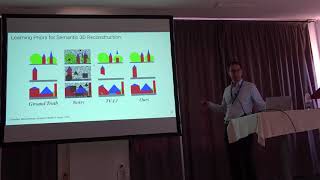
DALI 2018 - Andreas Geiger: How to Satisfy the Thirst for Data
Explore innovative approaches to address data scarcity in computer vision, including specialized architectures, soft constraints, self-supervision, and label transfer techniques.
Understanding Quantum Machine Learning Also Requires Rethinking Generalization
Explores challenges in understanding generalization in quantum machine learning, revealing limitations of traditional approaches and the need for new paradigms in model design and evaluation.
Learning from Multiple Data Sources
Explore multi-source data learning strategies and their implications for machine learning algorithms, focusing on challenges and potential solutions in diverse data environments.
Do ImageNet Classifiers Generalize to ImageNet? - Analyzing ML Progress and Challenges
Analyzing ImageNet classifiers' generalization, exploring overfitting and distribution shift in ML benchmarks, and addressing robustness issues like adversarial examples to improve machine learning reliability.
Provably Secure Machine Learning Algorithms - Designing Reliable AI Systems
Exploring vulnerabilities in machine learning systems and developing provably secure algorithms to defend against statistical attacks in high-dimensional settings and non-convex models.
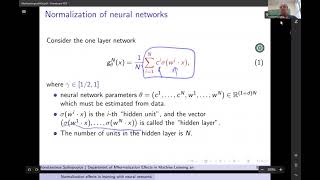
Normalization Effects on Neural Networks: Generalization and High-Dimensional Applications - SIAM FME Talk
Exploring neural network performance, normalization effects, and high-dimensional PDE solving using deep learning. Insights on generalization properties and applications in mathematical finance.
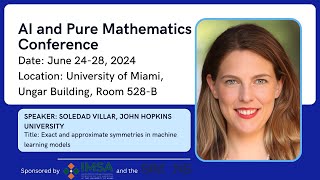
Exact and Approximate Symmetries in Machine Learning Models
Explore exact and approximate symmetries in machine learning models, examining their impact on model performance and interpretability. Gain insights into leveraging symmetries for more efficient and robust AI systems.
Large ML Potentials for Chemistry - Generalization, Inductive Biases, and Error Cancellation
Explore machine learning potentials in chemistry, focusing on generalization, inductive biases, and error cancellation techniques for improved accuracy and efficiency.
Bridging State and Action: Towards Continual Reinforcement Learning - 2023 Fall Robotics Colloquium
Explore AI systems that learn to represent knowledge, plan, and adapt through reinforcement learning. Discover a framework for efficient reasoning using affordances and temporally abstract partial models.
Bridging State and Action: Towards Continual Reinforcement Learning - 2023 Fall Robotics Colloquium
Explore AI systems that learn to represent knowledge, plan, and adapt through reinforcement learning. Discover a framework for efficient reasoning using affordances and temporally abstract partial models.
Approximately Piecewise E(3) Equivariant Point Networks
Explore APEN: a framework for approximate piecewise-E(3) equivariant point networks, improving generalization in part-based symmetry tasks like room scene analysis and human motion recognition.
Generalization in Diffusion Models from Geometry-Adaptive Harmonic Representation
Explore generalization in diffusion models through geometry-adaptive harmonic representation. Analyze denoising DNNs, score functions, and inductive biases to understand high-dimensional density learning and optimal basis adaptation.
Pre-training via Denoising for Molecular Property Prediction
Explore pre-training via denoising for molecular property prediction, learning force fields from equilibrium structures to improve generalization and achieve state-of-the-art results on QM9 dataset.
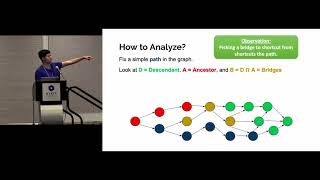
Parallel Reachability in Almost Linear Work and Square Root Depth
Explore efficient parallel algorithms for graph reachability, focusing on distributed computing and improved runtime complexity in large-scale networks.
A Practical Introduction to Convnets for Image Classification
Practical guide to developing CNN-based image classification pipelines, covering dataset handling, architecture design, training, and evaluation. Explores real-world applications in robotics and biomedicine.
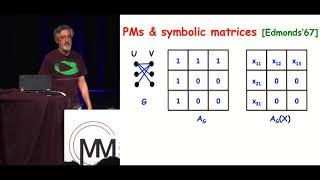
Alternate Minimization and Scaling Algorithms - Theory, Applications and Connections Across Mathematics and Computer Science
Explore alternate minimization and scaling algorithms, their applications, and connections across mathematics and computer science with Avi Wigderson's in-depth lecture.
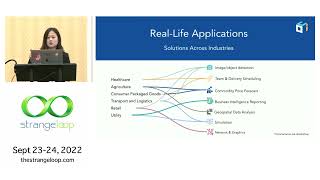
Level Up Your Machine Learning Lifecycle
Discover a scalable ML lifecycle framework that simplifies end-to-end projects, reduces development time, and enhances code quality through modular design across data, model, and deployment stages.
Where Does Negative Transfer Come From? On the Implicit Bias of SGD in Multi-Task Learning
Explore negative transfer in multi-task learning, examining task conflict, optimization temperature, and SGD's implicit bias. Gain insights into generalization challenges in neural networks.
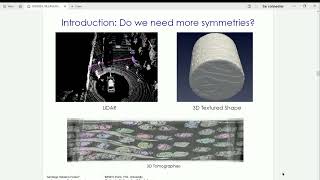
Can Generalized Divergences Help for Invariant Neural Networks?
Explore the potential of generalised divergences in enhancing invariant neural networks, examining their impact on network performance and robustness.
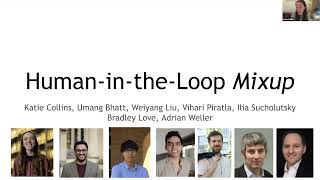
Human-in-the-Loop Mixup: Aligning Synthetic Data with Human Perception - Oral Session 2
Explore human-aligned synthetic data in machine learning, focusing on mixup regularization. Discover how perceptual judgments and uncertainties can enhance model reliability and generalization.