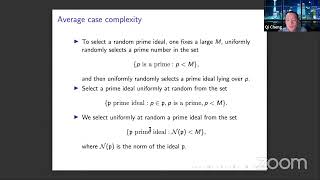
Isogenies and Lattices in Cryptography - Session 12
Explore isogenies and lattices in cryptography, covering twin smooth integers, polynomials, delayed encryption, sealed bid auctions, and lattice-based techniques for enhanced security.

The Ethical Algorithm - Designing Socially Aware AI
Exploring ethical challenges in AI and machine learning, including data privacy, algorithmic bias, and decision-making transparency. Discusses recent research on socially responsible algorithm design.
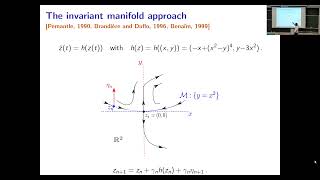
Avoidance of Traps for Nonconvex Stochastic Optimization and Equilibrium Learning in Games
Explore strategies to overcome challenges in nonconvex stochastic optimization and game theory equilibrium learning, focusing on trap avoidance techniques.

The Future of Generative AI
Explore the potential of generative AI to revolutionize communication, learning, and work. Discuss possibilities, challenges, and societal impacts with AI expert Professor Michael Wooldridge.

Retrospective on Multi-Agent Learning as a Path to Intelligence
Explore the potential of multi-agent learning in advancing artificial intelligence, drawing insights from psychology and neuroscience perspectives.
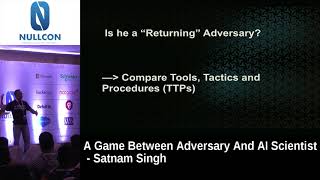
A Game between Adversary and AI Scientist
Explore game theory and AI in cybersecurity, focusing on adversary-defender dynamics, tactics, and the role of AI-powered tools in enhancing defensive strategies and visibility.

Should I Pay or Should I Go? Game Theory and Ransomware
Explore game theory concepts applied to ransomware decision-making, analyzing incentives, payoffs, and rational choices to understand the complexities of cybersecurity responses.
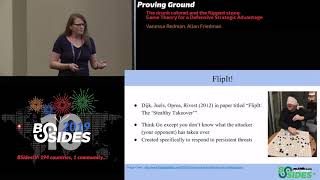
The Drunk Colonel and the Flipped Stone - Game Theory for a Defensive Strategic Advantage
Explore game theory's application in cybersecurity, focusing on strategic defense, resource allocation, and unpredictability to gain advantages against adversaries.
Game of Decoys - Optimal Decoy Routing Through Game Theory
Explore game theory's application to optimal decoy routing strategies, enhancing internet censorship circumvention through strategic placement and deployment of decoy routers.
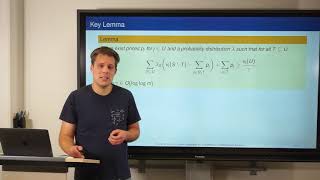
An O(log log m) Prophet Inequality for Subadditive Combinatorial Auctions
Explore advanced techniques in combinatorial auctions, focusing on subadditive prophet inequalities and their applications in algorithmic game theory and mechanism design.
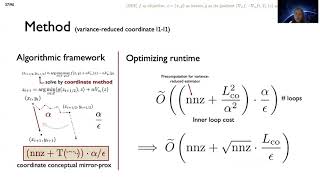
Coordinate Methods for Matrix Games
Explore efficient algorithms for solving matrix games, focusing on coordinate methods and their implementation challenges and benefits.
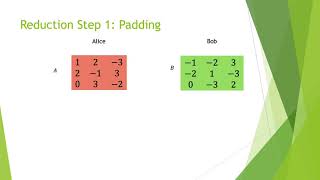
Smoothed Complexity of 2-player Nash Equilibria
Explore smoothed complexity in 2-player Nash equilibria, covering algorithmic hardness, approximation challenges, and novel approaches to finding equilibria in perturbed games.
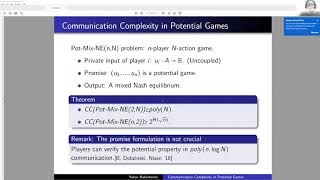
Communication Complexity of Nash Equilibrium in Potential Games
Explore communication complexity in potential games, focusing on Nash equilibrium, congestion games, and proof structures for hardness results.
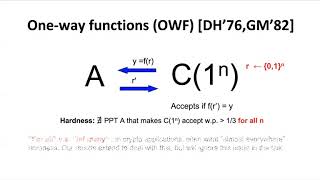
Is it Easier to Prove Statements that are Guaranteed to be True?
Explore the intricacies of proving statements in computational complexity, focusing on worst-case vs. average-case hardness and the challenges in NP-Search problems.
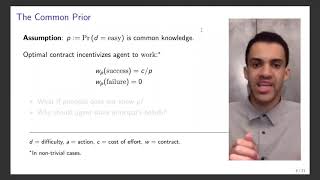
Mechanisms for a No-Regret Agent - Beyond the Common Prior
Explore advanced mechanism design principles for no-regret agents, challenging common prior assumptions and presenting innovative frameworks and algorithms.
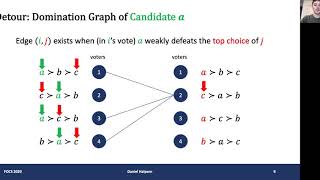
Resolving the Optimal Metric Distortion Conjecture
Explore voting theory and the Downseam Proximity Model to understand the Optimal Metric Distortion Conjecture, its proof, and implications for fair decision-making.
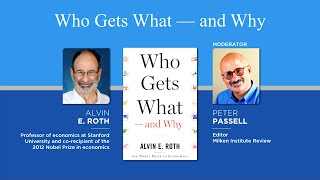
Who Gets What - and Why - The New Economics of Matchmaking and Market Design
Explore the hidden markets shaping our lives, from organ transplants to career choices. Learn how market design can solve societal problems and create better outcomes for all participants.
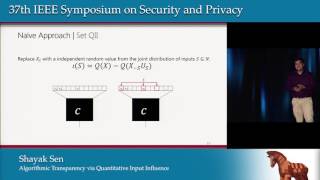
Algorithmic Transparency via Quantitative Input Influence - Theory and Experiments with Learning Systems
Exploring quantitative input influence measures to enhance algorithmic transparency in machine learning systems, with applications in decision-making, oversight, and privacy-preserving transparency reports.

Neuroscience, Game Theory, Monkeys
Explore the fascinating intersection of neuroscience and game theory, revealing insights into human decision-making and surprising comparisons with primate behavior.

Strategies Without Frontiers
Explore game theory strategies and their applications in security, psychology, and society. Learn about equilibrium, signaling, and iterated games to enhance decision-making skills.

The Adoption of Blockchain-Based Decentralized Exchanges
Explore decentralized finance exchanges, focusing on Automated Market Makers. Learn about their market structure, pricing functions, and impact on liquidity providers and arbitrageurs through game theory and data analysis.