
Aggregate Data with Map and Reduce - React Tutorial 60
Learn to efficiently aggregate data using map and reduce functions in React, enhancing your ability to manipulate and process complex datasets effectively.
Most Advanced JavaScript Course for Professionals - 2022
Comprehensive JavaScript tutorial covering advanced concepts and techniques for professional developers, building on previous programming language tutorials.
The Benefits of Learning a Different Programming Language
Explore the advantages of learning diverse programming languages, focusing on APL's array processing and functional paradigm, to enhance overall coding skills and adapt to modern hardware trends.
Ruby on Fails: Effective Error Handling with Rails Conventions
Explore effective error handling techniques in Rails, comparing approaches and leveraging conventions to improve application architecture and reliability.
Taming Quantum Time Complexity
Explore advanced quantum computing concepts focusing on time complexity, exactness, and thriftiness in quantum algorithms through novel transducer-based approaches and state conversion techniques.

How to Pin a Document to a Blockchain on Kaleido
Learn to pin documents to a blockchain using Kaleido, addressing enterprise data storage challenges while leveraging blockchain's decentralization and immutability benefits.

Blockchain 101: How They Work and What They Enable
Explore blockchain's unique properties, business applications, and future potential beyond cryptocurrencies. Gain insights into its transformative impact across industries.
Fluent APIs in Functional Languages
Explore implementing fluent APIs in functional languages using parametric polymorphism and Hindley-Milner type inference. Learn to enforce API protocols and DSL syntax at compile time without relying on name overloading.
Simple Reference Immutability for System F-sub
Explore reference immutability in hybrid languages, focusing on interactions with higher-order functions, polymorphism, and subtyping in System F-sub. Gain insights into taming mutation in modern programming paradigms.
A Gradual Probabilistic Lambda Calculus
Explore a gradual probabilistic lambda calculus combining static and dynamic typing for probabilistic programming, enhancing flexibility in machine learning and differential privacy applications.
Type Theory Session Preview - POPL 2023
Explore type theory fundamentals and recent advancements in this expert-led session preview for POPL 2023, enhancing accessibility of upcoming talks.
On the Metatheory of IRs and the CPS-Calculus
Explore the metatheory of IRs and CPS-calculus, examining their foundations, semantics, and applications in compiler optimization and dependently-typed programming languages.
Type System for Four Delimited Control Operators
Explore a uniform type system for four control operators, examining their relationships and implementation in Agda. Gain insights into CPS translation and termination properties.
Structural Subtyping as Parametric Polymorphism
Explore the relationship between structural subtyping and parametric polymorphism in programming languages, focusing on their expressive power and potential encodings.
Functional Collection Programming with Semi-Ring Dictionaries
Explore semi-ring dictionaries, a versatile collection type for functional programming. Learn about SDQL language and its optimizations for efficient database and linear algebra processing.
Resource-Aware Soundness for Big-Step Semantics
Explore resource-aware extensions to lambda calculus semantics and type systems, ensuring well-typed programs avoid resource exhaustion through coinductive reasoning and big-step formalization.
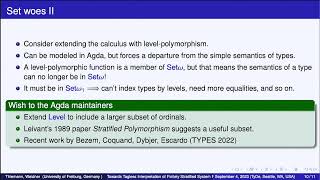
Towards Tagless Interpretation of Stratified System F
Explore the design of an intrinsically typed, tagless interpreter for stratified System F in Agda, focusing on advanced type theory concepts and implementation strategies.
A Dependently Typed Language with Dynamic Equality
Explore a novel dependently typed language with dynamic equality, addressing usability issues in type systems and providing clearer error messages through runtime equality checking.
Delimited Continuations Demystified
Explore delimited continuations: their nature, functionality, and applications in schedulers and effect systems. Gain insights into this powerful programming concept.
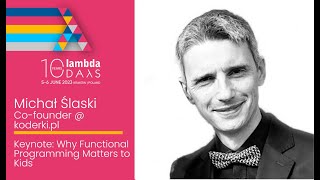
Why Functional Programming Matters to Kids - Lambda Days 2023
Explore the impact of functional programming on education and conference organization, with insights on teaching kids and creating memorable tech events.
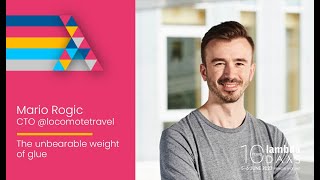
The Unbearable Weight of Glue - Tackling Complexity in Software Development
Explore how type-safe functional programming exposes and tackles glue code complexity, with insights from Elm community projects and interactive audience participation.