Introducing BRAT: A Functional Programming Language for Quantum-Classical Hybrid Programs
Explore BRAT, a functional language for quantum-classical hybrid programming, featuring unique syntax and type-level parameters for enhanced safety and composition.
Nominal Recursors as Epi-Recursors - POPL 2024
Explore nominal recursors in syntax with bindings, comparing expressiveness and viewing them as epi-recursors. Develop a framework for comparison and apply to nominal corecursors, validated with Isabelle/HOL.
Vehicle - A Specification Language for Neural Network Properties
Explore Vehicle, a functional DSL for specifying neural network properties. Learn to express, compile, and verify specifications across platforms, enhancing safety in ML-enhanced systems.
Semi-Automated Direction-Driven Functional Conversion - miniKanren'23
Explore semi-automated direction-driven functional conversion techniques in miniKanren, enhancing program transformation and optimization capabilities.
Functional Programming in the Large - Status and Perspective
Explore functional programming's role in large-scale industrial projects, its intersection with software architecture, and potential for cross-pollination with Domain-Driven Design techniques.
Types that Change: The Extensible Type Design Pattern
Explore the Extensible Type Design Pattern for compilers, addressing code duplication and enhancing traceability and error recovery in program representations.
A Software Architecture Based on Coarse-Grained Self-Adjusting Computations
Explore coarse-grained self-adjusting computations in Haskell for efficient data updates. Learn from a commercial system's architecture, API, and real-world application.
Phases in Software Architecture
Explore multi-phase computation structures in software architecture, focusing on novel applicative functors and their potential applications in choreography and multi-tier architecture.
Functional Shell and Reusable Components for Easy GUIs
Explore functional shells and observable toolkits for simplified GUI development, focusing on reusable views and architectural patterns derived from practical experience.
Generating Well-Typed Terms That Are Not "Useless"
Explore a novel algorithm for generating well-typed lambda terms that use their arguments effectively, improving random testing of functional language compilers.
Polyregular Functions on Unordered Trees of Bounded Height
Explore polyregular functions on unordered trees with bounded height, examining first-order interpretations, decidability of equivalence problems, and applications to graph classes with bounded tree-depth.
Fusing Direct Manipulations into Functional Programs
Explore a novel framework for bidirectional live programming that fuses direct manipulations into functional programs, enabling code-insensitive output modifications and automatic source code updates.
Disentanglement with Futures, State, and Interaction
Explore disentanglement in parallel programs with futures, examining its extension beyond fork/join parallelism and implications for functional, stateful, and non-deterministic code.
Learn Javascript with Chat GPT - Javascript Tutorial - Functions
Explore JavaScript functions: declaration, parameters, return values, and higher-order functions. Learn with clear explanations and practical code examples.
Meaning Representation for Natural Language Understanding - Mariana Romanyshyn - ODSC Europe 2019
Explore abstract meaning representation in NLP, its algorithms, and applications. Learn about AMR graphs and their potential to enhance question answering, summarization, and text simplification.
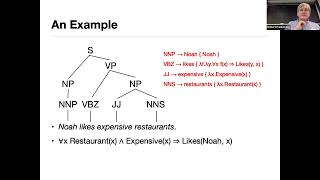
CMU Advanced NLP: Semantics and Discourse
Explore advanced NLP concepts like semantic parsing, discourse coherence, pragmatics, and reference resolution in this comprehensive lecture on natural language understanding.
Generics, Custom ArrayList, Lambda Expressions, Exception Handling, Object Cloning
Explore advanced Java concepts: generics, custom ArrayList, object comparison, lambda expressions, exception handling, and object cloning. Enhance your OOP skills with practical examples and in-depth explanations.
Peter Dybjer - Intuitionistic Type Theory
Explore intuitionistic type theory, inductive definitions, and finite axiomatizations in this advanced lecture on mathematical foundations and type systems.
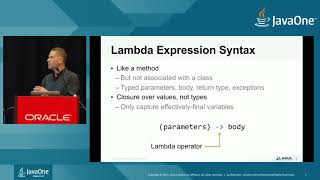
Lambda Expressions in Java - Performance and Advanced Applications
Explore lambda expressions in Java, from syntax to performance implications, and discover mind-bending functional programming techniques to solve complex problems using only lambdas.
Designing Functional Programs: From Imperative to Functional Paradigm
Learn functional programming principles and design techniques to build practical applications with immutability and higher-order functions, shifting from imperative and object-oriented paradigms.
Boston Data Mining - A High-Performance Implementation of Bayesian Clustering
Explore Bayesian nonparametric methods and probabilistic machine learning, focusing on the Chinese Restaurant Process for clustering. Learn optimization strategies for applying these models to big data.