Synthesizing Distributed Protocols from Global Session Types
Automata-theoretic approach to synthesizing distributed protocols from global session types, introducing a sound and complete projection operator for multiparty session types.
The Verification of a Distributed System
Explore techniques for verifying distributed systems, including formal methods, testing strategies, and fault injection, to build robust and reliable systems in the face of partial failure and asynchrony.
Formal Reasoning: An Alternative Approach to Formal Verification - Code BEAM America 2022
Explore formal reasoning techniques to improve system testing, monitoring, and design. Learn practical applications of formal verification concepts for more efficient software development and operations.
Making Linux Fly: Towards a Certified Linux Kernel
Explore efforts to create a certified Linux kernel, enhancing reliability and security through formal verification techniques and advanced testing methodologies.

Trustworthy Formal Natural Language Specifications
Explore a novel approach to translating natural language specifications into formal claims within proof assistants, enhancing software verification and bridging the gap between informal and formal specifications.
Formal Verification of a Mechanical Ventilator Using UPPAAL
Explore formal verification of mechanical ventilators using UPPAAL, enhancing system reliability and correctness through advanced modeling techniques.
Formal Probabilistic Methods for Combinatorial Structures using the Lovász Local Lemma
Explore formal probabilistic methods for combinatorial structures, focusing on the Lovász Local Lemma and its application to hypergraph coloring in Isabelle/HOL.
PfComp: A Verified Compiler for Packet Filtering Leveraging Binary Decision Diagrams
Explore PfComp, a verified compiler for stateless firewall policies using binary decision diagrams. Learn about its Coq-assisted proof, OCaml extraction, and performance benefits.
Formalizing Giles Gardam's Disproof of Kaplansky's Unit Conjecture
Explore the formalization of Giles Gardam's disproof of Kaplansky's Unit Conjecture using Lean 4, combining deductive proving and verified computation.
UTC Time, Formally Verified - Presentation at CPP 2024
Explore formal verification of UTC time conversions using Coq and MathComp, including leap seconds implementation and refinement techniques for software verification projects.
Taming Floating Points in Scala and CakeML
Explore formal verification techniques for floating-point programs in functional languages, focusing on static analysis to ensure accuracy and meaningful results despite rounding errors.
When Testing Just Doesn't Cut It - Formal Verification in Mission-Critical Software
Explore formal verification techniques for mission-critical software, using a financial application example to demonstrate mathematical proofs beyond standard unit testing.
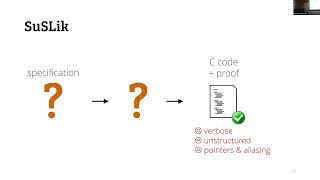
SuSLik: Deductive Synthesis of Safe Programs with Pointers - Tutorial 1b
Explore deductive program synthesis for creating provably correct pointer-manipulating programs using SuSLik. Practice specifying programs with formal logic and learn about separation logic.
High-Assurance Go Cryptography
Explore techniques for ensuring safety and bug-free implementation of cryptography in Go, including testing, fuzzing, static analysis, formal proofs, and code generation. Learn about safe interfaces and readability in standard libraries.
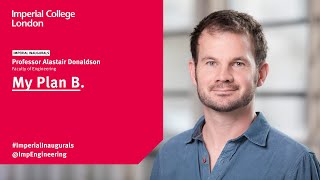
My Plan B: Exploring Alternative Strategies in Computer Science Research
Explore innovative approaches to software testing and verification with Professor Alastair Donaldson in his Imperial Inaugural lecture.
GFLean - Autoformalisation for Lean via Grammatical Framework
Explore GFLean, an innovative approach to autoformalisation in Lean using Grammatical Framework. Learn about its potential to bridge natural language and formal mathematics.
Lean4Less - A Term-Patching Framework for Eliminating Definitional Equalities in Lean
Explore a term-patching framework for eliminating definitional equalities in Lean, enhancing theorem proving efficiency and reducing computational overhead.
Lean4Lean - Formalizing the Type Theory of Lean
Explore the formalization of Lean's type theory with Mario Carneiro, delving into advanced concepts and techniques for theorem proving and mathematical reasoning.
Big Math Libraries in Interactive Theorem Provers
Explore five key aspects of Big Math in Interactive Theorem Provers: inference, computation, concretization, narration, and organization. Learn about library sizes, searching, integration, and maintenance.
Isabelle as System Platform for the Archive of Formal Proofs
Explore Isabelle's role as a system platform for the Archive of Formal Proofs, examining its impact on mathematical formalization and proof verification.
Experiences from Exporting Proof Assistant Libraries
Insights into exporting libraries from proof assistants, exploring challenges and solutions for interoperability between formal systems and knowledge management.