
Long Live The Honey Badger - Robust Asynchronous DPSS and its Applications
Explore robust asynchronous Dynamic-committee Proactive Secret Sharing (DPSS) protocols that handle network churn and faults efficiently, with insights on high-threshold DPSS and batch-amortized schemes.

Concurrency Abstractions for Application Security
Explore how concurrency abstractions in Erlang's virtual machine can enhance application security, comparing benefits with statically typed languages and discussing challenges in modern networked applications.

Introduction to Stream Processing with Apache Flink
Explore Apache Flink's powerful stream processing capabilities, from basic concepts to advanced features. Learn how industry leaders leverage Flink for resilient, scalable data pipelines and stateful applications.
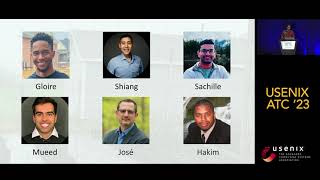
Comosum - An Extensible, Reconfigurable, and Fault-Tolerant IoT Platform for Digital Agriculture
Explore an innovative IoT platform for digital agriculture, featuring extensible architecture, fault tolerance, and edge analytics for sustainable farming and increased productivity.

Portunus - Re-imagining Access Control in Distributed Systems
Innovative cryptographic system using attribute-based encryption for secure, efficient TLS key management in distributed networks, enhancing access control without compromising performance.

Resilience Patterns in Practice
Explore fault tolerance concepts for distributed systems, including bulkhead, rate limiter, circuit breaker, retry, and fallback patterns. Learn to build resilient software that stays responsive in the face of failure.
Write a Fault Tolerant Web Service Using Gevent + Uwsgi
Learn to create resilient web services using gevent and uWSGI, focusing on fault tolerance techniques for improved reliability and performance in Python-based applications.

Systems Integration - The OpenStack Success Story
Explore OpenStack's successful integration strategies for distributed systems, focusing on scalability and data sharing without compromising performance or shared-nothing architecture.
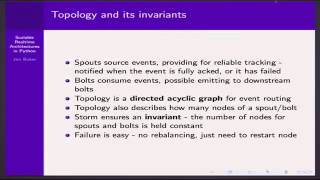
Scalable Realtime Architectures in Python
Explore scalable realtime architectures using Python with Storm, Kafka, and ZooKeeper. Learn about partitioning, retries, and idempotence for building robust, fault-tolerant systems that process continuous data streams.
A New Generation of Distributed Services Framework
Explore a distributed service-oriented platform for visual effects, covering setup, concurrency, componentization, and monitoring. Learn to build scalable systems for global collaboration.

Designing a Scalable and Distributed Application
Learn to design a scalable, distributed application using consul and uWSGI. Covers automatic service registration, health checking, distributed storage, and multi-datacenter awareness for global scalability.
ETL Pipeline to Achieve Reliability at Scale
Explore designing scalable ETL pipelines for high-volume financial transactions, focusing on fault tolerance, fast I/O, and efficient computations using Python, Luigi, and Spark.
Unlocking the Power of Raft Consensus with rqlite using Python
Explore Raft consensus implementation in distributed databases using rqlite and Python. Learn about data integrity, fault tolerance, and high availability in modern applications.
Automating Load Balancing and Fault Tolerance via Predictive Analysis
Explore predictive analysis for intelligent Kubernetes load balancing, improving performance, reducing costs, and enhancing reliability in hybrid cloud environments.

Optimizing Storage Assignment via Pod Scheduling Under Disturbance Factors
Explore automated storage allocation in distributed systems using Kubernetes, focusing on pod scheduling optimization and fault tolerance across racks for improved system reliability.

Kubernetes CronJobs - Does Anyone Actually Use This in Production
Explore the challenges and solutions of using Kubernetes CronJobs at scale, with insights from Lyft's experience implementing hundreds of CronJobs in production.
Distributed Real Time Stream Processing - Why and How
Explore state-of-art distributed streaming frameworks, their differences, trade-offs, and use-cases. Learn how to choose between Spark Streaming, Storm, Samza, and Flink for your specific streaming needs.

Fault Tolerance in Distributed Systems - A Case Study in Apache Spark
Explore fault tolerance in distributed systems through Apache Spark, examining design principles, challenges, and lessons for building robust systems and understanding their limitations.

How GraphQL Servers Break and How to Harden Your Resolvers
Explore techniques to enhance GraphQL server reliability and security using Solo.io's GraphQL Envoy proxy filter, enabling robust endpoints without coding.
Circuit-Breaker.js
Explore a JavaScript implementation of the Hystrix circuit breaker pattern for fault tolerance in distributed systems, enhancing resilience and preventing cascading failures.

What Every Node.js Developer Needs to Know About Elixir
Discover Elixir: A versatile, safe alternative to Node.js for server-side development. Learn its benefits, including expressive syntax, massive concurrency, and fault-tolerance.