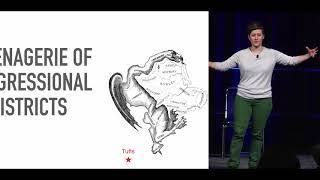
Political Geometry - Voting Districts, Compactness, and Ideas About Fairness
Explore political geometry, voting districts, and fairness concepts in redistricting through mathematical analysis and real-world examples from various U.S. states.

Formal Abstractions for Attested Execution Secure Processors
Explore formal abstractions for attested execution in secure processors, covering standard models, concrete examples, simulation, fairness, and implications for cryptographic protocols.

Secure Computation II
Explore advanced secure computation concepts, including information theory, MPC, ground complexity, fairness, and breakthrough results in cryptography.
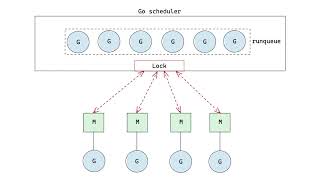
Queues, Fairness, and The Go Scheduler
Explore Go's scheduler, its fairness mechanisms, and runtime APIs. Gain insights into Goroutine scaling, thread mapping, and scheduler control techniques.

How Judges Can Show Respect
Victoria Pratt shares four principles of "procedural justice" to ensure dignity and respect in courtrooms, transforming the judicial process and positively impacting lives in Newark and beyond.

Moral Behavior in Animals
Explore surprising evidence of empathy, cooperation, and fairness in primates and mammals, challenging our understanding of moral traits as uniquely human.

Responsible AI: Challenges and Emerging Practices - Keynote
Explore challenges and emerging practices in responsible AI, including unintended consequences, model interpretability, fairness, and engineering objectives.

Fairness in Serving Large Language Models
Explore innovative scheduling algorithms for fair and efficient LLM inference services, addressing challenges of unpredictable request lengths and unique batching characteristics on parallel accelerators.

The Fairness of Fairness: Evaluating, Monitoring, and Impacts of ML in Insurance
Explore strategies for creating fair ML models in insurance, covering bias metrics, optimization techniques, and insights from FTC research on credit-based insurance scores' impact.

Advances in Algorithmic Recourse - Ensuring Causal Consistency, Fairness, and Robustness
Explore cutting-edge approaches to algorithmic fairness and transparency through causal inference methods, focusing on bias correction and ethical AI applications in healthcare and finance.
Rethinking Bias Mitigation: Fairer Architectures Make for Fairer Face-Recognition
Explore groundbreaking research on addressing bias in face recognition systems through neural architecture optimization, revealing how architectural choices impact fairness more than data preprocessing alone.

Operational Research for Fairness, Privacy and Interpretability in Machine Learning
Explore responsible AI through operational research, focusing on fairness, interpretability, and privacy in machine learning. Learn to leverage Integer Linear Programming for optimal, fair rule lists.

The Search for Transparency and Accountability in the Age of AI - RAI and XAI as Essential Tools
Explore responsible AI and explainable AI as crucial tools for building ethical, transparent, and trustworthy AI systems. Uncover their synergy in addressing fairness, accountability, and interpretability challenges.

Making GenAI Safe, Trustworthy and Fit for Purpose with Auto Alignment
Enhance fairness, robustness, and safety of generative AI through alignment templating. Learn to measure model performance, improve with minimal human intervention, and adapt for specific use cases.
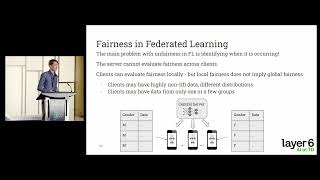
Navigating the Tradeoff Between Privacy and Fairness in Machine Learning
Explore the intersection of privacy and fairness in ML, addressing challenges and research-based solutions for regulated industries.
Opening the Machine Learning Black Box in Regulated Industries
Explore techniques for making machine learning models explainable and compliant in regulated industries like finance and insurance. Learn to bridge the gap between ML and regulatory requirements.

Rise of Responsible MLOps
Explore industry-wide developments in responsible AI, focusing on fairness, transparency, privacy, and robustness in MLOps for ethical decision-making systems.

How F.A.T. is Your ML Model Quality in the Era of Software
Explore F.A.T. (Fairness, Accountability, Transparency) properties for assessing ML model quality. Learn evaluation approaches, governance benchmarks, and bias mitigation techniques through case studies.

Auto-bidding in Online Advertising: Campaign Management and Fairness
Explore auto-bidding strategies in digital advertising, focusing on conversion maximization, ROI constraints, and fairness in auction outcomes. Learn efficient algorithms for multi-channel optimization.

High-Dimensional Prediction for Sequential Decision Making
Explore efficient algorithms for online high-dimensional predictions, enabling no-regret guarantees, fairness, and uncertainty quantification in multiclass settings for improved decision-making.

Ensuring Fair Behavior Among Autonomous Vehicles
Explore a novel approach to incentivize fair behavior in autonomous vehicle ecosystems using blockchain technology and fairness tokens.