
Ethics - Full Stack Deep Learning - Spring 2021
Explore AI ethics, covering long-term challenges, hiring practices, fairness, representation, and best practices. Gain insights into crucial ethical considerations for AI development and implementation.
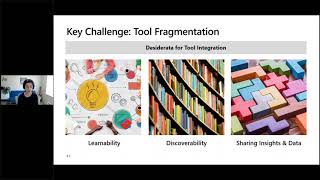
Responsible AI Dashboard - A Tool for Operationalizing Responsible AI
Explore Microsoft's Responsible AI Dashboard, an open-source framework integrating tools for error analysis, interpretability, fairness, and causal decision-making to build reliable and responsible AI products.
Simulating Apache Mesos Framework - Insights from Cook Scheduler Testing
Explore Apache Mesos framework simulation for testing algorithm changes, uncovering bugs, and improving system performance without running the entire distributed system.
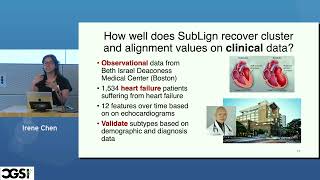
Fairness and Equity in Machine Learning for Healthcare
Explore fairness and equity in healthcare ML, addressing bias, challenges, and innovative solutions for equitable outcomes in medical applications and large language models.
CQS: A Formally-Verified Framework for Fair and Abortable Synchronization
Explore a formally-verified framework for fair and abortable synchronization, enabling efficient implementation of various primitives with modular proofs and improved performance.
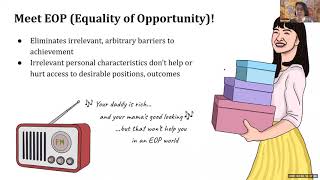
Translation Tutorial - Fairness and Friends
Explore fairness in AI and its societal implications with experts from NYU and STOP. Gain insights into ethical considerations and practical approaches for responsible AI development.

Fairness, Equality, and Power in Algorithmic Decision-Making
Explore the ethical implications of algorithmic decision-making, focusing on fairness, equality, and power dynamics in AI systems and their societal impact.

AI Explainability 360
Comprehensive tutorial on AI explainability, covering techniques, tools, and applications. Learn to implement transparent and interpretable machine learning models for ethical AI development.

Fairness, Welfare, and Equity in Personalized Pricing
Explore the ethical implications and economic impacts of personalized pricing strategies, focusing on fairness, consumer welfare, and equity considerations in dynamic market environments.

Profiling and Representation
Explores bias in semantic representations, fair crowdsourced recommendations, profiling potential of computer vision, and rich subgroup fairness in machine learning. Discusses ethical implications in AI and data science.

Translation Tutorial - A Shared Lexicon for Research in Human-Centered Software Systems
Explore key terms in fairness, accountability, and transparency in algorithmic systems. Learn how different disciplines interpret these concepts to improve cross-disciplinary communication and research in human-centered software.

Responsible AI in Industry - Lessons Learned in Practice
Explore practical lessons on implementing responsible AI in industry, covering explainability, fairness, and challenges faced by major tech companies.

What We Can’t Measure, We Can’t Understand - Challenges to Demographic Data Procurement in the Pursuit of Fairness
Explore challenges in demographic data collection for fairness, covering recruitment, privacy laws, anti-discrimination policies, and organizational trustworthiness in pursuit of equitable AI systems.

What Does Fairness Mean in Data Protection Law
Explore legal concepts of fairness in data protection, examining justice, equality, and AI ethics through practical scenarios and GDPR implications.
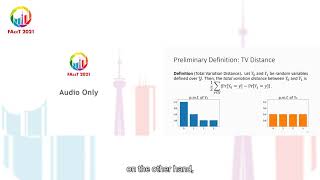
Avoiding Disparity Amplification under Different Worldviews
Explore strategies to prevent amplification of disparities in machine learning systems while considering diverse worldviews, with a focus on fairness and utility in decision-making processes.
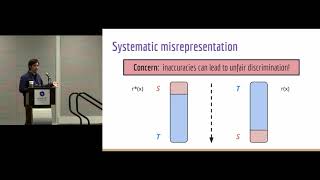
Learning from Outcomes - Evidence-Consistent Rankings
Explore evidence-consistent rankings in machine learning, focusing on fairness, misrepresentation, and multi-accuracy. Gain insights into domination compatibility and self-reference in ranking systems.

Moral Behavior in Animals
Explore surprising evidence of empathy, cooperation, and fairness in primates and mammals, challenging our understanding of moral traits in animals.

Shockwave - Fair and Efficient Cluster Scheduling for Dynamic Adaptation in Machine Learning
Efficient cluster scheduling system for dynamic adaptation in ML training, optimizing fairness and efficiency through market theory and stochastic dynamic programming.
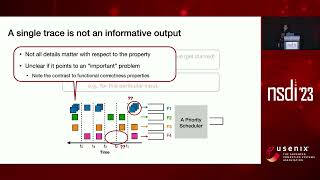
Formal Methods for Network Performance Analysis
Explores using formal methods for network performance analysis, offering a more exhaustive approach than simulation. Demonstrates effectiveness in analyzing packet scheduling algorithms and generating problematic workloads.
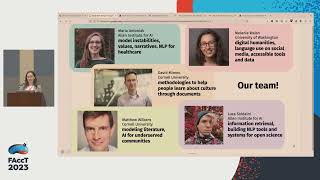
A Hands-On Introduction to Large Language Models for Fairness, Accountability, and Transparency Researchers
Hands-on exploration of large language models for researchers studying fairness, accountability, and transparency in AI systems.
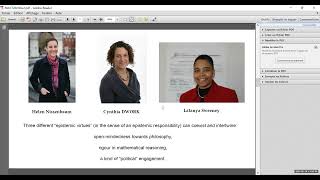
Fairness in Machine Learning from the Perspective of Sociology of Statistics - How Machine Learning Is Becoming Scientific by Turning Its Back on Metrological Realism
Explore the intersection of machine learning fairness and sociology of statistics, examining how ML evolves scientifically by moving away from metrological realism.