
Building and Selling Solo - An Open Source Secure Hardware Token
Learn about creating and selling Solo, an open-source security key implementing U2F and FIDO2 protocols. Explore hardware design, crowdfunding, production challenges, and the benefits of open-source security devices.

Demystifying IMSI Catchers
Uncover the mysteries of IMSI catchers, their functionality, detection methods, and legal implications. Gain insights into cellular network fundamentals and cutting-edge research on unauthorized cell sites.

Looking for Malicious Hardware Implants with Minimal Equipment
Explore hardware security threats, detection methods, and threat modeling with minimal equipment. Learn to identify unexpected features and understand the challenges of hardware implants and interdiction.
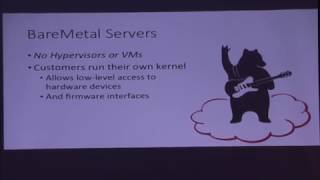
Securing Bare Metal Hardware at Scale
Explore advanced techniques for securing firmware in large-scale hardware deployments, addressing challenges and future trends in protecting against persistent backdoors and exploits.
Embedded Device Vulnerability Analysis Case Study Using Trommel
Comprehensive methodology for embedded device vulnerability analysis, covering firmware, web app, mobile app, and hardware. Includes case study and TROMMEL tool introduction.

Adventures in Hardware Hacking or Building Expensive Tools on a Budget
Explore hardware hacking techniques like CT scanning and chip decapping for non-destructive device analysis, circuit reconstruction, and vulnerability identification in embedded systems and access control.

Applicable and Achievable Formal Verification
Introductory overview of formal verification techniques in industry, focusing on safety-critical systems. Explores tools, applications, and adaptability to existing infrastructures.

Discovering and Understanding the Security Hazards in the Interactions between IoT Devices, Mobile Apps, and Clouds on Smart Home Platforms
Exploring security vulnerabilities in smart home platforms through reverse engineering and phantom device testing, revealing unexpected state transitions and potential attacks.
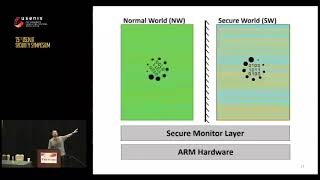
fTPM - A Software-Only Implementation of a TPM Chip
Explore software-based TPM implementation using ARM TrustZone, overcoming hardware limitations to provide robust security features for trusted computing in mobile devices.

Breaking Secure Bootloaders
Explore techniques to bypass secure bootloaders, including signature verification vulnerabilities, memory analysis, and firmware update exploits. Learn to identify and exploit weaknesses in modern device protection mechanisms.

Attacking IOBluetoothFamily HCI and Vendor-Specific Commands
Explores vulnerabilities in Bluetooth stacks, focusing on Host-Controller Interface (HCI) and vendor-specific commands. Demonstrates attack techniques and discusses security implications for MacOS and iOS devices.

How Embedded TCP-IP Stacks Breed Critical Vulnerabilities
Explore critical vulnerabilities in embedded TCP/IP stacks, their impact on system security, and techniques for analysis and mitigation in networked embedded systems.

Army of Undead - Tailored Firmware Emulation
Explore automated firmware emulation techniques for embedded systems, covering root filesystem location, architecture identification, and emulation methods using open-source tools and scripts.
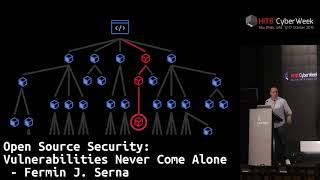
Open Source Security – Vulnerabilities Never Come Alone
Explore open source security challenges, variant analysis techniques, and real-world case studies. Learn about vulnerabilities in popular software and gain insights from industry expert Fermin J. Serna.

Bootstrapping Systems With Open Source Firmware
Explore open-source firmware for enhanced physical security and data protection. Learn about Heads, a custom firmware and OS configuration that combines hardware hardening with secure boot processes.
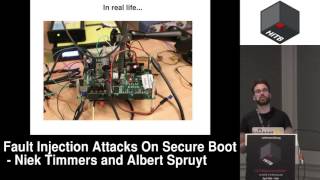
Fault Injection Attacks on Secure Boot
Exploring fault injection attacks on secure boot, this talk introduces techniques, impacts, and practical mitigation strategies for embedded systems security, with real-world examples and key takeaways.
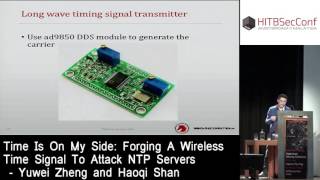
Forging a Wireless Time Signal to Attack NTP Servers
Forging wireless time signals to disrupt NTP servers and consumer devices. Explores vulnerabilities in radio timing services and demonstrates low-cost methods to spoof GPS, WWVB, and other signals used for time synchronization.
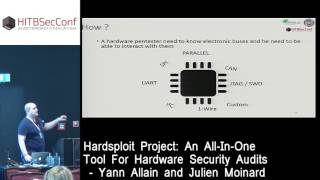
Hardsploit Project
Hardsploit: A comprehensive toolbox and framework for auditing electronic systems and embedded devices, addressing the growing security challenges in the Internet of Things era.
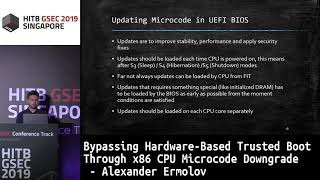
Bypassing Hardware-Based Trusted Boot Through x86 Downgrade
Exploiting microcode loader vulnerability to downgrade CPU microcode, enabling attacks on Intel security technologies like Boot Guard and TXT by loading older, vulnerable versions of Authenticated Code Modules.

TOCTOU Attacks Against Secure Boot and BootGuard
Explore TOCTOU attacks on Intel's BootGuard, learn about vulnerabilities in secure boot processes, and discover open-source tools for testing system security.

Industrial Technology Trajectory - Running with Scissors
Explore industrial technology's rapid evolution, its impact on cybersecurity, and the challenges of innovation, data management, and intelligent infrastructure in the digital age.