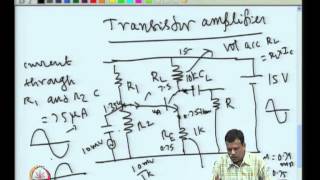
Circuits for Analog System Design
This course will concentrate on three aspects: 1) how to design and analog circuits, 2) error budgeting, and 3) various techniques involved in analog circuits.
Power Electronics
The course discusses power processing electronic circuits like rectifiers, AC voltage controllers, Frequency converters, DC-DC converters and inverters apart from introducing the basics of power semiconductor devices like SCRs, power BJTs, IGBTs, and MOS…
Power System Dynamics and Control
This course first introduces a student to power stability problems and the basic concepts of modeling and analysis of dynamical systems. Modeling of power system components - generators, transmission lines, excitation and prime mover controllers - is cov…
Optimal Control
Comprehensive exploration of optimization techniques, from unconstrained problems to dynamic optimization, covering linear and non-linear programming, optimal control, and robust stability analysis.

Basic Electrical Circuits
The course begins with an introduction to the course; Current and Voltage; Kirchhoff\'s Current and Voltage laws. Electrical circuit elements: Voltage and current sources; R, C, L; Controlled sources; Determining the characteristics of a two-terminal ele…
ARM Based Development
Explore ARM-based development, covering architecture, instruction sets, embedded systems, pipelining, memory management, and programming for ARM processors.
Signals and Systems
Comprehensive exploration of signal processing fundamentals, covering continuous and discrete-time systems, Fourier and Laplace transforms, sampling theory, and Z-transforms for practical applications.
Illumination Engineering
Explore the science of light, from vision and photometry to various lamp types and lighting applications, covering interior, sports, and road illumination.
Illumination Engineering
Explore the science of light, from vision and photometry to various lamp types and lighting applications, enhancing your understanding of illumination systems and design.
Applied Optimization for Wireless, Machine Learning, Big Data
This course is focused on developing the fundamental tools/ techniques in modern optimization as well as illustrating their applications in diverse fields such as Wireless Communication, Signal Processing, Machine Learning, Big Data and Finance.
Transform Calculus and Its Applications in Differential Equations
Comprehensive exploration of integral transforms, focusing on Laplace and Fourier transforms, their properties, and applications in solving differential equations and boundary value problems.
Semiconductor Devices and Circuits
Explore quantum mechanics, semiconductor physics, and electronic devices. From wave-particle duality to charge transport and continuity equations, gain a comprehensive understanding of semiconductor fundamentals.
Fundamentals of Power Electronics
The course introduces the basics of power electronic devices and converters. Basic working principles, operating modes and analysis of DC-DC, DC-AC, AC-DC, and AC-AC converters would be covered. Control of power electronic converters is explained
An Introduction to Electronics System Packaging
Comprehensive exploration of electronics system packaging, covering semiconductor basics, chip packaging, electrical issues, CAD tools, PCB fabrication, soldering techniques, and emerging technologies.
Advanced Digital Signal Processing - Multirate and Wavelets
Explore advanced digital signal processing concepts, focusing on multirate systems and wavelets. Learn about filter banks, time-frequency analysis, and various wavelet transforms with practical applications.
Power Electronics and Distributed Generation
Comprehensive exploration of distributed generation technologies, power electronics, and distribution systems, covering protection, islanding, inverters, and economic evaluation for modern electrical grids.
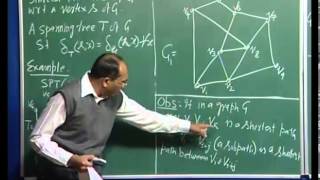
Computer Algorithms - 2
The course discusses efficient algorithms from a large number of domains. This course assumes the knowledge of data structures, the knowledge big-O notation and the concept of time and space complexity of an algorithm.
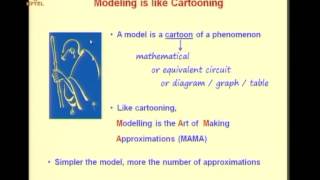
Semiconductor Device Modeling
Comprehensive exploration of semiconductor device modeling, covering transport equations, drift-diffusion models, energy band diagrams, and MOSFET characteristics for advanced understanding of electronic components.
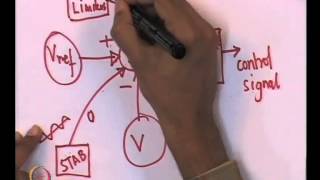
Power System Dynamics and Control
This course introduces a student to power stability problems and the basic concepts of modeling and analysis of dynamical systems. Modeling of power system components - generators, transmission lines, excitation and prime mover controllers - is covered i…
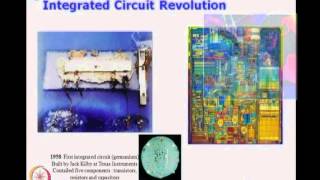
Digital Circuits and Systems
Comprehensive exploration of digital circuits and systems through 53 lectures, covering fundamental concepts to advanced applications in electronic design and analysis.
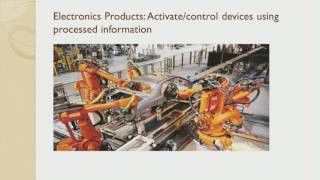
Analog Circuits and Systems 1
The main aim of the course ‘Analog Circuits and Systems 1’ is to design analog circuits and systems that perform signal conditioning, signal processing functions, and signal generation using devices including Op-Amps, amplifiers, and comparators.