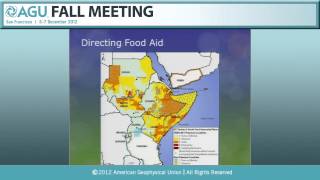
Advancing Drought Monitoring and Prediction - 2012 AGU Fall Meeting
Explore cutting-edge research on drought monitoring and prediction, including remote sensing, soil moisture analysis, and early warning systems for improved decision-making and humanitarian response.
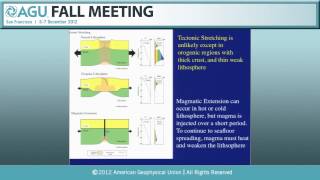
The Geodynamics of Plate Tectonics II - 2012
Explore cutting-edge geodynamics research on plate tectonics, including continental collisions, mantle plumes, subduction zones, and their effects on Earth's topography and magmatism.
Nonlinear and Scaling Processes in the Atmosphere and Ocean at All Scales
Explore cutting-edge research on nonlinear and scaling processes in atmospheric and oceanic systems, covering climate reconstructions, sensitivity, long-range memory, megadroughts, turbulence, and micro-scale phenomena.
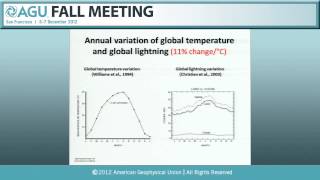
Lightning and Climate - Franklin Lecture 2012
Exploring lightning's role in climate change, its correlation with temperature and water vapor, and its potential as a climate indicator. Discusses challenges in long-term monitoring and the impact of aerosols on lightning activity.
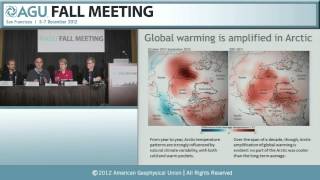
What's Going On in the Arctic - Fall 2012 Arctic Report Card Update
Experts discuss alarming Arctic changes: record sea ice loss, declining snow extent, rising permafrost temperatures, and extensive Greenland ice sheet melting, despite unremarkable air temperatures.
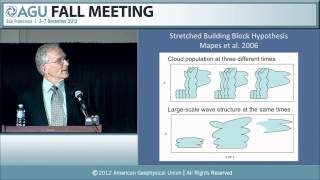
Tropical Convection: A Half Century Quest for Understanding
Exploring tropical convection's role in global climate, from field expeditions to satellite observations, revealing advances in understanding cloud-circulation interactions and their impact on weather patterns.
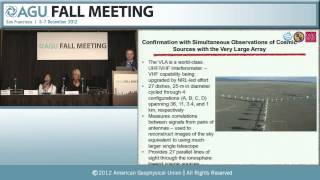
An Unlikely New Tool for Spotting Clandestine Nuclear Tests
Innovative use of GPS technology for detecting clandestine nuclear tests, exploring ionospheric disturbances and acoustic waves as potential indicators of underground explosions.
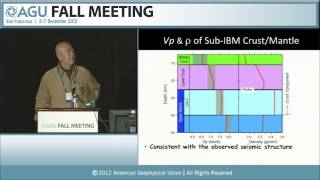
The Andesite Problem: Why is This Planet to be the Earth? - Bowen Lecture
Explore the Earth's unique geological features, focusing on continental crust formation, plate tectonics, and the role of water in shaping our planet's surface and internal dynamics.
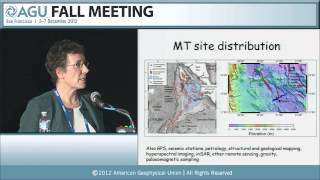
Magnetotelluric Studies in East Africa: Imaging Subsurface Melt and Magma
Explore magnetotelluric studies in East Africa, focusing on imaging subsurface melt and magma. Learn about data collection, processing, and interpretation in interdisciplinary rift zone research.
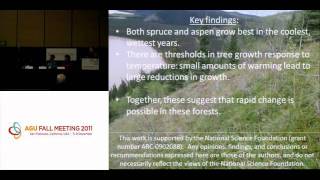
Small Climate Changes, Big Ecological Impacts - Fall Meeting 2011
Exploring how small climate changes can trigger rapid ecosystem shifts, including potential impacts on boreal forests and arctic tundra, and historical examples of regime shifts affecting megafauna.
Predicting and Managing Extreme Weather and Climate Events
Explore strategies for predicting and managing extreme weather and climate events with insights from Dr. Jane Lubchenco's lecture at the AGU Fall Meeting 2011.
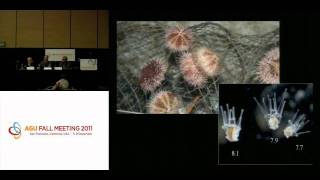
Ocean Acidification: Physiological Tipping Points for Marine Species - Press Conference
Experts discuss new research on ocean acidification's impact on marine species beyond corals, revealing stunted growth and development in fish, crustaceans, and sea urchins due to lower pH levels.
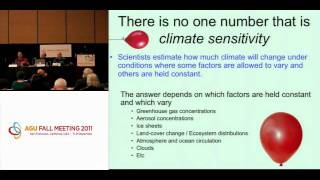
Paleoclimate Record Points to Potential Rapid Climate Changes - 2011 AGU Fall Meeting
Paleoclimate data suggests Earth may face rapid climate changes, with sea levels potentially rising several meters, even if global warming is limited to two degrees Celsius above pre-industrial levels.
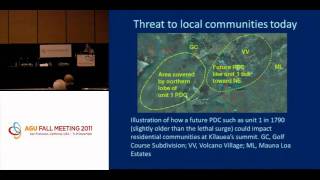
New Views of the Explosive Past of Kilauea Volcano - 2011 AGU Fall Meeting
Newly discovered evidence sheds light on Kilauea's explosive history, including the deadly 1790 eruption, providing crucial insights for assessing future catastrophic events at this frequently visited volcano.
2012 American Geophysical Union Honors Tribute
Honoring excellence in geophysical sciences: AGU's 2012 award ceremony recognizes outstanding contributions in research, education, journalism, and climate communication across various disciplines.
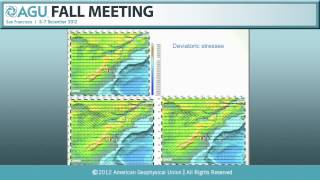
Understanding Recent and Historical Seismicity in the Central and Eastern U.S. - 2012
Explore recent developments in seismology for Central and Eastern US, covering ground-motion modeling, earthquake processes, intraplate dynamics, and implications for nuclear safety.
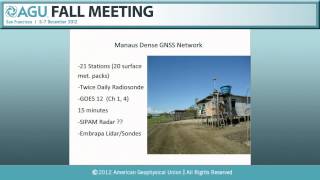
Climate and Meteorological Applications for GNSS and Related Remote Sensing Techniques
Explore cutting-edge research on using GNSS and remote sensing for climate and meteorological applications, including water vapor mapping, temperature anomalies, and tropospheric observations.
What Can Pyroclasts Tell Us? - Fall Meeting 2012
Explore pyroclastic density currents through modeling, observations, and experiments. Gain insights into flow dynamics, deposit characteristics, and hazard implications for volcanic eruptions.
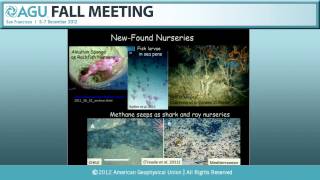
Deep Margins Under Pressure - Climate Change and Human Impacts on Continental Slopes
Exploring deep continental margins: their ecological importance, vulnerability to climate change, and challenges from human exploitation. Calls for improved stewardship of these crucial deep-ocean ecosystems.
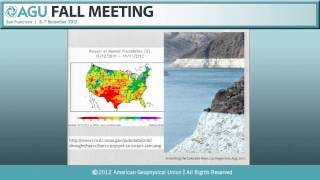
Mechanisms of Past and Future Droughts in the Southwest United States
Explore past and future drought mechanisms in the Southwest US, covering precipitation patterns, climate proxies, water availability projections, and global climate factors influencing regional hydrology.
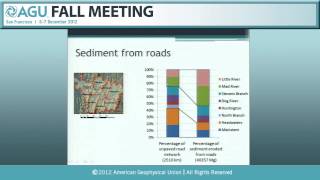
Human Influences on Hydroecogeomorphic Processes Across Spatial Scales
Explore human impacts on water, ecology, and landforms across scales, focusing on wildfires, logging, and road networks. Gain insights into erosion, runoff, and water quality in forested landscapes.