
Streaming Aggregation on Cloud Scale Telemetry
Explore streaming aggregation techniques for cloud-scale telemetry, enhancing system observability and performance monitoring in large-scale distributed environments.
MicroCeph: Simplifying Storage
Explore MicroCeph's simplified storage solutions for efficient data management in cloud environments. Learn key features and implementation strategies.
Building Resilient Applications with Durable Execution
Explore Durable Execution Engines to build resilient e-commerce backends. Learn to track user carts, ensure single payments, and manage order delivery while handling crashes and recoveries.

Building Scalable Platforms - Lessons from Embedded Systems to Finance
Explore universal patterns for building top-performing platforms across industries. Gain insights on creating inspiring engineering environments that unleash creativity and innovation.
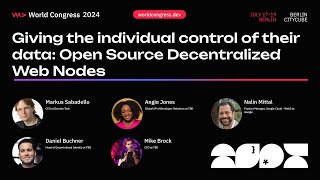
Giving the Individual Control of Their Data: Open Source Decentralized Web Nodes
Explore decentralized data storage for apps, empowering individuals with data control and reducing privacy risks. Learn about innovative solutions that shift data ownership from developers to users.
Breaking Boundaries - TACC as a Unified Cloud-Native Infrastructure for AI and HPC
Explore TACC, a unified cloud-native infrastructure for AI and HPC, bridging K8S and Slurm advantages. Learn about seamless UI, multi-tenant resource management, and robust distributed infrastructure.
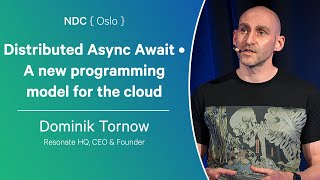
Distributed Async Await - A New Programming Model for the Cloud
Explore Distributed Async Await, a new cloud programming model extending async-await simplicity. Learn theoretical foundations and practical insights for crafting delightful, scalable cloud applications.
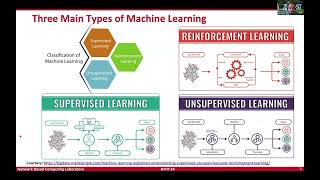
Principles and Practice of Scalable and Distributed Deep Neural Networks Training and Inference
Dive into scalable and distributed deep neural networks, exploring advanced training and inference techniques for enhanced performance and efficiency in modern AI systems.
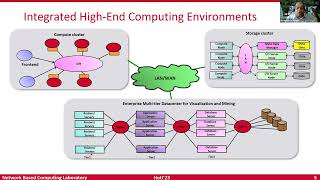
Networking Technologies for High-Performance Computing - Principles and Solutions
Explore advanced networking principles and solutions for high-performance computing systems, focusing on interconnect technologies, design strategies, and optimization techniques.

Six Impossible Things in Software Development - Lecture 1
Explore six impossible concepts in software development, from integer representation to task estimation, and learn to work within these limits to create effective solutions.
Public, Verifiable, and Unbiasable Randomness - Wassat?
Explore randomness types, their importance, and applications. Learn about drand, a distributed randomness software, and its role in providing public, verifiable randomness as a service.
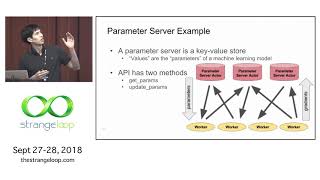
Ray - A Distributed System for Emerging AI Applications
Explore Ray, a scalable distributed system designed for AI workloads, featuring task-parallel and actor abstractions, in-memory storage, and a distributed scheduler for emerging AI applications.
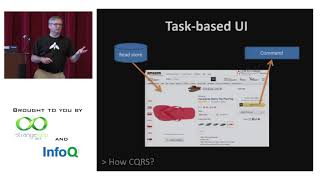
CQRS with Erlang
Explore CQRS implementation in Erlang, highlighting its advantages for distributed systems and eventual consistency. Learn how Erlang's features complement CQRS principles.
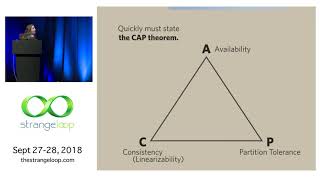
Towards Language Support for Distributed Systems
Exploring language-level solutions for distributed systems challenges, focusing on CRDTs and serverless function compositions to simplify development and enhance reliability.
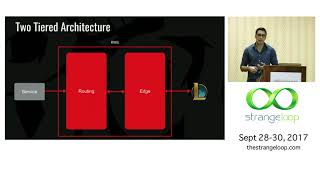
Riot Messaging Service - Message Players Like a Pro
Explore the architecture and scalability of Riot Games' messaging system for League of Legends, enabling real-time communication with millions of players across hundreds of services.

Changing the Engine in Flight - Rebuilding Monitoring at Scale
Explore real-time data processing architecture for high-traffic monitoring, including distributed systems, Go-based microservices, and Kafka with ElasticSearch. Learn from successes and failures in upgrading monitoring systems.
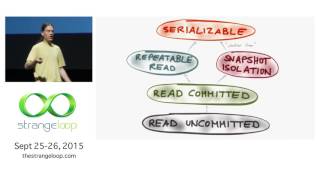
Transactions - Myths, Surprises and Opportunities
Explore the evolution of database transactions, from NoSQL to modern implementations. Learn about ACID, isolation levels, distributed algorithms, and maintaining transactional guarantees in stream processing.
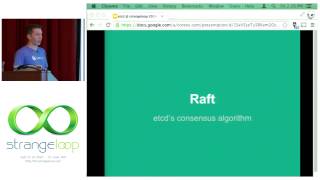
etcd - Distributed Locking and Service Discovery
Explore etcd's distributed locking and service discovery capabilities, its HTTP+JSON API, consensus algorithm, and architecture. Learn about community-built tools and libraries for this powerful open-source project.
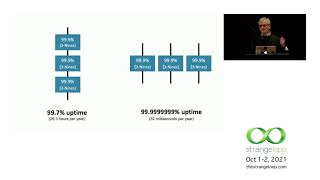
Waterpark - Distributed Actors vs the Pandemic
Explore how HCA Healthcare's Waterpark platform, built with ErlangVM and Elixir, revolutionized healthcare integration during COVID-19. Learn about actor models, continuous availability, and innovative tech solutions in a Fortune 100 company.

Tracking Millions of Ganks in Near Real Time
Explore Riot Games' transition to Riak for real-time statistics in League of Legends, discussing data modeling, scalability challenges, and strategies for handling eventually consistent data in gaming.
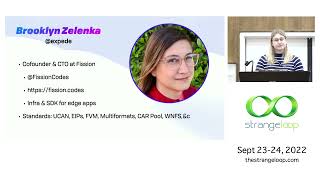
A Distributed File System for Secure P2P Applications
Explore WebNative File System: a content-addressed, encrypted forest of blocks enabling secure, user-centric collaborative software without platform dependence. Learn its applications in decentralized, multiuser scenarios.