Turning Caches into Distributed Systems with Mcrouter
Explore Facebook's mcrouter software for transforming standalone caches into robust distributed systems, addressing challenges like transient failures and multiple clusters.

Facebook's Use of Memcached for Caching and Storage Performance
Learn how Facebook optimized memcached for high-performance caching and storage, including solutions to common issues and innovative modifications to improve efficiency and scalability.
Distributed System Design for Data Engineering
Overview of distributed system design principles for data engineering, covering partitioning, replication, fault tolerance, and scalability. Includes real-world examples and best practices for building robust, large-scale data systems.

Jaeger - Present and Future in Distributed Tracing
Explore Jaeger's distributed tracing capabilities, its integration with OpenTelemetry, and new features like the monitoring tab. Learn about deployment strategies and how to contribute to this open-source project.
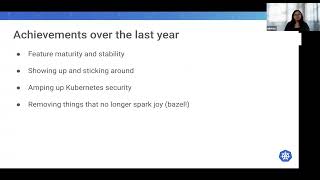
State of Kubernetes in 2022 - 1.24 and Beyond
Explore Kubernetes trends, challenges, and achievements in 2022. Learn about version 1.24 features and future developments, with insights on Indian contributors' impact.
Why Large-Scale Observability Needs Graph
Explore how graph technology enhances large-scale observability, addressing challenges in understanding complex systems and leveraging interconnected data for more effective monitoring and analysis.

SIG-Multicluster Introduction and Deep Dive
Explore SIG-Multicluster's solutions for managing multiple Kubernetes clusters across cloud providers, including best practices, current projects, and future directions in multi-cluster deployments.

Connect All the Things - Using NATS to Simplify Communication Everywhere
Explore NATS, an open-source messaging system for simplified, globally scalable communication. Learn about its features, patterns, and applications in building adaptive, multi-cloud systems.
Orchestrating Interconnected Apps Across Geographically Distributed Kubernetes Clusters
Explore multi-site Kubernetes orchestration with Nephio, addressing workload deployment, config specialization, policy conformance, and automated management for complex, interconnected applications.

Tips and Tricks to Successfully Migrate from Jaeger to OpenTelemetry
Explore effective strategies for migrating from Jaeger to OpenTelemetry, preserving key features while navigating challenges. Learn best practices and see a live demo of the migration process.

Jaeger: The Future with OpenTelemetry and Metrics
Explore Jaeger's evolution into a monitoring system with OpenTelemetry integration, including auto-instrumentation, scalable trace pipelines, and new metrics capabilities via Prometheus in the Jaeger UI.
Developing a Mental Model of Istio: From Kubernetes to Sidecars to Ambient Mesh
Explore Istio's evolution from Kubernetes abstractions to sidecar model and Ambient Mesh, understanding key concepts and mental shifts for effective implementation and management.
The Present and Future of Open Source Observability
Experts discuss recent advances, challenges, and future opportunities in open source observability, covering ecosystem developments and community impact.

Observability at Scale: Collecting Telemetry from Over 10,000 Edge Devices Worldwide
Explore how Open Systems manages observability for 10,000+ global edge devices, collecting 100M+ metrics and 5 TiB logs daily using Thanos and Loki. Learn challenges, solutions, and insights for monitoring large distributed systems.

Life Without Sidecars - Is eBPF's Promise Too Good to Be True?
Explore eBPF's potential to revolutionize service mesh technology, examining its promises, limitations, and impact on cloud-native infrastructure security, resilience, and operational complexity.
Tales from On-Call: Operating Etcd at Scale
Explore challenges and solutions for operating etcd at scale, including memory management, size quota, and revision divergence recovery, shared by Amazon EKS engineers.
Setting up Etcd with Kubernetes to Host Large-Scale Clusters - Best Practices
Learn best practices for deploying etcd in large-scale Kubernetes clusters, focusing on performance, reliability, and scalability for thousands of nodes. Insights from Datadog and Google Cloud experts.
Using OpenTelemetry for Application Security - A Real-Life Example
Explore OpenTelemetry's role in securing cloud-native applications. Learn how to detect vulnerabilities in microservices architectures through a practical Kubernetes example and Jaeger visualization.
On the Hunt for Etcd Data Inconsistencies
Explore etcd's journey in tackling data inconsistencies through innovative testing methodologies, uncovering critical issues and developing a robust framework to ensure system reliability.
Jaeger: The Future with OpenTelemetry and Metrics
Explore Jaeger's evolution with OpenTelemetry, including trace-derived metrics, operational monitoring, and the new Prometheus-powered UI. Learn best practices for scalable trace pipelines and auto-instrumentation.
Recovering from Regional Failures at Cloud Native Speeds
Explore k8gb, an open-source global load balancing solution for Kubernetes, enabling efficient recovery from regional failures and improving app reliability across dispersed clusters.