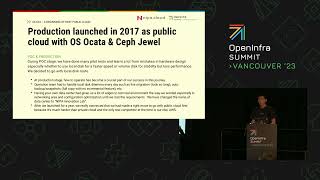
OpenStack Ocata as Public Cloud - A Production Use Case Study
Discover how OpenStack Ocata powers NIPA's public cloud infrastructure, featuring container integration, Ceph storage, and successful scaling strategies for managing 600+ VMs and increased network workloads.
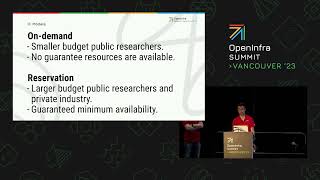
One Nova Cluster to Serve Multiple Computing Needs - Managing On-Demand and Dedicated Instances
Discover how San Diego Supercomputer Center efficiently manages a unified nova cluster serving diverse user needs, from on-demand instances to dedicated hosts, using OpenStack, Ceph, and custom Python solutions.
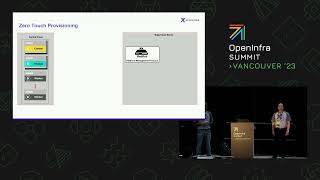
StarlingX at Scale - Infrastructure Management of Distributed Edge Clouds
Explore StarlingX's solutions for managing large-scale edge computing deployments, focusing on zero-touch provisioning and multi-level orchestration for efficient far edge cloud operations.
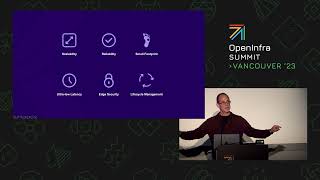
Enabling the Intelligent Edge with StarlingX
Explore StarlingX's cloud infrastructure capabilities for distributed edge computing, focusing on high availability, low latency, and integration across various industry verticals from core to far edge systems.
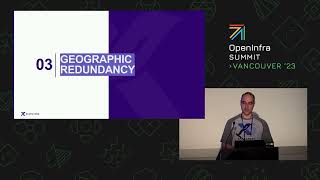
StarlingX Evolution - New Deployment Architectures for Distributed Cloud Systems
Explore StarlingX's enhanced distributed cloud architecture featuring geographic redundancy, flexible network design, and hybrid-cloud capabilities for large-scale deployments across industries.

NoSQL Database Fundamentals - Architecture, Modeling and Querying
Dive into NoSQL fundamentals, exploring data modeling, architecture principles, and essential querying techniques while comparing SQL and NoSQL approaches for high-performance databases.
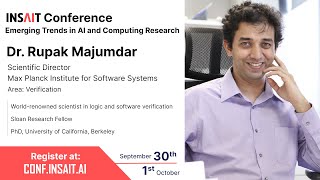
How to Randomly Test Programs and Why Random Tests Are Good
Discover effective random testing techniques for distributed systems, exploring combinatorial insights, probabilistic methods, and fuzzing strategies for ensuring program reliability.
Living on the Edge - Kubernetes as Software Delivery Mechanism for the Far Edge
Discover how to deploy and manage ultra-small Kubernetes edge clusters with minimal resources, enabling automated workload delivery and secure connectivity for remote industrial applications and sensor arrays.
Using OpenStack to Enable High Availability Workloads Across Multiple Availability Zones and Regions for Disaster Recovery
Discover how to implement high availability in OpenStack through multi-zone and multi-region architecture, focusing on enterprise-grade disaster recovery solutions and infrastructure deployment strategies.
Practices of Kafka Cloud-Native Architecture
Discover how XiaoHongShu implements Kafka cloud-native architecture, exploring real-world practices, data storage solutions, and messaging engine optimization in large-scale deployments.
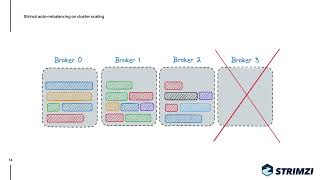
Strimzi Auto-rebalancing on Cluster Scaling - Feature Overview and Demo
Discover how to implement auto-rebalancing features in Strimzi 0.44.0 for efficient cluster scaling through a practical demonstration of problem-solving approaches and usage techniques.
Inside the Cloud: A Deep Dive into Cold Data Archiving
Dive into cloud-based cold data archiving strategies, exploring leading systems like AWS S3/Glacier and Azure Archive Storage while mastering distributed storage management, data integrity, and enterprise-level implementation.
The European Computing Continuum - Initiatives, Community, and Directions
Explore the evolving landscape of European computing initiatives, examining key developments in cloud, edge, and IoT technologies while understanding future directions and community impact.
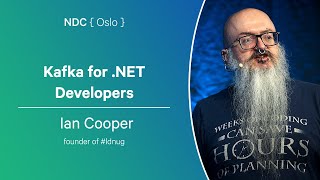
Kafka for .NET Developers
Discover how to leverage Kafka's streaming capabilities in .NET applications, from basic concepts like records and offsets to advanced features including Connect and Flink, with practical code examples.
Security Pitfalls in Distributed Erlang and Elixir Systems
Discover essential security vulnerabilities and protective measures for distributed systems built with Erlang and Elixir, focusing on common pitfalls and their solutions.
Cloud Foundry - Inside a Private PaaS
Explore Cloud Foundry's open-source PaaS, its enterprise benefits, implementation, and robust distributed system architecture. Learn about resource management, routing, and deployment options.
Say YES! to NoSQL - A Guide on When to Ditch Relational Databases - Adrienne Tacke - NDC Sydney 2020
Explore NoSQL databases, their advantages over relational databases, and learn when to choose them for modern applications. Gain insights into CAP theorem, ACID vs BASE properties, and data characteristics.
Say YES! to NoSQL - A Guide on When to Ditch Relational Databases - Adrienne Tacke
Explore NoSQL databases, their advantages over relational models, and learn when to adopt them for modern application development. Gain insights into data models, CAP theorem, and decision-making criteria.

From Python to PySpark and Back Again - Unifying Single-Host and Distributed Deep Learning with Maggy
Unifying single-host and distributed deep learning with Maggy framework, enabling seamless transition from laptop to cluster for efficient model development and training using TensorFlow and PySpark.
Supercharge Your Data Graph with Apollo Federation
Explore Apollo Federation for efficient GraphQL API management, enabling distributed architecture and seamless data graph consolidation without compromising developer velocity or API flexibility.
Developing Event-Driven Microservices with Event Sourcing and CQRS - Philly ETE 2015
Explore event-driven microservices architecture using event sourcing and CQRS. Learn to solve distributed data management problems, maintain consistency, and build scalable cloud-native applications.