Wasserstein Gradient Flows and Applications to Sampling in Machine Learning - Lecture 3
Explore Wasserstein gradient flows and their applications to sampling in machine learning with Anna Korba's advanced lecture on this complex mathematical topic.
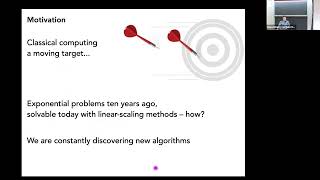
Revisiting the Classics: Turning Old Ideas into New Methods with Tensor Networks
Explore innovative approaches to high-dimensional problem-solving by combining classic methods with tensor networks, unlocking new possibilities in quantum simulations and differential equations.
Modified Scattering for the Three Dimensional Maxwell-Dirac System
Explore global well-posedness and modified scattering for the massive Maxwell-Dirac equation in R3+1, focusing on small, localized initial data and novel approaches to Dirac equations.
Diffusion Models for Solving Forward and Inverse Problems in PDEs - Tutorial 3
Explore diffusion models for solving forward and inverse problems in partial differential equations with expert Tony Zhuang.
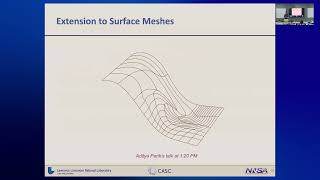
Interpolation at Arbitrary Points in High-Order Meshes on GPUs
Discover advanced techniques for arbitrary point interpolation in high-order mesh computations, focusing on GPU optimization and parallel processing for efficient scientific simulations.
Absolute Continuity of the Robin Harmonic Measure on Rough Domains
Delve into advanced mathematical analysis exploring Robin harmonic measure's absolute continuity on rough domains, connecting to lung modeling and boundary value problems in physics.
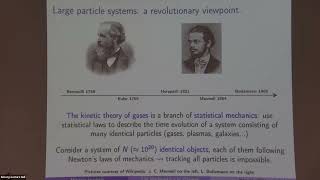
Challenges and Breakthroughs in the Mathematics of Plasmas
Explore fundamental mathematical concepts in plasma physics, focusing on Vlasov equations, kinetic theory, and new Wasserstein-type distances for analyzing charged particle behavior.
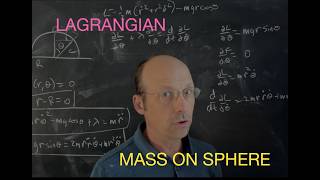
Lagrangian Mechanics - Mass Sliding Off a Frictionless Sphere Using Lagrange Multipliers
Explore the physics of a mass sliding off a frictionless sphere through Lagrangian mechanics and Lagrange multipliers, with practical Python implementation and visual demonstrations.
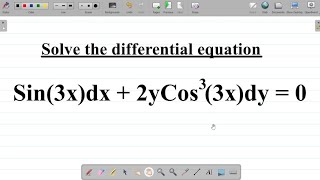
Solving Differential Equations Using the Variable Separation Method
Master the variable separation method for solving first-order differential equations through a clear, step-by-step demonstration of this fundamental mathematical technique.
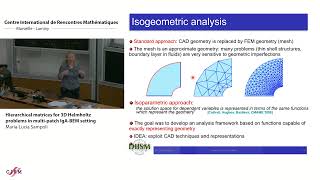
Hierarchical Matrices for 3D Helmholtz Problems in Multi-patch IgA-BEM Setting
Delve into advanced mathematical concepts of hierarchical matrices for 3D Helmholtz problems, exploring their application in multi-patch IgA-BEM frameworks through expert analysis and demonstrations.

Mathematical Modelling of Microtube Driven Invasion of Glioma
Explore mathematical modeling techniques for understanding glioma invasion through microtubes, featuring advanced research insights and theoretical frameworks for cancer progression analysis.
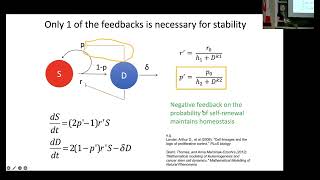
Mathematical Models of the Hematopoietic System at Homeostasis and the Clonal Evolution of Cells
Explore mathematical modeling approaches to understand hematopoietic system homeostasis and cellular clonal evolution patterns in cancer development and progression.
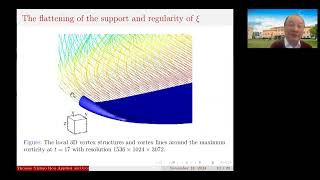
Potentially Singular Behavior of the 3D Incompressible Navier-Stokes Equations
Delve into advanced mathematical analysis exploring potential singularities in 3D incompressible Navier-Stokes equations, with insights from leading researcher Thomas Hou.
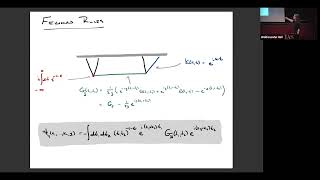
Kinematic Flow and Differential Equations for Cosmological Correlators
Explore advanced mathematical concepts in cosmological correlators, focusing on kinematic flow and differential equations through fundamental physics principles and theoretical frameworks.
Sharp Strichartz Estimates via Hermite Polynomials and Hypercontractivity
Delve into advanced mathematical concepts exploring Schrödinger propagator inequalities through pseudo-conformal transformation and hypercontractivity in Gauss space, featuring Hermite polynomials applications.
Recent Progress in Mean Curvature Flow
Delve into advanced mathematical concepts of mean curvature flow, exploring recent breakthroughs in singularity formation and the resolution of the Multiplicity One Conjecture.
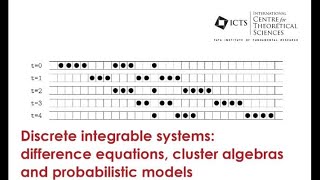
Entanglement Transitions in Non-Hermitian Integrable Floquet Systems
Explore quantum entanglement transitions and their behavior in non-Hermitian integrable Floquet systems through advanced theoretical physics concepts and mathematical frameworks.
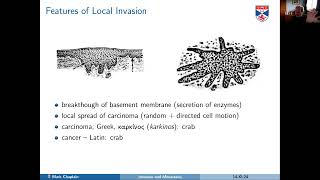
Mathematical Oncology: Invasion and Metastatic Spread
Explore the mathematical modeling of cancer invasion and metastasis through advanced mathematical oncology concepts, focusing on tumor spread patterns and biological mechanisms.
Advection-Diffusion Problems on Polygonal Meshes
Explore advanced mathematical techniques for solving advection-diffusion PDEs on polygonal meshes, covering high-order finite elements, WENO methods, and practical applications in geosciences.
The Study of the Prandtl System and Zero Viscosity Limit in Navier-Stokes Equations
Delve into advanced mathematical analysis of the Prandtl system, boundary layer evolution, and zero viscosity limits in Navier-Stokes equations with expert insights from NYU researcher Nader Masmoudi.
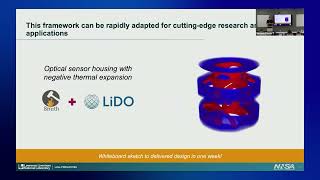
Automatic Parameter Sensitivities in Serac for Engineering Applications
Discover how to leverage automatic parameter sensitivities in Serac for engineering applications, featuring robust nonlinear solvers, coupled thermal-mechanics, and differentiable material models for optimization workflows.