Optimal Transportation, Monge-Ampère Equations and Riemannian Ricci Bounds - Lecture 1
Explore optimal transportation, Monge-Ampère equations, and Riemannian Ricci bounds in this advanced mathematics lecture by L. Ambrosio from Scuola Normale Superiore di Pisa.
New Approaches in Simulation of Transition Paths - IPAM at UCLA
Explores tensor methods for simulating chemical transition processes, focusing on compressing high-dimensional PDE functions and introducing a novel tensor-network generative modeling approach without optimization.
Gradient Descent, Stochastic Gradient Descent, and Acceleration - Part 2
Explore advanced gradient-based optimization methods for large-scale machine learning, including stochastic gradient descent and accelerated versions, with convergence analysis and ODE connections.
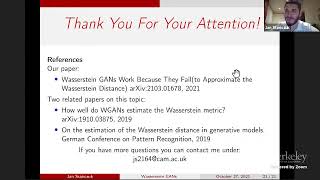
Wasserstein GANs Work Because They Fail - to Approximate the Wasserstein Distance
Explore the counterintuitive success of Wasserstein GANs despite their failure to accurately approximate the Wasserstein distance, offering insights into their effectiveness in generative modeling.
Deep Learning Approaches in Inverse Problems by Deep Ray
Explore deep learning techniques for solving inverse problems in various fields, focusing on applications, challenges, and recent advancements in this cutting-edge area of research.
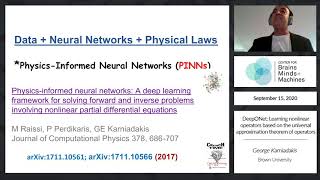
DeepOnet - Learning Nonlinear Operators Based on the Universal Approximation Theorem of Operators
Learn to approximate nonlinear operators using DeepONet, a neural network architecture based on the universal approximation theorem. Explore applications in differential equations, fluid mechanics, and multiphysics problems.
Spacetime Topological Defect Networks and Floquet Codes - Dominic Williamson
Explores topological defect networks and Floquet codes in quantum systems, covering anyons, toric code, TQFT dynamics, and spacetime defects. Provides insights for researchers in integrable models and quantum physics.
Provably Efficient Quantum Algorithms for Nonlinear Dynamics and Machine Learning
Explore quantum algorithms for nonlinear dynamics and machine learning, including efficient solutions for differential equations and training sparse neural networks with potential quantum enhancements.
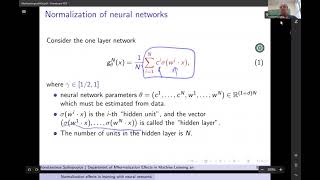
Normalization Effects on Neural Networks: Generalization and High-Dimensional Applications - SIAM FME Talk
Exploring neural network performance, normalization effects, and high-dimensional PDE solving using deep learning. Insights on generalization properties and applications in mathematical finance.

Neural ODEs - From ResNet to Continuous-Time Machine Learning
Explore Neural ODEs: a powerful machine learning approach for learning ODEs from data. Discover its advantages over ResNet and extensions like HNNs and LNNs.
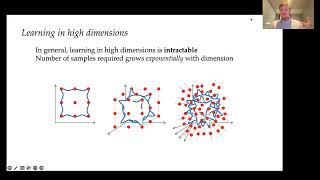
Geometric Deep Learning - Graph Neural Networks and Differential Equations
Explore Graph Neural Networks, symmetry principles, and connections to differential equations, geometry, and topology in this comprehensive introduction to Geometric Deep Learning.
Score Matching via Differentiable Physics
Explore score matching via differentiable physics for inverse problems. Learn about combining physics operators with stochastic differential equations to generate plausible trajectories towards given end states.
Converging Advances to Accelerate Molecular Simulation
Explore advances in molecular simulation through deep learning, ASIC architectures, and quantum computation. Discover potential applications in sustainable technologies, drug development, and material design.
Reflected Diffusion Models: Principled Data Constraints in Generative Modeling
Explore reflected diffusion models for improved image generation. Learn about reversing stochastic differential equations, addressing numerical errors, and incorporating data constraints in principled ways.
GenPhys: From Physical Processes to Generative Models
Explore how physical processes inspire new generative models, including diffusion and Poisson flow. Learn to translate PDEs into AI algorithms and expand the design space of generative approaches.
An Optimal Control Perspective on Diffusion-Based Generative Modeling
Explore optimal control theory's connection to diffusion-based generative modeling. Gain insights into stochastic differential equations, Hamilton-Jacobi-Bellman equations, and novel sampling methods for unnormalized densities.
Transport, Variational Inference and Diffusions
Explore connections between optimal transport and variational inference, focusing on stochastic differential equations and Girsanov transformations. Discover novel sampling and generative modeling techniques.
Action Matching: Learning Stochastic Dynamics from Samples
Explore Action Matching for learning stochastic dynamics from samples. Discover applications in quantum systems, biology, and generative modeling. Gain insights into novel approaches for simulating trajectories.
Stochastic Interpolants: A Unifying Framework for Flows and Diffusions - Lecture
Explore a unified framework for generative models, bridging flow-based and diffusion-based methods using stochastic interpolants. Learn about probability flow equations, likelihood estimation, and applications in AI for drug discovery.
Hierarchical Component-Based Modeling with ModelingToolkit.jl
Explore hierarchical component-based modeling using ModelingToolkit.jl for efficient simulation of complex systems. Learn to build, simplify, and analyze large-scale models with Julia's SciML ecosystem.
Opportunities for Infusing Physics into AI - ML Algorithms
Explore the fusion of physics and AI algorithms, covering neural programming, hierarchies, equations, and applications in autonomous systems and technology.