Speeding up Langevin Dynamics by Mixing
Explore a method to accelerate Langevin dynamics using mixing drift, improving convergence to stationary distribution in polynomial time for systems with multiple local minima.
Magnetohydrodynamic Turbulence - Weak Solutions and Conserved Quantities
Explore magnetohydrodynamic turbulence, weak solutions, and conserved quantities in ideal systems. Analyze the mathematical structures behind Taylor-Woltjer relaxation theory and Faraday systems.
Effective Gaps for Time-Periodic Hamiltonians Modeling Floquet Materials
Exploration of Floquet materials and their energy transport properties, focusing on effective quasi-energy gaps in parametrically forced Schrödinger equations and their implications for band-limited Dirac wave-packets.
Optimal Shape of Tree Roots and Branches - Seminar in Analysis and Methods of PDE
Explore mathematical models for optimal shapes in nature, focusing on tree roots and branches. Examine functionals for sunlight capture and nutrient collection, combined with transportation costs.
Survey of the Benjamin-Ono Equation with Periodic Boundary Conditions
Explore the Benjamin-Ono equation's dynamics, including explicit solutions, well-posedness, and long-term behavior, with insights from Lax pair analysis in periodic boundary conditions.
Coarse-graining, Renormalization, and Quantitative Homogenization in PDE Analysis
Explore quantitative homogenization in elliptic and parabolic equations, focusing on coarse-graining and renormalization techniques. Discuss applications to degenerate equations and mathematical physics models.
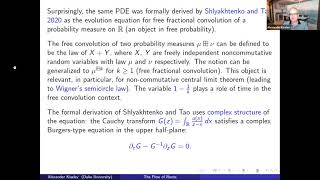
The Flow of Polynomial Roots Under Differentiation - SIAM PDE Seminar
Explores the movement of polynomial roots under differentiation, connecting it to a hydrodynamic PDE model similar to those in mathematical biology, with focus on global regularity and trigonometric polynomials.
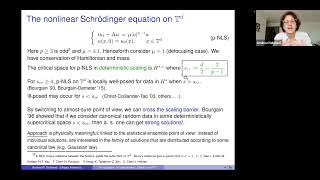
Gibbs Measures and Propagation of Randomness in Nonlinear Dispersive PDE
Explore Gibbs measures and randomness propagation in nonlinear dispersive PDE flows with Andrea R. Nahmod. Gain insights into advanced mathematical concepts and their applications in this engaging seminar.

Directed Mean Curvature Flow in Noisy Environment
Explore directed mean curvature flow in noisy environments and its connection to the KPZ equation through advanced mathematical analysis and stochastic PDEs.
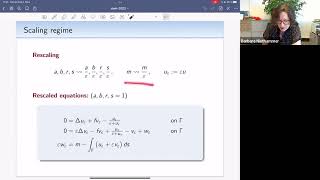
An Obstacle Problem for Cell Polarization
Explore cell polarization modeling through diffusion equations and reaction-diffusion systems. Discover obstacle-type problems, steady-state stability, and polarization onset parameters in this mathematical biology seminar.
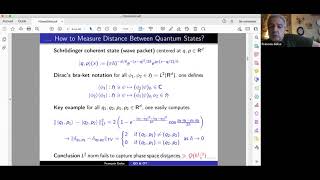
Quantum Dynamics and Optimal Transport
Explore quantum dynamics and optimal transport with François Golse, discussing the application of Monge's theory to quantum states and its implications for mean-field and classical limits in quantum mechanics.
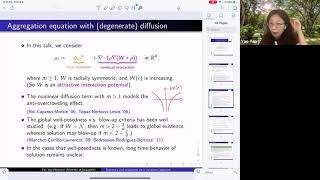
Symmetry and Uniqueness in Nonlocal PDEs - A Variational Approach
Explore symmetry and uniqueness in nonlocal PDEs using variational approaches. Yao Yao discusses recent progress in aggregation-diffusion equations and 2D Euler equations, focusing on steady states and radial symmetry.
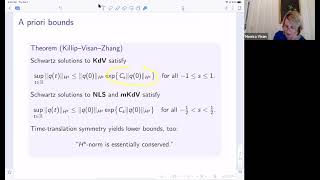
Determinants, Commuting Flows, and Recent Progress on Completely Integrable Systems
Explore recent developments in completely integrable nonlinear dispersive PDE, including a priori bounds, orbital stability, well-posedness, and Gibbs distributed initial data dynamics.

Generic Regularity in Obstacle Problems - SIAM PDE Seminar
Explore the generic regularity in obstacle problems with Alessio Figalli. Learn about recent advancements in understanding singular sets and their codimension within free boundaries in elastic membrane equilibrium.
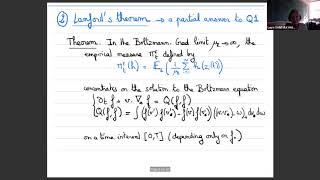
Fluctuation Theory in the Boltzmann-Grad Limit
Explore fluctuation theory in the Boltzmann-Grad limit for hard-sphere gases, examining dynamical correlations and their implications for the kinetic Boltzmann equation and large deviation asymptotics.
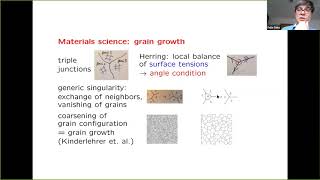
The Thresholding Scheme for Mean Curvature Flow and De Giorgi's Ideas for Gradient Flows
Explores the thresholding scheme for mean curvature flow in multi-phase systems, its applications in grain growth, and convergence proofs based on De Giorgi's gradient flow ideas.
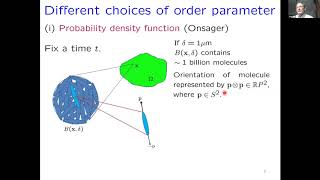
Energy Minimization Problems for Liquid Crystals - SIAM PDE Seminar
Explore energy minimization in liquid crystals through probability density, tensor averages, and molecular orientation theories with Sir John Ball.
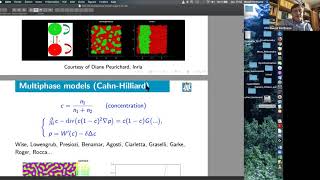
Multiphase Models of Living Tissues and the Hele-Shaw Limit
Explore multiphase models of living tissues, focusing on mechanical modeling for tissue repair and tumor growth. Discover mathematical analysis techniques and incompressible limit cases in this advanced PDE seminar.
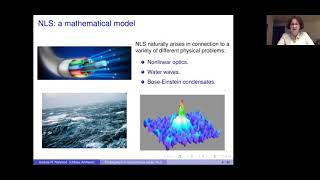
Propagation of Randomness Under the Flow of Nonlinear Dispersive Equations
Explore the propagation of randomness in nonlinear dispersive equations with Andrea R. Nahmod, delving into advanced mathematical concepts and their applications in this insightful lecture.
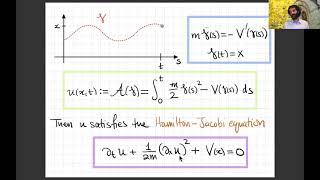
The Hamilton-Jacobi Equation: Past and Present
Explore the historical and contemporary significance of the Hamilton-Jacobi equation in mathematics with insights from Ryan Hynd of the University of Pennsylvania.
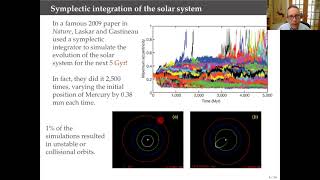
Structure Preservation in the Discretization of Partial Differential Equations
Explore structure preservation techniques in discretizing partial differential equations, enhancing numerical accuracy and stability in computational mathematics.