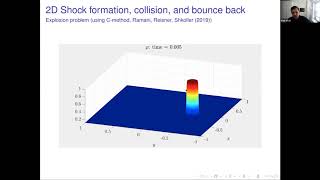
Shock Formation and Vorticity Creation for Compressible Euler
Exploration of shock formation and vorticity creation in compressible Euler equations, featuring constructive proofs, self-similar variables, and analysis of singularities in multiple dimensions.
Can You Define Trig Functions via a Differential Equation
Explore an unconventional approach to defining trigonometric functions using differential equations, offering a fresh perspective on these fundamental mathematical concepts.
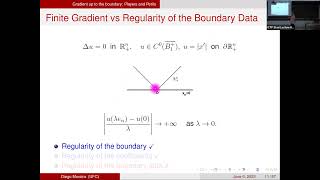
Analysis Seminar - Up to the Boundary Gradient Estimates in Bernoulli Type Free Boundary Problems
Explore recent advances in gradient estimates for viscosity solutions of free boundary problems, featuring new Inhomogeneous Pucci Barriers and innovative proof techniques inspired by Harmonic Analysis.
Introduction to Theory and Numerics of Partial Differential Equations - Lecture 5
Explore numerical methods for solving partial differential equations, focusing on techniques essential for gravitational wave astronomy and computational relativity.

Introduction to Theory and Numerics of Partial Differential Equations - Lecture 2
Explore numerical methods for solving partial differential equations, focusing on techniques essential for gravitational wave astronomy and computational relativity.
Introduction to Theory and Numerics of Partial Differential Equations - Lecture 3
Explore numerical methods for solving partial differential equations, focusing on techniques essential for gravitational wave astronomy and computational relativity.
Introduction to Theory and Numerics of Partial Differential Equations - Lecture 1
Explore fundamental concepts and numerical techniques for solving partial differential equations, essential for modeling complex physical phenomena in gravitational-wave astronomy and astrophysics.
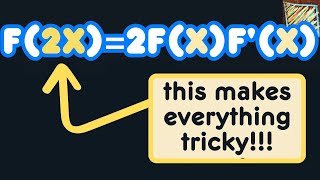
A Suspicious and Tricky Combination - A Functional-Differential Equation
Explore the intriguing world of functional-differential equations, combining two complex mathematical concepts for a challenging and insightful problem-solving experience.
Boundary-Value Problems for a Linear Loaded Integro-Differential Equation
Explores boundary-value problems for linear loaded integro-differential equations, discussing mathematical techniques and applications in theoretical physics and engineering.
Boundary Problems for Incompressible Fluids by Senjo Shimizu
Exploration of free boundary problems in incompressible fluid dynamics, discussing mathematical approaches and recent developments in this complex area of fluid mechanics.
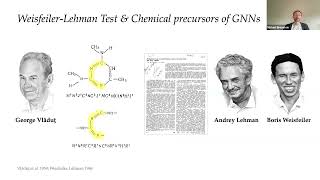
Michael Bronstein: Physics-Inspired Graph Neural Networks
Explore physics-inspired continuous learning models for graph neural networks, leveraging tools from differential geometry and algebraic topology to enhance expressive power beyond traditional message-passing paradigms.
Physics-Inspired Learning on Graph - Michael Bronstein, PhD
Explore physics-inspired continuous learning models for graphs, challenging traditional message-passing paradigms. Discover new approaches using differential geometry, algebraic topology, and differential equations to revolutionize graph machine learning.
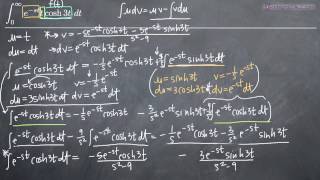
Laplace Transforms and Integration by Parts with Three Functions
Learn advanced techniques for solving Laplace transforms using integration by parts with three functions. Master this crucial concept in differential equations to enhance problem-solving skills.
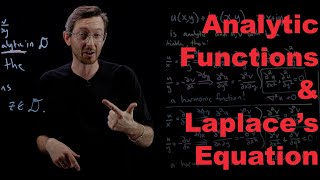
Complex Analysis - Analytic Functions Solve Laplace's Equation
Explore how analytic complex functions' real and imaginary parts solve Laplace's equation, introducing harmonic functions in this in-depth mathematical analysis.
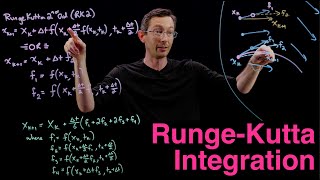
Runge-Kutta Integrator Overview - All Purpose Numerical Integration of Differential Equations
Comprehensive introduction to Runge-Kutta schemes for numerical integration of differential equations, covering RK2 and RK4 methods with intuitive explanations and visual representations.
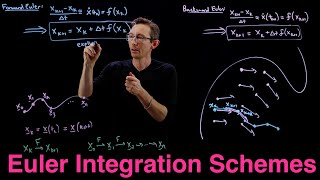
Deriving Forward Euler and Backward-Implicit Euler Integration Schemes for Differential Equations
Explore Forward and Backward Euler integration methods for ODEs, including derivations, error sources, and stability analysis. Gain insights into numerical integration techniques for solving differential equations.
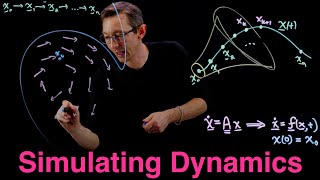
Numerical Simulation of Ordinary Differential Equations - Integrating ODEs
Explore numerical integration of ODEs to analyze nonlinear systems and generate trajectories. Learn techniques for solving complex dynamics where analytic methods fall short.
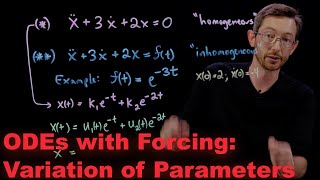
Differential Equations with Forcing: Method of Variation of Parameters
Learn to solve forced linear differential equations using the powerful method of variation of parameters, replacing unknown coefficients with time-dependent functions based on external forcing.
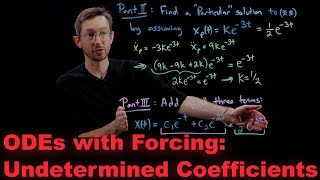
Differential Equations with Forcing: Method of Undetermined Coefficients
Learn to solve linear differential equations with external forcing using the method of undetermined coefficients. Understand homogeneous solutions, particular solutions, and how to combine them for a complete solution.

Deriving the Heat Equation in 2D and 3D and in N Dimensions with Control Volumes and Vector Calculus
Explore the derivation of the heat equation in multiple dimensions using Gauss's theorem, control volumes, and vector calculus techniques for a comprehensive understanding of heat transfer.

Partial Differential Equations Overview
Explore the mathematical language of physical phenomena with an overview of partial differential equations, covering canonical PDEs, linear superposition, and nonlinear PDEs like Burgers Equation.