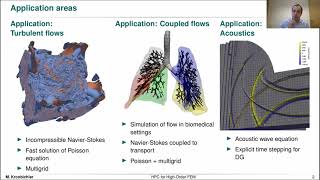
High-Performance Implementations for High-Order Finite-Element Discretizations of PDEs
Explore matrix-free finite-element algorithms for solving PDEs, focusing on high-performance implementations and recent developments in performance engineering for complex geometries.
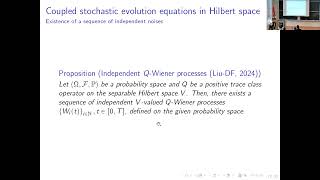
Hilbert-Space Valued LQ Mean Field Games - An Infinite-Dimensional Analysis
Explore infinite-dimensional analysis of Hilbert-space valued LQ mean field games, delving into advanced mathematical concepts and their applications in finance.
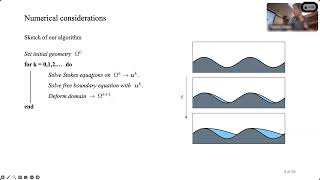
Numerical Solvers for Viscous Contact Problems in Glaciology
Explore numerical solvers for viscous contact problems in glaciology, focusing on ice flow modeling, subglacial cavities, and marine ice sheet dynamics. Overcome computational challenges in Stokes equations.
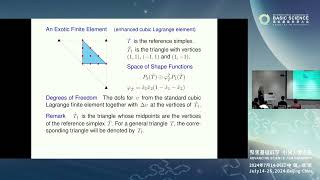
A Nonlinear Least-squares Finite Element Method for the Monge-Ampere Equation
Explore a nonlinear least-squares finite element method for solving the Monge-Ampere equation, focusing on smooth convex solutions and innovative degrees of freedom.

Control Systems: An Overview - From Differential Equations to Controller Design and Deployment
Explore control systems, from differential equations to controller design and deployment, with streamlined workflows for effective system management and optimization.
A Potential Approach for One-Dimensional Price Formation Models
Explore a novel approach to solving first-order mean-field games in price formation using Poincaré's Lemma and potential functions, with applications to linear-quadratic models.
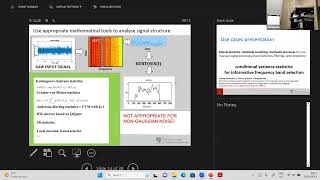
How Math Can Help with Engineering Problems
Odkryj, jak matematyka rozwiązuje problemy inżynieryjne, wykorzystując zaawansowane metody i narzędzia do analizy złożonych systemów technicznych.
Sharp Restriction Theory - Part 1
Explore advanced concepts in sharp restriction theory, focusing on key principles and applications in mathematical analysis.

Mathematical Oncology: Insights into Cancer Treatment from a Mathematical Perspective
Explore mathematical models for cancer treatment, gaining insights into tumor growth, drug delivery, and therapeutic strategies from a quantitative perspective.
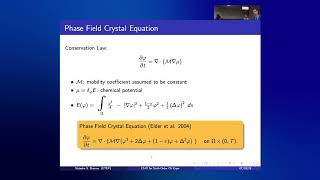
Continuous Interior Penalty Method Framework for 6th Order Cahn-Hilliard Equations
Explore unconditionally stable numerical methods for sixth-order Cahn-Hilliard equations, focusing on crystal growth and microemulsion systems. Gain insights into complex physical phenomena modeling.
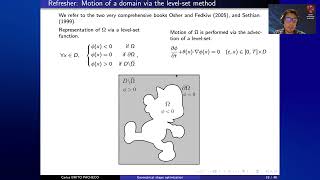
Rodin: Density and Topology Optimization Framework - MFEM Workshop 2022
Explore Rodin, a C++17 framework for shape, density, and topology optimization. Learn its functionalities, from refining shapes to solving variational problems in scientific simulations.
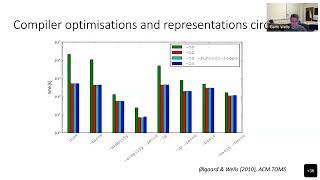
FEniCSx: Design of the Next Generation FEniCS Libraries for Finite Element Methods
Explore FEniCSx, the next-gen finite element library. Learn design improvements, high-performance kernels, and flexible solver creation in C++ or Python for partial differential equations.
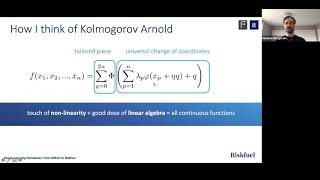
Deeply Learning Derivatives - From Hilbert to Riskfuel
Explore advanced derivatives pricing using deep learning, from Hilbert's 13th problem to modern neural networks for valuing high-dimensional contingent claims in quantitative finance.
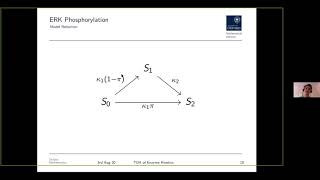
Geometric and Topological Data Analysis of Enzyme Kinetics
Explore geometric and topological data analysis techniques applied to enzyme kinetics, focusing on ERK molecular dynamics and its implications for cancer and developmental defects.
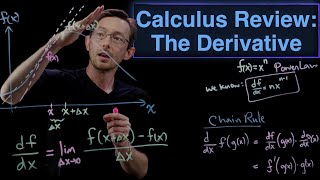
Calculus Review - The Derivative, the Power Law, and the Chain Rule
Comprehensive review of derivatives, power law, and chain rule in calculus. Essential concepts for understanding differential equations and dynamical systems.
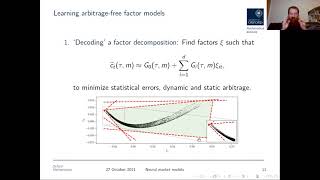
Arbitrage-Free Neural-SDE Market Models
Explore neural-SDE market models for arbitrage-free pricing, combining machine learning with stochastic differential equations in quantitative finance.

Risk Management of Option Books with Arbitrage-Free Neural-SDE Market Models
Explore advanced risk management techniques for option books using arbitrage-free neural-SDE market models, covering nonparametric modeling, inference, and hedging strategies with real-world applications.
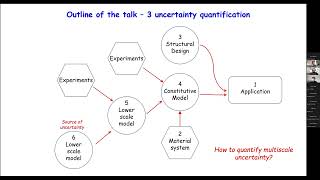
Learning-Based Multiscale Modelling: Computing, Data Science, and Uncertainty Quantification
Explore machine learning frameworks for multiscale modeling in materials science, including Fourier and recurrent neural operators, to accelerate computations and bridge scales across multiple physics levels.
Enhancing Scientific Computing Through Physics-Informed Neural Networks
Explore physics-informed neural networks (PINNs) as an alternative to traditional scientific computation, addressing challenges in high-dimensional problems and incorporating noisy data in inverse problems.

Exploring Variational Functions - Calculus of Variations and Geometric Measure Theory
Dive into variational problems and bounded Hessian functions with Luigi Ambrosio. Explore the intersection of Calculus of Variations and Geometric Measure Theory, inspired by machine learning insights.
Adaptive Regularization and Linearization for Nonsmooth and Degenerate Problems
Explore advanced mathematical techniques for solving nonsmooth and degenerate problems in flow and transport, focusing on adaptive regularization methods and Newton-based linearization approaches.