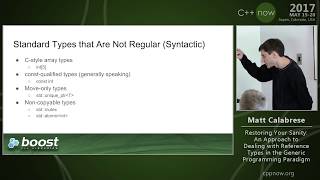
An Approach to Dealing with Reference Types in the Generic Programming Paradigm
Explore handling reference and proxy types in generic programming, discussing challenges, semantics, and potential solutions for future datastructures. Audience participation encouraged.

The Holy Grail - A Persistent Hash-Array-Mapped Trie for C++
Exploring Hash-Array-Mapped Tries: A persistent, efficient data structure for C++ that combines tree and hash table characteristics, offering superior memory efficiency and immutability benefits.
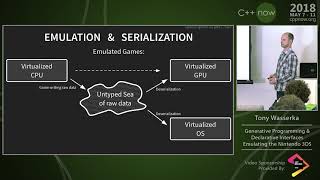
Generative Programming in Action - Emulating the 3DS
Explore generative programming in C++ for console emulation, focusing on the 3DS interprocess communication system. Learn to balance performance, maintainability, and correctness using modern C++ techniques.
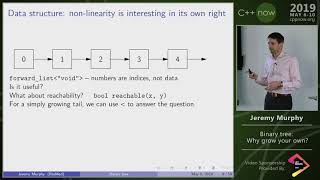
A Generic Binary Tree - Why Grow Your Own?
Explore the design and implementation of a generic binary tree for Boost.Graph, discussing trade-offs, storage options, and performance comparisons while drawing insights from classic computer science texts.

How to - Colony
Dive deep into the mechanics of the colony container, exploring its implementation details, performance optimizations, and potential applications in C++ programming.
The Performance Price of Dynamic Memory in C++
Explore performance impacts of dynamic memory in C++, covering allocation costs, memory access patterns, and cache-aware design principles with practical examples and solutions.

Variations on Variants
Explore std::variant in C++, its implementation, and alternative approaches for serialization. Learn about Intrusive-Variant and Variant-of-Base techniques, and gain insights into modernizing C-style code with variants.

A Lock-free Atomic shared_ptr
Explore lock-free atomic shared_ptr implementation for C++, discussing motivation, existing solutions, and a new portable open-source implementation for low-latency applications.
Binary Object Serialization
Explore minimally intrusive binary object serialization techniques for C++, including hierarchical data traversal, dynamic reconstruction, and optimizations using Template Argument Deduction and reflection.
Rehashing Hash Tables and Associative Containers
Explore novel improvements in generic programming for associative containers, including performance enhancements, API design, and compile-time perfect hash tables. Learn advanced C++ techniques for efficient key-value mapping.
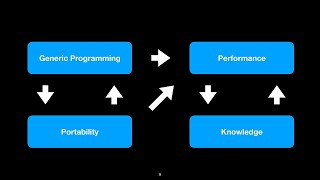
How Generic Programming and C++ Portability Give Great Performance and Knowledge of What Performs Well
Explore how generic programming in C++ enables high performance, adaptability, and insights into hardware capabilities through configurable hash table implementations.
C++ Loves Python - From Modules to Hybrid Applications
Explore integrating C++ with Python to create powerful hybrid applications and extend existing C programs with Python scripting capabilities, enhancing performance and functionality.

Type Hints - Putting More Buzz in Your Fizz
Explore type hints in Python, from basics to complex structures. Learn debugging techniques, class definitions, and library stubs. Enhance code quality and confidence through practical examples.
Dashboards for All
Learn to create interactive dashboards using Python libraries like Bokeh and Panel. Explore data visualization techniques, analyze diverse datasets, and tell compelling stories through customized, user-friendly interfaces.
Using Declarative Configs for Maintainable Reproducible Code
Explore declarative configs for maintainable, reproducible code. Learn input formats, representations, deserialization, and type-safety. Discover strategies for evolving configs while preserving backwards compatibility.
No, Maybe and Close Enough - Using Probabilistic Data Structures in Python
Explore probabilistic data structures in Python for efficient counting and item recognition, focusing on Hyperloglog and Bloom Filter algorithms for fast, scalable solutions.
Serialization - More Than Pickling
Explore alternatives to Python's pickle for object serialization, comparing efficiency and security considerations for different methods.
Distributed Web Scraping in Python
Learn to build a distributed web scraper in Python, reducing batch job times and improving code durability. Explore techniques, lessons, and stories for efficient large-scale web scraping.
Employing NumPy's NPY Format for Faster Than Parquet DataFrame Storage
Explore faster DataFrame storage using NumPy's NPY format, outperforming Parquet in read/write times while supporting all DataFrame characteristics and NumPy dtypes.
Effective Protobuf - Everything You Wanted to Know, But Never Dared to Ask
Comprehensive exploration of Protocol Buffers, covering serialization, performance, encoding, and practical applications. Ideal for developers seeking to optimize data exchange in distributed systems.
How Pydantic V2 Leverages Rust's Superpowers
Explore how Pydantic V2 utilizes Rust to enhance performance, extensibility, and maintainability in data validation. Learn about architecture changes and real-world trade-offs in combining Python and Rust.