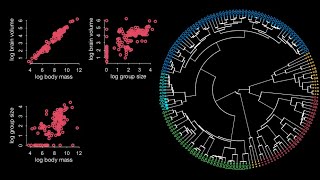
Statistical Rethinking 2022 - Gaussian Processes
Explore Gaussian processes, spatial confounding, and phylogenetic inference in statistical modeling. Learn to apply these concepts to real-world examples like oceanic covariance and primate phylogeny.
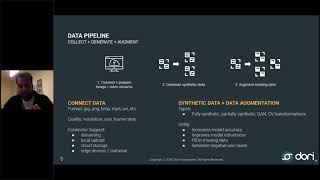
Building Scalable AI Computer Vision Applications
Standardized workflow for building scalable AI computer vision applications, covering data preparation, annotation, model selection, benchmarking, deployment, and monitoring for efficient development.
The Hamiltonian Monte Carlo Revolution Is Open Source - Probabilistic Programming with PyMC3
Explore Bayesian statistical computation and Hamiltonian Monte Carlo algorithms using PyMC3, an open-source probabilistic programming package. Learn to apply these advanced techniques to complex models in Python.
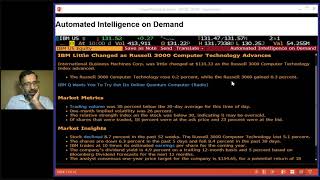
Automated Insights in Finance Using Machine Learning & AI
Explore AI and ML techniques for extracting actionable insights from alternative data sources in finance, leading to profitable trading strategies and robust portfolio construction.
Machine Learning for Continuous Integration - Andrea Frittoli & Kyra Wulffert - ODSC Europe 2019
Explore machine learning techniques for analyzing CI/CD pipeline data, extracting insights, and automating failure identification using open-source tools like TensorFlow and Pandas with real-life OpenStack community data.
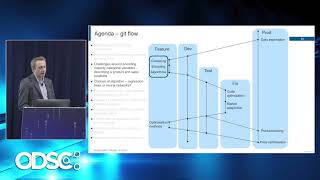
Price Optimisation - From Exploration to Productionising - David Adey, PhD & Alexey Drozdetskiy, PhD
Explore dynamic price optimization using machine learning, from data analysis to cloud deployment. Learn about feature encoding, model selection, efficiency improvements, and practical implementation strategies for revenue growth.
Towards Deep Learning Models Resistant to Adversarial Attacks
Explore deep learning model vulnerabilities and defense strategies against adversarial attacks, examining research findings and experimental results.
Overly Optimistic Prediction Results on Imbalanced Data - Flaws and Benefits of Over-sampling
Explore flaws and benefits of over-sampling in imbalanced datasets, examining prediction results and comparing studies to improve machine learning model performance.
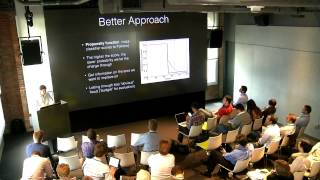
Counterfactual Evaluation of Machine Learning Models
Explore counterfactual evaluation techniques for machine learning models, focusing on charge outcomes and iterative improvements in financial technology applications.
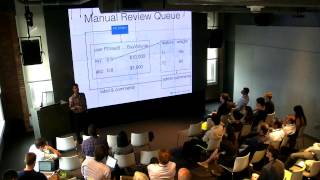
Fraud Detection in Bitcoin Payment Networks
Explore fraud detection in Bitcoin networks using machine learning, covering techniques like deep learning and entity recognition for effective cryptocurrency security.
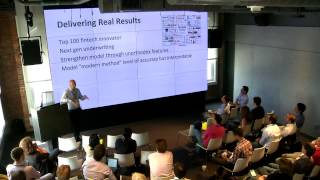
Applied Machine Learning for Startups - Arshak Navruzyan
Applied ML strategies for startups: practitioner training, team structures, guidelines, and cutting-edge techniques in NLP and deep learning.
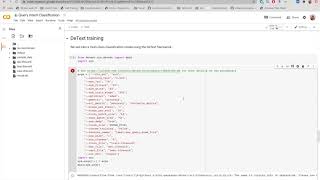
Deep Learning for Search and Recommender Systems in Practice - Part 2
Explore advanced techniques in deep learning for search and recommender systems, focusing on practical implementation and real-world applications at LinkedIn.
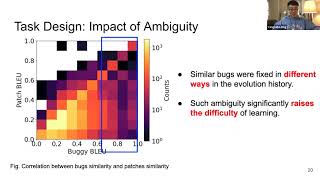
Patching as Translation: The Data and the Metaphor
Explore neural machine translation for code patching, examining data collection, task design, and architectural approaches to improve automated bug fixing in software development.

SIGCOMM 2020 - Server-Driven Video Streaming for Deep Learning Inference
Explore server-driven video streaming for deep learning inference, including real-time camera set heuristics, object detection, and experimental results.
Separations and Equivalences Between Turnstile Streaming and Linear Sketching
Explore streaming algorithms, linear sketching, and their equivalences. Learn about turnstile streaming, limitations, and separations in bounded-degree triangle counting and insertion-only algorithms.
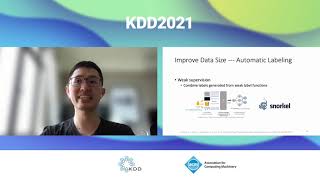
Towards an Easy-to-use AI Platform - Data, Algorithms, and Systems - Wei Wang
Explore the development of user-friendly AI platforms, covering data preparation, model construction, debugging, and deployment, with a focus on enhancing efficiency and accessibility.
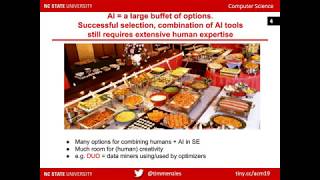
What Role for Programmers in the Age of AI
Exploring the evolving role of programmers in AI era, discussing synergies between data mining and optimization, and highlighting the continued importance of human expertise in software development.

End to End ML Project - Data Transformation Implementation Using Pipelines
Implement data transformation using pipelines for ML projects, covering categorical and missing value handling, standard scaling, and artifact storage.
Hands on Machine Learning - Unsupervised Learning
Explore unsupervised learning techniques including clustering, dimensionality reduction, and Gaussian mixture models. Hands-on implementation using Python libraries for data analysis and visualization.

Time Series Forecasting with XGBoost - Advanced Methods
Explore advanced time series forecasting with XGBoost, covering outlier removal, cross-validation, lag features, and future predictions. Enhance your skills in handling complex time-dependent data for improved forecasting accuracy.

Time Series Forecasting with XGBoost - Use Python and Machine Learning to Predict Energy Consumption
Learn to predict energy consumption using XGBoost and Python in this hands-on tutorial. Covers data preparation, feature engineering, model building, and forecasting techniques for time series analysis.