Database Fundamentals for Beginners - Database Tutorial
Comprehensive introduction to database concepts, covering normalization, relational databases, SQL, and administration fundamentals. Ideal for beginners preparing for Microsoft certification.
Machine Learning for Beginners - Data Scientists and Analysts
Comprehensive introduction to machine learning for data professionals, covering key concepts, techniques, and practical applications in business contexts, with hands-on coding examples.

Autoencoders Explained Easily
Intuitive explanation of autoencoders, covering key concepts like representation learning and latent space, with applications in data generation, denoising, and anomaly detection.
Recurrent Neural Networks Explained Easily
Explore Recurrent Neural Networks: architecture, time series, and Back Propagation Through Time. Learn about simple RNN units and their applications in sequence processing tasks.

Build a Spotify-Like Music Recommender System in Python
Create a Spotify-like music recommender system using Python, collaborative filtering, and Alternating Least Squares. Learn about music recommendation types, Spotify's architecture, and implement artist suggestions with the 'implicit' library.

Hybrid Classical-Quantum Algorithms
Explore hybrid algorithms combining quantum and classical computing for optimization and inference, leveraging strengths of both platforms to solve complex problems efficiently.

Discussion - Offline Reinforcement Learning
Explore offline reinforcement learning, covering data sets, optimism under uncertainty, state coverage, and policy evaluation. Gain insights into pragmatic and conceptual approaches.
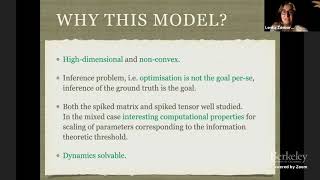
Insights on Gradient-Based Algorithms in High-Dimensional Learning
Explore gradient-based algorithms in high-dimensional learning, covering statistical physics solutions for performance analysis in nonconvex settings like spiked mixed matrix-tensor model, perceptron, and phase retrieval.
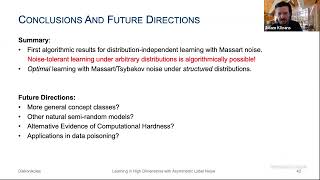
Recent Developments in Supervised Learning With Noise
Explore recent advancements in supervised learning with noise, focusing on high-dimensional scenarios, noise models, and innovative techniques to overcome learning challenges.
Neural Networks and Spurious Correlations
Explore neural networks' vulnerability to spurious correlations and strategies to enhance robustness, including reweighting, subsampling, and overcoming simplicity bias in machine learning models.
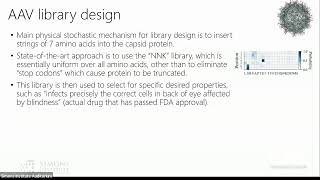
Machine Learning-Based Design of Proteins
Explore machine learning-based protein design with Jennifer Listgarten, covering directed evolution, predictive models, and optimization techniques for gene therapy applications.
Mind Over Data - The One Thing You Know and Machines Don't
Explore the intersection of human intuition and machine learning in causal reasoning, examining Bayesian networks, confounding factors, and real-world applications in AI and data analysis.
Federated Heavy Hitters Discovery with Differential Privacy
Explore federated learning, differential privacy, and heavy hitters discovery in this talk by Peter Kairouz. Learn about multiparty computation, open research, and practical applications in data analysis.
K-Means and K-Medians Under Dimension Reduction
Explore k-means and k-medians clustering algorithms under dimension reduction, examining distortion graphs, cost analysis, and combinatorial lemmas for robust high-dimensional statistics.
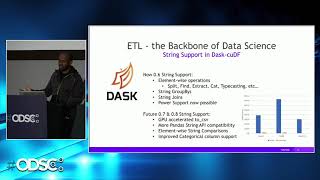
RAPIDS - The Platform Inside and Outside - Joshua Patterson - ODSC East 2019
Accelerating data science with GPUs using RAPIDS: open-source libraries for GPU-powered data manipulation, machine learning, and graph analytics, scaling across multiple GPUs and integrating with existing Python ecosystems.
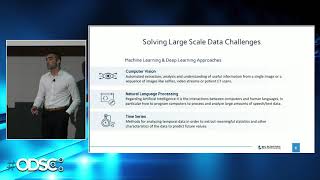
Practical AI Solutions Within Healthcare and Biotechnology - Michael Segala
Explore AI applications in healthcare, including image analysis, NLP, and time-series data. Learn about challenges, workflows, and real-world use cases in diagnostics and patient care.
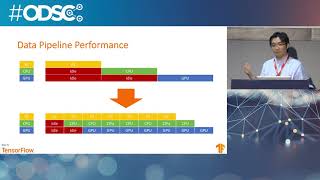
Deep Learning for Real Time Streaming Data with Kafka and TensorFlow - ODSC East 2019
Learn to process real-time streaming data using Apache Kafka and TensorFlow's KafkaDataset module for efficient machine learning applications in mission-critical scenarios.
Understanding Unstructured Data with Language Models - Alex Peattie
Explore language models for unstructured data analysis, covering classification, predictive modeling, and information retrieval. Learn key concepts and practical applications in various fields.
Boston Data Mining - A High-Performance Implementation of Bayesian Clustering
Explore Bayesian nonparametric methods and probabilistic machine learning, focusing on the Chinese Restaurant Process for clustering. Learn optimization strategies for applying these models to big data.
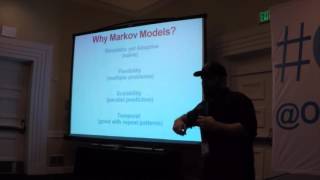
ODSC West 2015 - Hacking Machine Data
Explore techniques for analyzing machine data, including Hidden Markov Models and anomaly detection. Learn to handle time-series datasets with high volatility and noise, applying real-world methods to extract valuable insights.
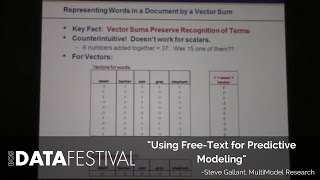
Using Free Text for Predictive Modeling
Explore efficient text representation for predictive analytics, covering techniques to transform varied-length text into fixed-length vectors for machine learning applications like sentiment analysis and news classification.