
Turing Lecture - AI Through the Looking Glass
AI's societal impact: opportunities, challenges, and ethical considerations. Explores job automation, socio-technical approaches, and UK's positioning in AI evolution. Emphasizes unexpected outcomes and the need for diverse perspectives.
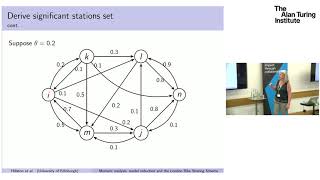
Jane Hillston - Moment Analysis, Model Reduction and London Bike Sharing
Explore moment analysis and model reduction techniques for complex systems, with applications to London's bike-sharing system. Learn about PCTMCs, moment equations, and directed contribution graphs.
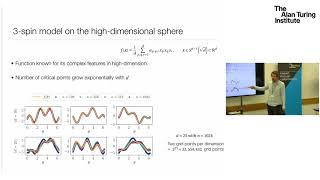
Neural Networks as Interacting Particle Systems
Explore neural networks as interacting particle systems, examining their mathematical foundations and applications in complex systems modeling across various scientific disciplines.
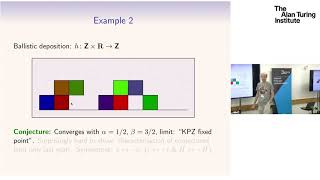
Universality Classes for 1+1 Dimensional Systems
Explore universality classes in 1+1 dimensional systems, focusing on weak universality conjecture, graphical construction, and links to Brownian web. Gain insights into complex systems modeling.

Turing Lecture - Algorithmic Accountability - Professor Ben Shneiderman, University of Maryland
Exploring algorithmic accountability and human-centered oversight for safer AI systems. Emphasizes comprehensible, predictable, and controllable designs to prevent failures and improve safety in critical services.
Turing Lecture - Chief Scientific Advisor for the Department of Transport, Phil Blythe
Explore evolving transport techniques, from aging infrastructure to autonomous vehicles, and their impact on future travel with insights from the Department of Transport's Chief Scientific Advisor.

The Truck Backer-Upper
Explore neural network applications in vehicle control, focusing on the Truck Backer-Upper problem. Learn about state transitions, training strategies, and Bayesian neural networks.
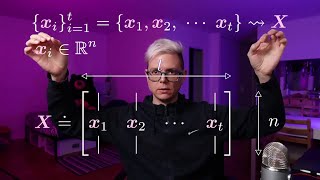
Self - Cross, Hard - Soft Attention and the Transformer
Explore attention mechanisms and Transformer architecture, covering self/cross and hard/soft attention, key-value stores, and practical implementation in PyTorch for advanced deep learning applications.
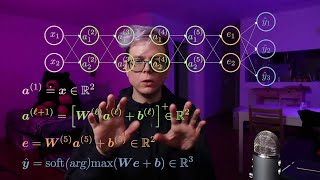
Recurrent Neural Networks, Vanilla and Gated - LSTM
Explore recurrent neural networks, including LSTM, covering architectures, training methods, and practical implementations using PyTorch for sequence-based tasks in deep learning.
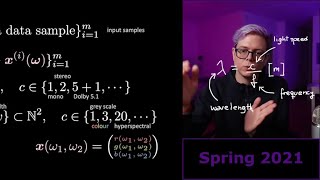
Natural Signals Properties and the Convolution
Explore natural signal properties, convolutional neural networks, and their applications in image processing. Learn about stationarity, locality, sparsity, and parameter sharing in neural network architectures.

Neural Nets - Rotation and Squashing
Explore neural network fundamentals, including affine transformations, non-linearities, and PyTorch implementation. Learn about ReLU, tanh, and deep network architectures through intuitive explanations and coding examples.
Tools, Classification with Neural Nets, PyTorch Implementation
Explore neural network classification, PyTorch implementation, and advanced concepts like space-fabric stretching and regression uncertainty estimation in this comprehensive tutorial.

Recent Progress in Predictive Inference - Emmanuel Candes, Stanford University
Emmanuel Candes discusses novel calibration techniques for machine learning predictions, addressing issues like false discovery rate control and adaptive conformal inference to handle distribution shifts.
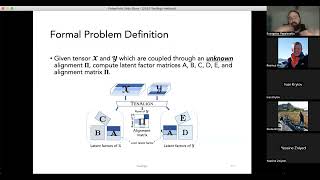
Joint Tensor Alignment and Coupled Factorization
Explore joint tensor alignment and coupled factorization for analyzing coupled datasets with unknown entity correspondence, outperforming multi-stage approaches in data mining applications.

Getting Machine Learning Models into Use
Practical guide to deploying bioinformatics machine learning models, focusing on scalability, user-friendliness, data security, and maintainability for real-world impact.
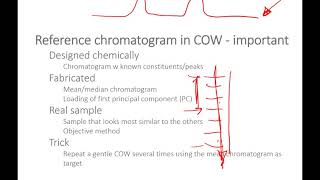
Preprocessing - Warping Data
Learn about Correlation Optimized Warping (COW) for aligning misaligned data, including its principles, parameters, and applications in bilinear models and data preprocessing.
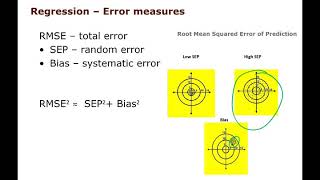
PLS Number of Components
Learn validation techniques for PLS models, including outlier detection, error measures, cross-validation, and practical tips for selecting the optimal number of components.
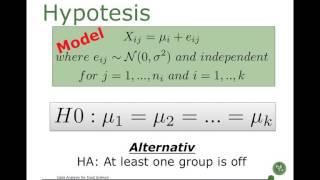
Oneway ANOVA
Explore variation splitting using ANOVA, covering model specification, ANOVA tables, and practical applications in food science data analysis.
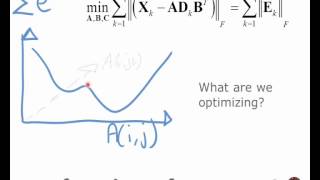
Multi-Way Analysis - The Algorithm
Explore the alternating least squares algorithm for multi-way analysis, focusing on PARAFAC modeling in chemometrics. Learn about notation, potential problems, and alternative approaches.

Understanding Audio Data for Deep Learning
Explore fundamental audio processing concepts for deep learning, including waveforms, pitch, Fourier transform, and MFCCs, essential for AI applications in sound analysis.
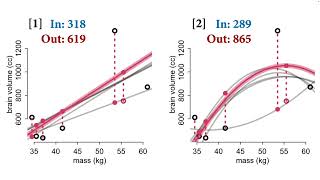
Statistical Rethinking 2023 - Fitting Over & Under
Explore advanced statistical concepts including cross-validation, regularization, and robust regression to enhance model fitting and selection techniques in data analysis.