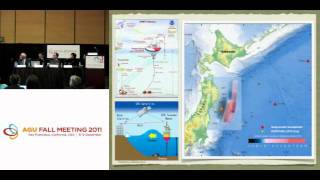
The 11 March 2011 Japan Tsunami - Scientific Assessments and Implications - Press Conference 1
Scientists discuss tsunami forecasting, eyewitness video analysis, and risk awareness implications following the 2011 Japan tsunami. Experts explore lessons for future preparedness and Pacific Northwest seismic risks.
Nonlinear and Scaling Processes in the Atmosphere and Ocean at All Scales
Explore cutting-edge research on nonlinear and scaling processes in atmospheric and oceanic systems, covering climate reconstructions, sensitivity, long-range memory, megadroughts, turbulence, and micro-scale phenomena.
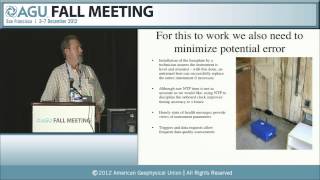
Citizen-Empowered Seismology - Advances in Public Participation
Explore innovative citizen science initiatives in seismology, including USGS "Did You Feel It?", Quake-Catcher Network, NetQuakes, and smartphone-based earthquake detection methods.
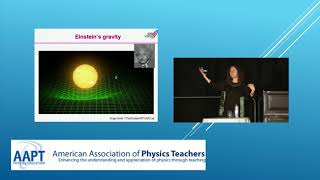
Gravitational Waves Discovery and LIGO Research - Gabriela González
Explore gravitational wave discovery with LIGO team physicist Gabriela González, focusing on instrument development, data calibration, and diagnostics to enhance astrophysical research methods.
Evidence for Human Effects on Global Climate
Explore evidence for human-induced climate change with insights from an American Physical Society subcommittee, covering key findings and implications for global climate policy.
Police Chase - Variable Acceleration - Episode 5
Explore variable acceleration functions to model realistic police officer motion in a chase scenario using Scilab and gnuplot for visualization.
Mountain Hydrology, Fourth Paradigm, and Color of Snow - Nye Lecture
Explore mountain hydrology, data-driven science, and snow properties in this lecture. Learn about environmental applications, measurement techniques, and challenges in understanding snow dynamics and their impact.
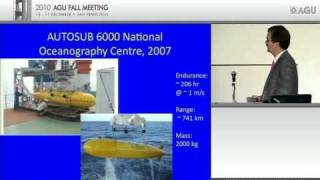
The Autonomous Revolution - Transforming Ocean Observation with Mobile Platforms
Explore cutting-edge autonomous mobile platforms revolutionizing ocean observation, enhancing our understanding of marine ecosystems and climate change impacts.
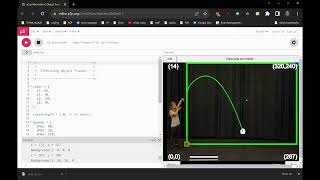
Trying Out the STEMCoding Object Tracker - Episode 1
Explore a user-friendly object tracking app for physics analysis, featuring hands-on demonstrations and practical applications in STEM education.
Jupyter Notebook Assignment - Euler-Cromer Method Development - Part 2
Explore the Euler-Cromer Method for computational physics through a guided Jupyter notebook project. Learn to implement and analyze this numerical integration technique for solving differential equations.
Simple Calculations with Spreadsheets
Learn to use spreadsheets for basic physics calculations, enhancing computational skills and problem-solving abilities in a visual, step-by-step manner.
Tracking Two-Dimensional Motion - Tracker for Beginners Part 7
Learn to analyze two-dimensional motion using Tracker software, covering x- and y-components, magnitudes, and angles for comprehensive projectile motion studies.
Graph Analysis and Acceleration - Tracker for Beginners Part 4
Explore three techniques for analyzing acceleration data in Tracker software, enhancing your video-based motion analysis skills for physics experiments and research.
Tracking Multiple Objects - Tracker for Beginners Part 3
Learn to analyze multiple objects' motion and their center of mass using Tracker software, gaining insights into interesting physics concepts through video analysis techniques.

Marble in a Bowl - Fun with Lagrangians - Part 1
Explore 3-D spherical coordinates through a marble rolling in a bowl. Learn Lagrangian mechanics with interactive GlowScript and Jupyter examples in this engaging physics tutorial.
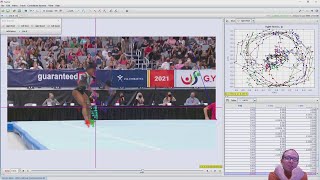
Motion Tracking Simone Biles' Gymnastics Move - Olympics 2021
Analyze Simone Biles' signature gymnastics move using motion tracking software, revealing the intricate dynamics of her hands and feet during Olympic-level performance.
Spring Pendulum Simulation Using Jupyter - Fun With Lagrangians
Explore spring pendulum dynamics using Jupyter, focusing on energy conservation and competing forces. Includes GlowScript and Jupyter implementations for rich phase space visualization.
Python Tutorial 3 - Graphing for Computational Physics - Absolute Beginners
Learn to create graphs for computational physics using Python, ideal for undergraduate assignments and beginners in scientific data visualization.
Pendulum Simulation with Jupyter - Fun with Lagrangians - Part 1
Explore pendulum motion using Jupyter and Lagrangian mechanics. Create graphs to visualize equations of motion and gain insights into classical physics analysis.
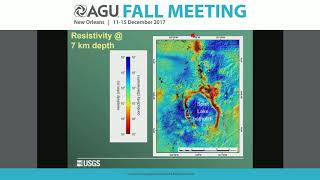
Frontiers in Electromagnetic Methods I - 2017 Fall Meeting
Explore cutting-edge electromagnetic methods in geophysics with expert presentations on advancements, applications, and innovative techniques for Earth exploration and understanding.
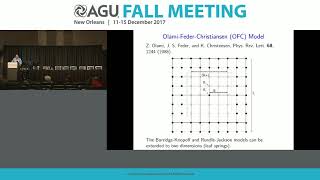
Climate Dynamics and Predictability: Insights from Simple Models - 2017 Fall Meeting Lorenz Lecture
Explore the Lorenz Lecture on simple models in geophysics, covering topics like residual stress, data collapse, and Gutenberg-Richter scaling, with implications for fault behavior and earthquake prediction.