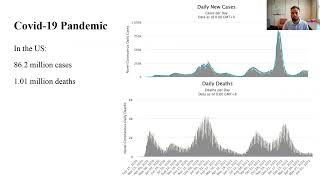
Mathematical Modeling of Diseases Spread - The Dextrous Use of Simple Machine-Learning Tools
Explore machine learning techniques for modeling disease spread, focusing on data preparation, model training, and interpreting results to inform public health policies.
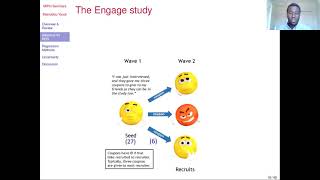
Recent Developments in Respondent-Driven Sampling
Explore recent advancements in respondent-driven sampling techniques for surveying hidden populations, including network-based approaches and regression methods for data analysis.
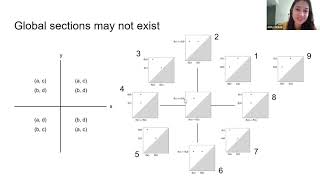
Persistence Diagram Bundles- A Multidimensional Generalization of Vineyards
Explore persistence diagram bundles, a multidimensional generalization of vineyards for analyzing topological changes in data sets with multiple parameters, including computation methods and potential applications.
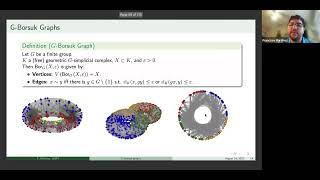
Chromatic Number of G-Borsuk Graphs
Explore G-Borsuk graphs, their chromatic numbers, and topological connections. Delve into G-actions, Hom-complexes, and random graph thresholds for a deeper understanding of this algebraic topology concept.

New Results in Computing Zigzag and Multiparameter Persistence
Explore new advancements in computing zigzag and multiparameter persistence, including efficient conversion methods and improved algorithms for 2-parameter persistence modules.
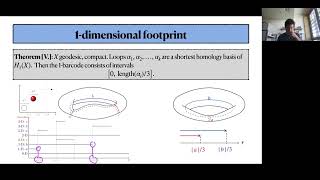
Žiga Virk - Information Encoded in Persistence Diagrams
Explore topological data analysis through persistence diagrams, uncovering spatial properties like homology, geodesics, and proximity in various mathematical contexts.
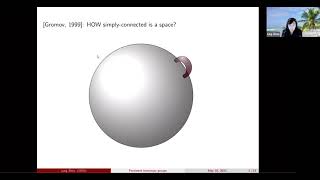
Persistent Homotopy Groups of Metric Spaces
Explore persistent homotopy groups of metric spaces, their stability, and advantages over persistent homology. Learn about tree-like structures and ultrametrics in fundamental groups.
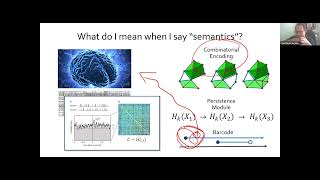
An Approach to Assigning Semantics to Persistent Homology Classes
Explore a novel approach to interpreting persistent homology classes in applied settings, overcoming traditional limitations by leveraging comparative measurements against known models.
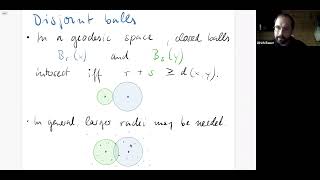
Ulrich Bauer - Gromov Hyperbolicity, Geodesic Defect, and Apparent Pairs in Rips Filtrations
Explore Gromov hyperbolicity, geodesic defect, and apparent pairs in Rips filtrations, extending Rips' results on contractibility and examining computational implications for persistent homology.
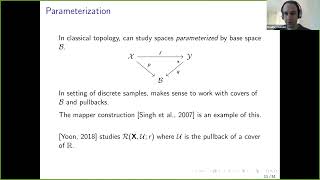
Bradley Nelson: Parameterized Vietoris-Rips Filtrations via Covers
Explore computational topology techniques for large filtered geometric complexes, focusing on Vietoris-Rips filtrations and cover-based methods for parallel computation and compression.

The Medical Test Paradox and Redesigning Bayes' Rule
Explore the medical test paradox and a redesigned Bayes' rule, focusing on likelihood ratios and Bayes factors to enhance understanding of conditional probability in diagnostic testing.
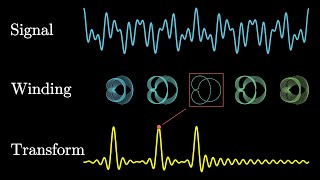
What is the Fourier Transform? A Visual Introduction
Animated exploration of the Fourier Transform, offering a visual and intuitive understanding of this complex mathematical concept. Ideal for those seeking a clear, engaging introduction to signal processing fundamentals.
Morning Session- Causality
Explore racial bias in data, examining tensions between quantitative and qualitative approaches. Experts discuss implications for fairness and accuracy in research and decision-making.
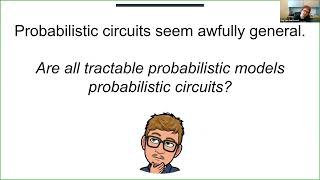
Tractable Probabilistic Circuits
Explore recent developments in tractable probabilistic circuit models, their efficient learning from data, and applications in causal inference algorithms for computing marginal probabilities and related queries.
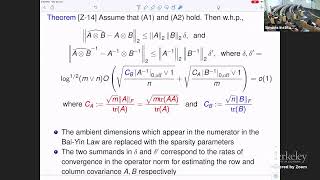
Tensor Graphical Models for Complex and High Dimensional Data
Explore advanced statistical methods for analyzing complex, high-dimensional data using tensor graphical models, with applications in algorithmic inference and combinatorial structures.

Efficient Algorithms for Outlier-Robust Regression
Explore advanced techniques for outlier-robust regression, focusing on efficient algorithms and their applications in high-dimensional statistics and machine learning.
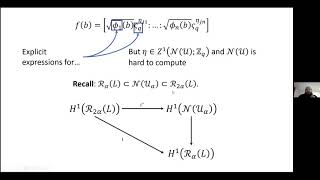
Data Driven Torsion Coordinates and Wasserstein Stability
Explore data-driven torsion coordinates in finite Lens spaces, LPCA dimensionality reduction, and Wasserstein stability for topological data analysis and nonlinear dimensionality reduction.

Geometry and Topology of Decision
Explore geometric and topological approaches to decision-making when faced with conflicting expert opinions, examining theoretical concepts and practical applications in various scenarios.
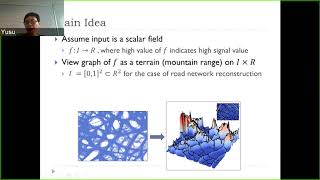
Graph Reconstruction via Discrete Morse Theory
Explore graph reconstruction using discrete Morse theory, focusing on geometric graphs and density data. Learn about theoretical guarantees and applications in road network reconstruction.
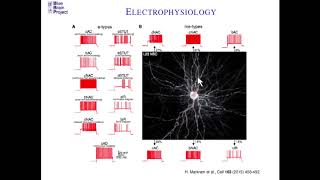
Kathryn Hess - Bedlewo: Topology Meets Neuroscience
Explore how topology applies to neuroscience across scales, from neurons to brain regions. Discover topological analysis of microconnectomes and neuron classification, with insights into brain imaging data.
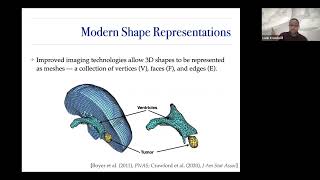
Probabilistic Generative Frameworks for Sampling 3D Complex Shapes and Images
Explore probabilistic frameworks for simulating 2D and 3D shapes, with applications in computational biology. Learn about sub-image selection and shape statistics in cellular imaging and primate mandibular molars.