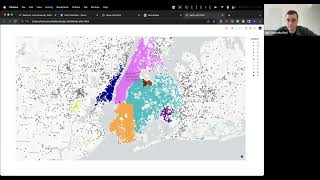
Recent Advances in Theory and Implementation of Multi-Parameter Persistence
Explores recent developments in multi-parameter persistence, covering stable filtrations and discrete descriptors. Includes interactive clustering software demo and discusses extensions of one-parameter persistence concepts.
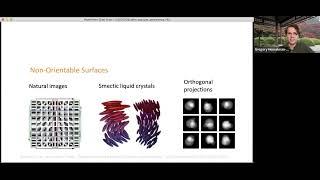
Saecular Persistence
Explore saecular persistence, a method to decompose persistence modules with non-field coefficients. Learn about applications in topology, generalized persistence diagrams, and scientific data analysis.
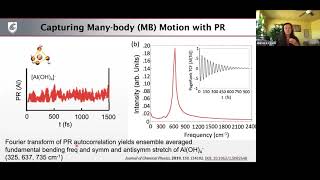
Multiscale Many-body Correlations and Structure in Chemistry Data
Integrating graphs, topology, and geometry to analyze complex chemistry data, providing insights into multiscale correlations and structures beyond traditional methods.
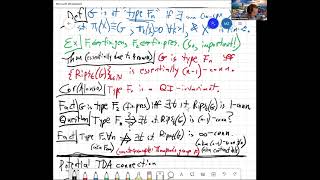
Vietoris-Rips Complexes and Geometric Group Theory
Explore Vietoris-Rips complexes in geometric group theory, focusing on topological finiteness properties, hyperbolic groups, and recent developments in Morse theory and persistent homology.

Homotopy Types of Vietoris–Rips Complexes of Metric Gluings
Explore homotopy types of Vietoris-Rips complexes in metric wedge sums and gluings, with applications to persistent homology of metric graphs and insights into open research directions.
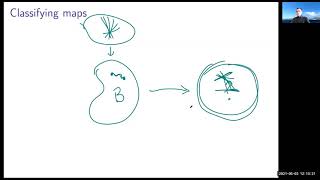
Approximate and Discrete Vector Bundles
Explore synchronization problems and dimensionality reduction through vector bundles. Learn how characteristic classes provide insights into global synchronization and data analysis challenges.
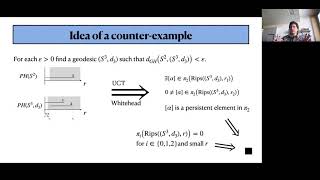
A Counter-Example to Hausmann's Conjecture
Explore a counter-example to Hausmann's conjecture on Vietoris-Rips complexes, challenging long-held beliefs in algebraic topology using persistent homology.
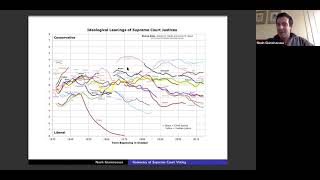
Looking for Geometry in the Supreme Court
Exploring geometric approaches to analyze U.S. Supreme Court voting behavior, discussing recent investigations using planar geometry and phylogenetic trees, and suggesting future directions in topology and geometry.
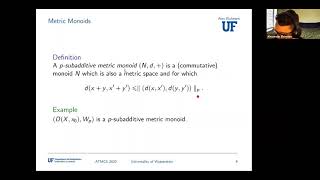
Universality of Persistence Diagrams and Bottleneck & Wasserstein Distances
Explore the mathematical foundations of persistence diagrams and their associated metrics, focusing on universality properties and distance calculations in topological data analysis.
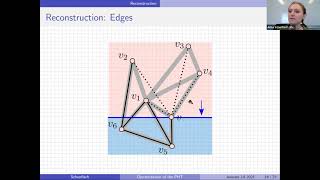
A Faithful Discretization of the Persistent Homology Transform
Explore a faithful discretization method for the Persistent Homology Transform, enhancing computational efficiency in topological data analysis and shape recognition.
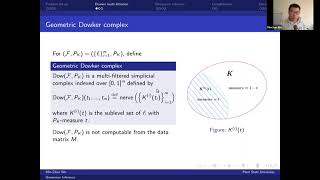
A Topological Approach to Inferring the Intrinsic Dim. of Convex Sensing Data
Explore a topological method for determining the intrinsic dimension of convex sensing data, offering insights into data analysis and dimensionality reduction techniques.
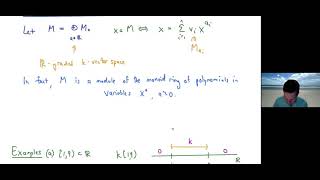
Homological Algebra for Persistence Modules
Introduction to persistence modules in algebraic topology, exploring tensor products, Hom operations, and their role in homological algebra. Insights into preserving exact sequences and advanced concepts.
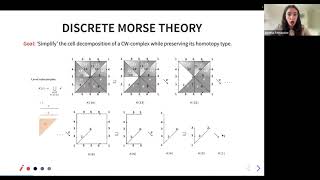
Morse Theory for Group Presentations and the Persistent Fundamental Group
Discrete Morse theory refinement for CW-complexes, with applications in combinatorial group theory and topological data analysis, including persistent fundamental group computation.
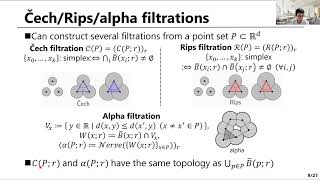
RipsNet- Fast and Robust Estimation of Persistent Homology for Point Clouds
Estimating persistence diagrams of point clouds using neural networks for faster, more robust topological analysis. Overcomes computational complexity and sensitivity to outliers in practical applications.
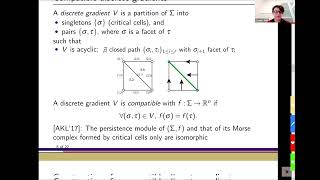
Claudia Landi - Multi-parameter Persistence from the Viewpoint of Discrete Morse Theory
Explore multi-parameter persistence through discrete Morse theory, connecting combinatorial properties of critical cells to algebraic properties of persistence modules in topological data analysis.
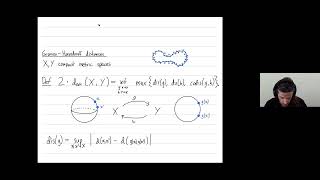
Gromov-Hausdorff Distances, Borsuk-Ulam Theorems, and Vietoris-Rips Complexes
Explore Gromov-Hausdorff distances, Borsuk-Ulam theorems, and Vietoris-Rips complexes in geometry. Learn about recent advancements in lower bounding distances between spheres using innovative mathematical techniques.
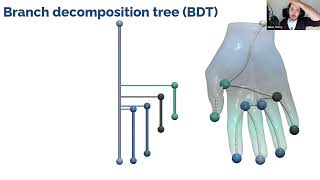
Wasserstein Distances, Geodesics and Barycenters of Merge Trees
Explore computational frameworks for merge trees, including Wasserstein distances, geodesics, and barycenters. Learn efficient algorithms and applications in visualization, feature tracking, and ensemble clustering.
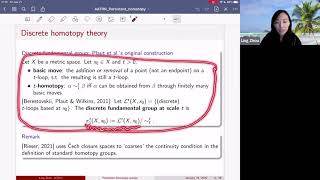
Persistent Homotopy Groups of Metric Spaces
Exploring persistent homotopy groups of metric spaces, blending topology and geometry to capture dataset features beyond persistent homology, with applications and stability properties.
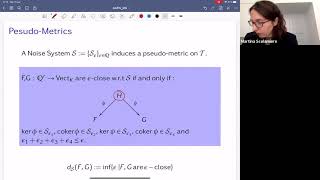
Extracting Persistence Features with Hierarchical Stabilisation
Explore hierarchical stabilisation for extracting stable invariants from persistence modules, focusing on the stable rank and its applications in data analysis and classification tasks.
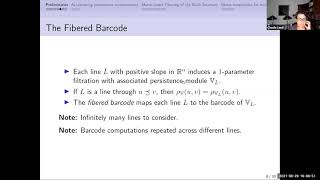
Discrete Morse Theory Meets Multi-Parameter Persistence
Exploring connections between discrete Morse theory and multiparameter persistence in topological data analysis, focusing on critical cells, fibered rank invariant, and computational efficiency.
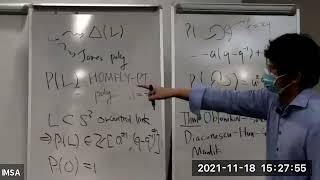
Hilbert Schemes of Plane Curve Singularities and Matrix Factorizations
Explore connections between algebraic geometry and topology through plane curve singularities, Hilbert schemes, and matrix factorizations in this advanced mathematics lecture.