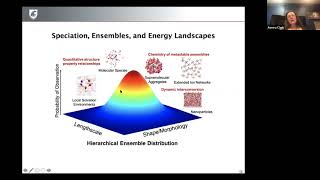
Topology in Chemistry Applications
Explore topological data analysis in chemistry, focusing on molecular relationships, graph theory, and network analysis to extract new insights from chemical data.
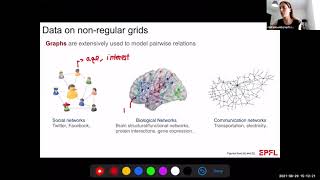
Simplicial Neural Networks
Explore simplicial neural networks, a generalization of graph neural networks for multi-dimensional data, and their applications in imputing missing data on coauthorship complexes.
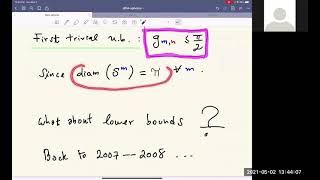
The Gromov-Hausdorff Distance Between Spheres
Explore the Gromov-Hausdorff distance between spheres, its applications in geometry and topology, and methods for calculating precise values between specific sphere pairs.
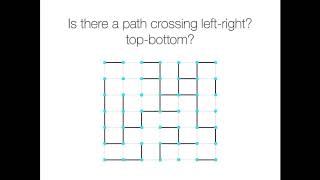
Homological Percolation: The Formation of Giant Cycles
Explore homological percolation, analyzing giant cycles in random structures and their phase transitions. Learn to differentiate signal from noise in persistence diagrams and discover connections to Euler characteristic curves.
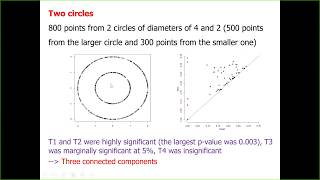
Modeling and Replicating Persistence Diagrams
Explore modeling and replicating persistence diagrams for statistical inference in topological data analysis. Learn about RST approach, parametric modeling, and improvements for clustered data.
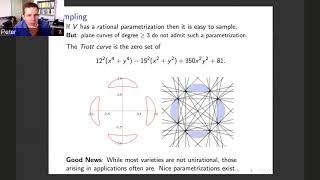
Bernd Sturmfels - Learning Algebraic Varieties from Samples
Explore algebraic varieties through sampling, focusing on topology and geometry. Learn algorithms for determining dimensions and polynomials, with practical applications in Julia.
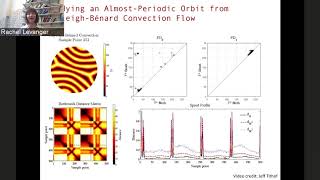
Rachel Levanger - A Comparison Framework for Interleaved Persistence Modules
Explore rigorous tracking of noise in persistent homology, comparing approximation techniques and addressing non-uniform sub-level set filtrations in topological data analysis.
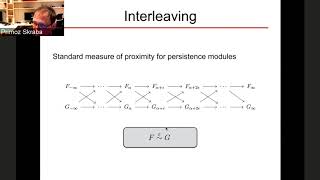
An Approximate Nerve Theorem
Explore the Nerve Theorem's application in topological data analysis, focusing on epsilon-acyclic covers and their impact on persistent homology approximations in space filtrations.
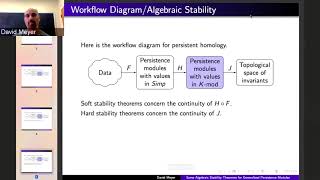
David Meyer - Some Algebraic Stability Theorems for Generalized Persistence Modules
Algebraic stability theorems for generalized persistence modules, exploring interleaving metrics, bottleneck metrics, and isometry theorems in the context of poset algebras and quiver representations.
Pawel Dlotko - A Few Simple Stories on Topology in Action
Explore practical applications of computational topology in material science, dynamical systems, and brain research. Learn how theory and algorithms work together to solve real-world problems.
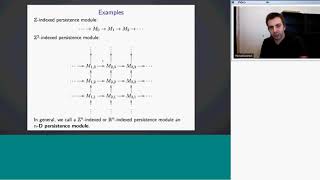
Michael Lesnick - Algebraic Stability of Zigzag Persistence Modules
Explore algebraic stability in zigzag persistence modules, covering key concepts, theorems, and applications in topological data analysis and computational topology.

Tamal Dey - A Framework for Topological Summarization
Explore topological summarization frameworks, covering concepts like nerve complexes, multiscale mapper, persistence diagrams, and stability in hierarchical covers. Gain insights into advanced computational topology techniques.
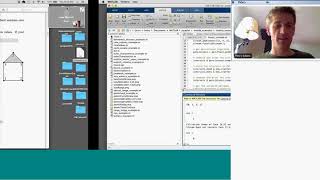
Applied Algebraic Topology Network - Student Seminar Introduction to JavaPlex
Learn to use JavaPlex for topological data analysis, covering key concepts like witness complexes, data representation, and visualization tools. Ideal for students exploring computational topology.
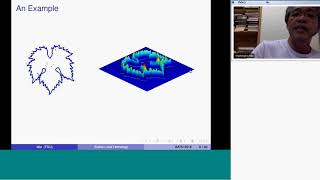
Washington Mio - Stable Homology of Metric Measure Spaces
Explore stable homology in metric measure spaces, covering Wasserstein distance, local homology stability, and applications in data analysis and taxonomic classification.
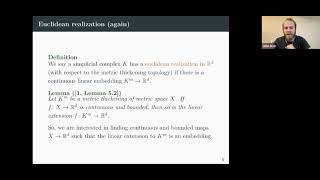
Johnathan Bush - Maps of Čech and Vietoris–Rips Complexes into Euclidean Spaces
Explore simplex-preserving maps in Čech and Vietoris–Rips complexes, their applications, and the challenge of finding such maps from various domains to Euclidean spaces.

Jürgen Jost - Geometry and Topology of Data
Explore geometric and topological approaches to data analysis, focusing on ball intersections, curvature concepts, and convexity in metric spaces.
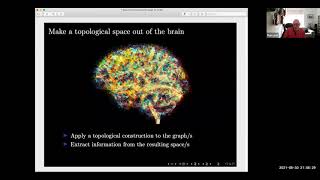
An Application of Neighborhoods in Directed Graphs in the Classification of Binary Dynamics
Explore graph theory applications in classifying binary dynamics, focusing on vertex neighborhoods and their use in analyzing neuronal network activity, with insights from the Blue Brain Project.
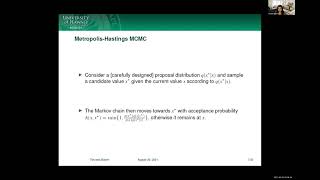
Farzana Nasrin - Random Persistence Diagram Generator
Explore a method for generating random persistence diagrams using parametric models and Markov chain Monte Carlo algorithms, with applications in material science and topology.
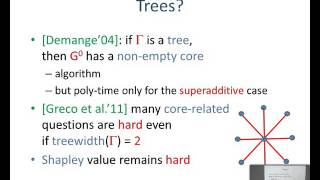
Edith Elkind- Coalitional Games on Sparse Social Networks
Explore coalitional games on social networks, analyzing graph structures, computational complexity, and solution concepts for connected subsets of agents.
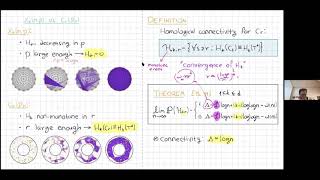
Omer Bobrowski - Random Simplicial Complexes
Explore higher-dimensional generalizations of random graphs, focusing on random d-complexes and Cech complexes. Learn about connectivity, cycle formation, and giant components in these structures.

Statistics and Data Analysis for Cosmology - Lecture 1
Explore probability concepts in cosmology, including joint and conditional probability, PDFs, independence, Bayes' theorem, and data modeling for analyzing cosmic phenomena.