Graph Theory Basics - Types of Graphs - Components of Graph
Explore graph theory fundamentals, including types, components, and applications. Learn about vertex degrees, handshaking lemma, and various graph classifications. Gain insights into adjacency matrices for network analysis.

Normal Distribution Excel Exercise - Probability and Statistics - Khan Academy
Explore how normal distribution approximates binomial distribution for large trials using Excel. Gain practical insights into probability concepts through hands-on spreadsheet analysis.
Topological Strings, Knots, and Quivers - Lecture 1
Explore topological strings, knots, and quivers in this lecture covering knot invariants, Chern-Simons theory, A-polynomials, volume conjectures, and knot homology, with exercises and examples.

Variations on the Wire Problem - Optimization in Geometry for Math Teachers
Explore optimization through hands-on activities, addressing Common Core Standards. Learn to cut and bend wire into polygons for minimum or maximum enclosed area, enhancing high school math instruction.
Measuring Speed - Average and Instantaneous Velocity - Part 1
Explore average and instantaneous velocity concepts through practical examples and data analysis techniques in this engaging calculus lesson.
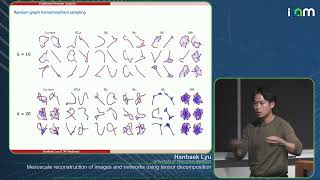
Mesoscale Reconstruction of Images and Networks Using Tensor Decomposition
Explore mesoscale reconstruction of images and networks using tensor decomposition, focusing on a unified framework, error bounds, and online CP-dictionary learning for multi-modal datasets.
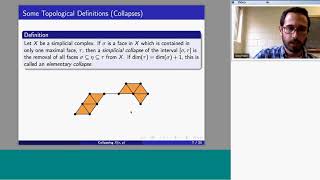
Greg Malen - Collapsibility of Random Clique Complexes
Explore k-collapsibility in random clique complexes, examining dimensional faces, strong connectivity, and homology implications for topological data analysis.
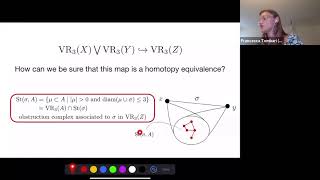
Decomposing Simplicial Complexes - Without Losing Pieces
Explore simplicial complex decomposition, its impact on homotopy type, and applications in Vietoris-Rips complexes. Learn about obstruction complexes and their role in understanding topological changes.
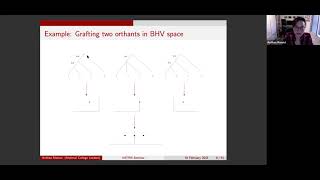
Tropical Geometry of Phylogenetic Tree Spaces
Explore tropical geometry's application to phylogenetic tree spaces, examining BHV space, tropical Grassmannians, and their implications for computational biology and statistics.
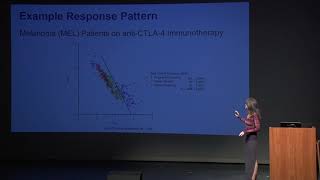
Teaching Contemporary Math - Modeling Cancer Treatment
Explore innovative approaches to teaching math through real-world applications in cancer treatment, data modeling, and error analysis with Helen Moore.
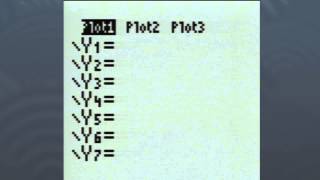
The Box Problem: Optimizing Volume in Rectangular Cardboard Boxes - Grades 8-9
Explore volume optimization through 'The Box Problem'. Investigate using models, tables, and graphs. Learn to define variables, write functions, and use graphing calculators for advanced analysis.
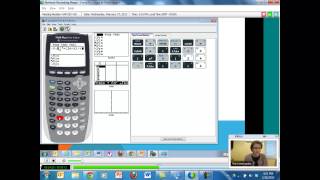
Using Functions to Build Models - Math Teacher Professional Development
Hands-on exploration of mathematical modeling using real-world problems, connecting concepts across Math I to Calculus. Focuses on function creation, domain analysis, and student engagement techniques.
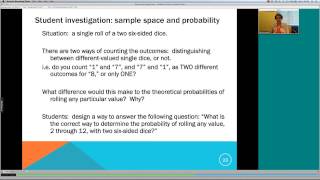
Probability Topics in Middle Grades - Simulation and Data Collection
Explore probability concepts through simulations and data collection, using various technologies to enhance understanding of middle-grade mathematics topics.
Distinguishing Between Linear and Exponential Growth in Mathematics - Real-World Applications
Explore real-world applications of linear and exponential growth through population and food production data, using calculators for analysis and modeling in mathematics.
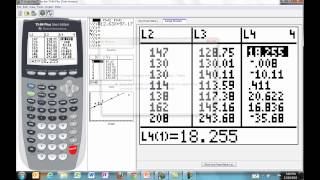
Linear Data Analysis for Math Common Core Standards - Part 3
Explore linear functions for real-world data modeling, focusing on slope and intercept interpretation, linear regression, and residual analysis using interactive tools and practical examples.
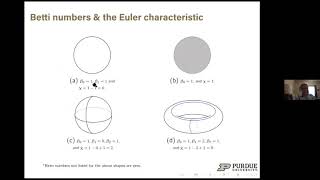
Andrew Thomas - Functional Limit Theorems for Euler Characteristic Processes
Explore functional limit theorems for Euler characteristic processes in Vietoris-Rips complexes, covering strong law of large numbers and central limit theorem in the thermodynamic regime.
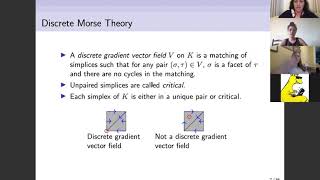
Morse-Based Fibering of the Rank Invariant
Explore multi-parameter persistence in data analysis using discrete Morse theory to compute rank invariants, partition parameter space, and deduce persistence diagrams for equivalent classes of lines.
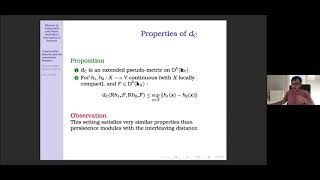
Sheaves as Computable and Stable Topological Invariants for Datasets
Explores sheaf theory in topological data analysis, connecting level-sets persistence with derived sheaves. Presents functorial equivalences, stability theorems, and barcode decompositions for continuous data analysis.

Convex Sunflower Theorems and Neural Codes
Explore convex sunflower theorems and neural codes, connecting neuroscience with discrete geometry to understand place cell encoding and cognitive mapping in rat hippocampus.
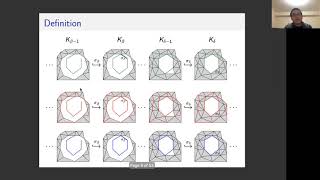
Computing Minimal Persistent Cycles - Polynomial and Hard Cases
Explores computing minimal persistent cycles in algebraic topology, discussing polynomial and NP-hard cases, and presenting algorithms for weak pseudomanifolds with applications to scientific data analysis.
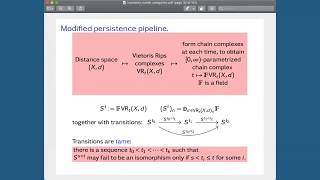
Wojciech Chachólski - TDA Invariants and Model Categories
Exploring TDA invariants and model categories in data analysis, focusing on simplification techniques from homotopy theory to extract meaningful summaries while balancing information retention.