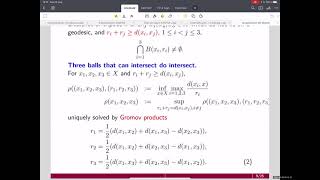
Geometry and Topology of Data
Explore geometric and topological properties of data sets, including curvature concepts and their relation to hyperconvexity, offering new insights into Topological Data Analysis.
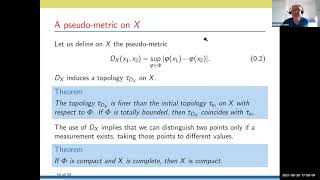
On the Role of Group Equivariant Non-Expansive Operators in TDA
Explore group equivariant non-expansive operators as tools for approximating data observers in Topological Data Analysis, focusing on their mathematical properties and applications.
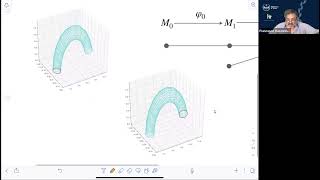
Parallel Decomposition of Persistence Modules Through Interval Bases
Explore parallel decomposition of persistence modules using interval bases, enhancing Topological Data Analysis with distributed computation and Hodge decomposition techniques.

Topological Data Analysis Based Machine Learning Models for Drug Design
Explores TDA-based models for effective molecular representation in drug design, combining persistent homology, spectral models, and Ricci curvature with machine learning for improved performance.
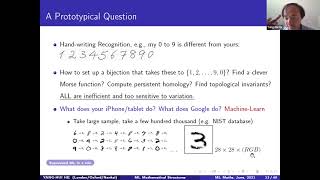
Universes as Bigdata- From Geometry, to Physics, to Machine-Learning
Explore the intersection of string theory, geometry, and machine learning in physics, examining how AI aids mathematical research across various fields.
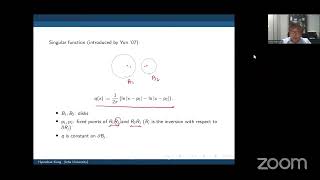
Quantitative Analysis of Field Concentration in Presence of Closely Located
Quantitative analysis of field concentration in composites with closely located inclusions, focusing on optimal estimates and asymptotic characterization in various physical contexts.

Transparent, Reproducible, and Adaptable Data Analysis with Snakemake
Explore Snakemake for sustainable data analysis, enabling transparency, reproducibility, and adaptability in scientific workflows and computational research.
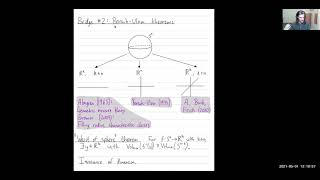
Bridging Applied and Quantitative Topology
Survey of emerging connections between applied and quantitative topology, focusing on Vietoris-Rips complexes and their applications in computational topology, geometric group theory, and dataset shape approximation.
Practical Clustering and Topological Data Analysis
Explore clustering algorithms and topological data analysis from a data science perspective, covering techniques from k-means to DBSCAN and dimensionality reduction methods like UMAP.
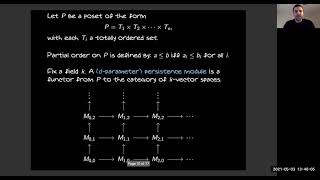
L-P Metrics on Multiparameter Persistence Modules
Explores generalizations of p-Wasserstein distance for multi-parameter persistence modules, introducing d_I^p and d_M^p metrics. Examines their properties and applications in topological data analysis.
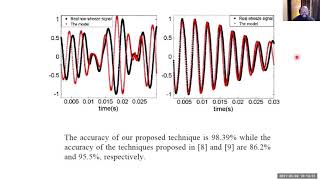
Quasiperiodicity and Persistent Kunneth Theorems
Explore quasiperiodicity in signals, persistent homology, and Kunneth theorems. Learn applications in time series analysis and computational chemistry through topological data analysis.
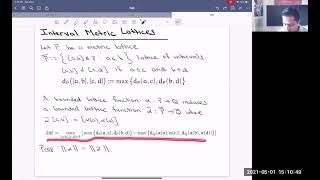
Edit Distance and Persistence Diagrams Over Lattices
Functorial pipeline for persistent homology: from filtered simplicial complexes to persistence diagrams. Addresses multiparameter persistent homology and functoriality of persistence diagrams.
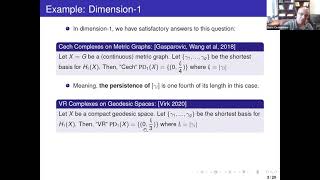
Geometric Approaches on Persistent Homology
Explore geometric interpretations of persistence diagrams, focusing on quantitative descriptions of homology class size and persistence, with analysis of power filtration on unweighted graphs.
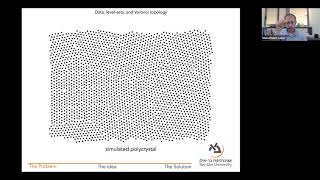
High-Dimensional Data, Level-Set Geometry, and Voronoi Analysis of Point Sets
Explore spatial point sets, high-dimensional data analysis, and Voronoi cell topology to understand complex physical systems and classify data structures in innovative ways.
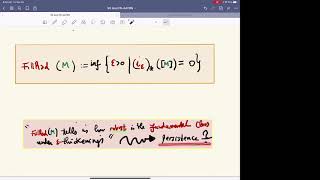
Vietoris-Rips Persistent Homology, Injective Metric Spaces, and The Filling Radius
Explore geometric persistent homology, its isomorphism with Vietoris-Rips filtration, and applications in characterizing persistence barcodes, bounding intervals, and connecting to filling radius.
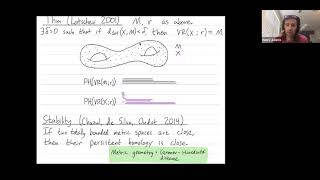
Vietoris-Rips Thickenings - Problems for Birds and Frogs
Explore open problems in Vietoris-Rips complexes, connecting diverse mathematical areas. Suitable for both broad theorists and problem-solving specialists in applied algebraic topology.

Introduction to Cubical Complexes and Persistence - 2020
Explore cubical complexes and cubical homology for efficient analysis of digital images using persistent homology, with applications in topological data analysis.
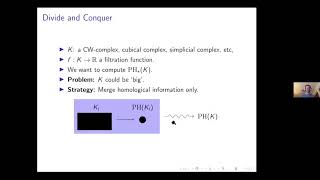
The Persistence Mayer-Vietoris Spectral Sequence
Explore the persistent Mayer-Vietoris spectral sequence, its applications in parallelizing persistent homology computations, and its ability to provide locality-enriched persistence barcodes.
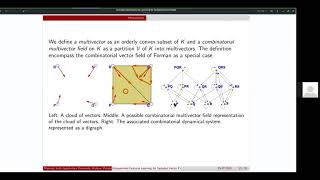
Unsupervised Features Learning for Sampled Vector Fields
Explore innovative techniques for analyzing sampled vector fields using graph structures and unsupervised learning, revealing hidden features correlated with known dynamics in analytical models.
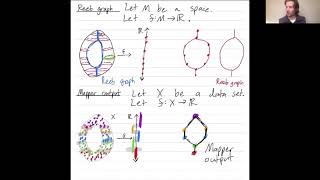
The Mapper Algorithm and Reeb Graphs
Explore the mapper algorithm in applied topology, its connection to Reeb graphs, and its application to high-dimensional data analysis and 3D object recognition.
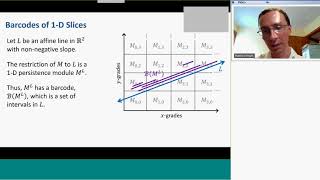
Visualizing 2 Dimensional Persistent Homology
Explore techniques for visualizing 2D persistent homology, a powerful tool in topological data analysis, to gain insights into complex datasets and their underlying structures.