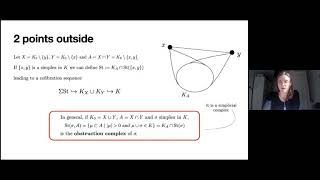
Homotopical Decompositions of Simplicial and Vietoris Rips Complexes
Explore homotopical decompositions of simplicial complexes, focusing on obstruction complexes and their applications in topological data analysis, with insights on Vietoris-Rips complexes.
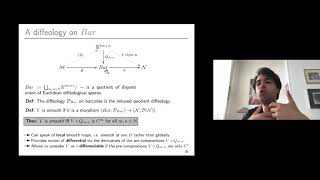
Differential Calculus on Persistence Barcodes
Explore differential calculus on persistence barcodes, covering differentiability concepts, lifts to ordered barcodes, and applications in topological data analysis.
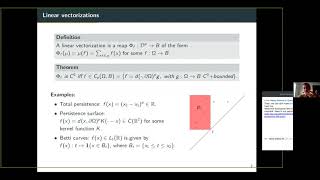
Studying the Space of Persistence Diagrams Using Optimal Partial Transport II
Exploring persistence diagrams through optimal transport theory, bridging topological data analysis with measure spaces to characterize convergence and prove new results in random settings.
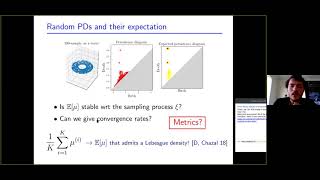
Studying the Space of Persistence Diagrams Using Optimal Partial Transport - Part I
Exploring persistence diagrams through optimal partial transport, bridging topological data analysis with measure theory. Novel approach enables new insights into convergence, continuity, and random settings in TDA.
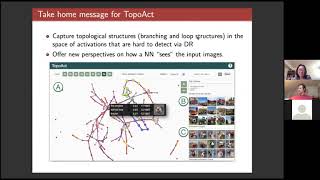
TopoAct - Visually Exploring the Shape of Activations in Deep Learning
Explore the shape of neuron activations in deep learning using topological data analysis. Gain insights into learned representations of image classifiers with TopoAct visualization system.
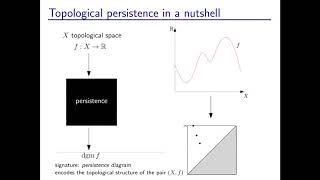
On the Metric Distortion of Embedding Persistence Diagrams into RKHS
Explores embedding Persistence Diagrams into Reproducing Kernel Hilbert Spaces, analyzing metric properties and stability guarantees for machine learning applications in Topological Data Analysis.
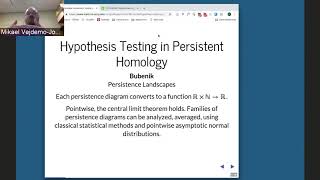
Multiple Hypothesis Testing with Persistent Homology
Exploring methods for multiple hypothesis testing in persistent homology, including family-wise error rates and false discovery rates, with applications to Mapper complex validation.
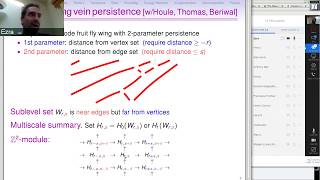
Real Multiparameter Persistent Homology
Explores real multiparameter persistent homology, addressing challenges and practical applications in data science. Introduces topological tameness and its implications for algebraic concepts and computational methods.
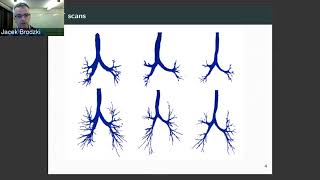
Quantifying Lung Structure in COPD and Solubility of Chemical Compounds
Explore topological data analysis applications in medicine and chemistry, focusing on lung structure in COPD and chemical compound solubility using persistent homology as a key tool.
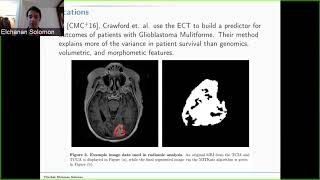
An Intrinsic Persistent Homology Transform
Explores an intrinsic persistent homology transform for metric spaces, focusing on metric graphs. Discusses injectivity results and compares to related constructs in topological data analysis.

Topological Data Analysis of Collective Motion
Explore topological data analysis for collective motion in nature, examining bird flocks, fish schools, and insect swarms through innovative mathematical models and simulations.
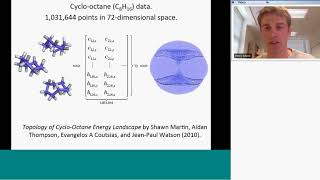
The Vietoris Rips Complex of the Circle
Explore the Vietoris-Rips complex of the circle, its homotopy types at different thresholds, and implications for persistent homology in topological data analysis.

High-Throughput Spectroscopy and Material Discovery by Beyond-DFT Work and Data-Analysis
Explore high-throughput spectroscopy and materials discovery using advanced computational methods, workflows, and data analysis frameworks for accelerated insights in materials science.

Lab-in-the-Loop De Novo Antibody Design - What Are We Missing From Machine Learning?
Explore lab-in-the-loop de novo antibody design, focusing on computational aspects. Discover generative modeling, computational oracles, and active learning in molecular systems research.
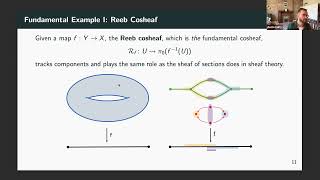
Exemplars of Sheaf Theory in TDA
Exploring sheaf theory applications in topological data analysis through four case studies, covering level set persistence, merge trees, and innovative approaches to persistent homology.
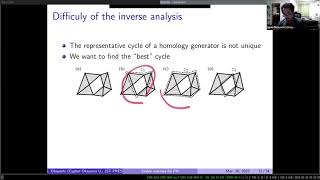
Ippei Obayashi - Stable Volumes for Persistent Homology
Explore stable volumes in persistent homology: a novel method to identify robust topological structures in data, overcoming instability issues and revealing minimal building blocks.
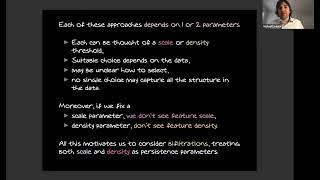
Stability of 2-Parameter Persistent Homology
Explores stability results for 2-parameter persistent homology, covering multicover bifiltration, subdivision bifiltrations, and degree bifiltrations. Discusses computational aspects and implications for practical applications.
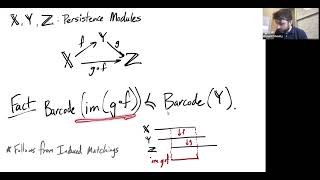
Don Sheehy - Persistent Homology of Lipschitz Extensions
Explore persistent homology of Lipschitz functions, analyzing sublevel set filtrations and barcodes from sample data. Learn about sub-barcodes and their theoretical guarantees in topological data analysis.
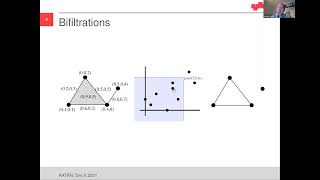
Multi-Parameter Persistent Homology is Practical
Explore practical applications of multi-parameter persistent homology in topological data analysis, focusing on efficient algorithms for large datasets and recent computational advancements.
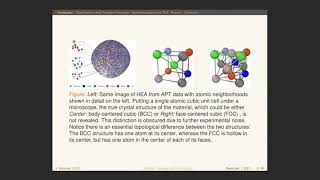
Statistics, Topology and Data Analysis
Explore the synergy between statistics and topological data analysis for solving real-world problems, with a focus on supervised learning and applications in materials science.
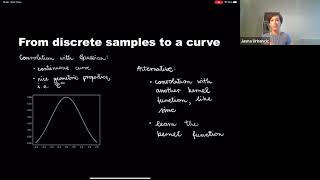
Optimizing Embedding Using Persistence
Explore optimizing Takens-type embeddings of time series using persistent (co)homology. Learn practical approaches for finding good embeddings and discuss the space of embeddings and open questions.