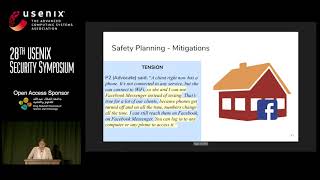
Computer Security and Privacy in the Interactions Between Victim Service Providers and Human Trafficking Survivors
Exploring technology's role in victim service provider-survivor interactions, balancing trust-building and risk mitigation for human trafficking survivors' recovery and empowerment.
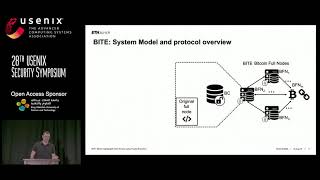
BITE - Bitcoin Lightweight Client Privacy Using Trusted Execution
Innovative approach to enhance privacy for Bitcoin lightweight clients using SGX enclaves, combining trusted execution and private information retrieval techniques for improved security without compromising performance.
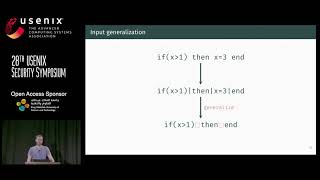
GRIMOIRE - Synthesizing Structure while Fuzzing
Innovative fuzzing technique for programs with structured inputs, synthesizing complex structures on-the-fly without pre-configuration, outperforming existing methods and uncovering 19 memory corruption bugs.
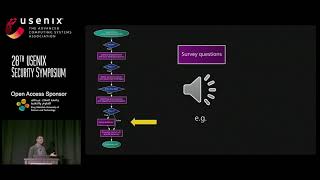
Users Really Do Answer Telephone Scams
Explores factors influencing susceptibility to telephone scams through ethical phishing experiments, revealing the significant impact of spoofed Caller ID on victims' willingness to disclose sensitive information.
Kafka on Kubernetes - From Evaluation to Production at Intuit
Explore Intuit's journey of running Kafka on Kubernetes in AWS, covering evaluation, testing, configuration, and integration with monitoring tools. Learn about challenges faced and solutions implemented.
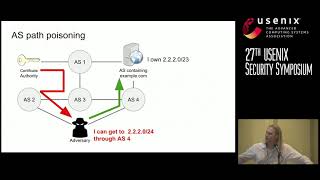
Bamboozling Certificate Authorities with BGP
Análisis de vulnerabilidades en la infraestructura de clave pública y demostración de ataques BGP para obtener certificados falsos, con propuestas de contramedidas para mejorar la seguridad.
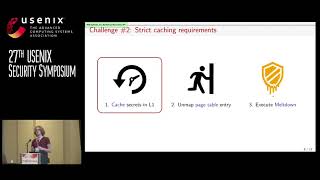
Foreshadow - Extracting the Keys to the Intel SGX Kingdom with Transient Out-of-Order Execution
Unveiling Foreshadow: A microarchitectural attack exploiting speculative execution to extract secrets from Intel SGX enclaves, compromising trusted execution environments and remote attestation.
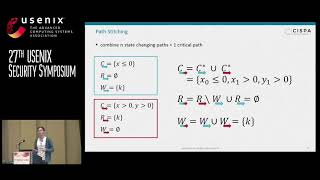
TeEther - Gnawing at Ethereum to Automatically Exploit Smart Contracts
Explore automatic vulnerability detection and exploit generation for Ethereum smart contracts using teEther, a tool that analyzes binary bytecode to identify and exploit security weaknesses.
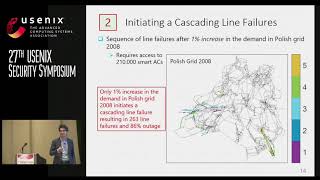
BlackIoT - IoT Botnet of High Wattage Devices Can Disrupt the Power Grid
Explores potential attacks on power grids using IoT botnets of high-wattage devices, demonstrating vulnerabilities and impacts through simulations on real-world models. Highlights interdependency between IoT and power grid security.

Analogy Cyber Security - From 0101 to Mixed Signals
Explores threats to sensor integrity in smart devices and their impact on system security. Discusses EMI interference, vulnerabilities in voice-controlled systems, and potential defenses for improving sensor security.
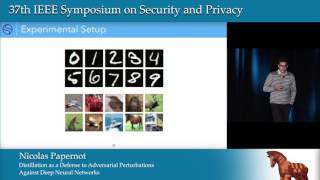
Distillation as a Defense to Adversarial Perturbations against Deep Neural Networks
Introduces defensive distillation to protect deep neural networks from adversarial attacks, reducing attack effectiveness from 95% to 0.5% and increasing robustness by 800% in tests.
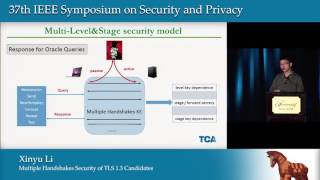
Multiple Handshakes Security of TLS 1.3 Candidates
Explores security aspects of TLS 1.3 candidates, focusing on multiple handshake protocols. Introduces a multi-level security model and proves the soundness of TLS 1.3 security design.
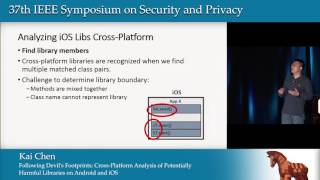
Following Devil's Footprints - Cross-Platform Analysis of Potentially Harmful Libraries on Android and iOS
Cross-platform analysis of potentially harmful libraries in Android and iOS apps, revealing widespread infection and risky behaviors like unauthorized data access and audio/video recording.
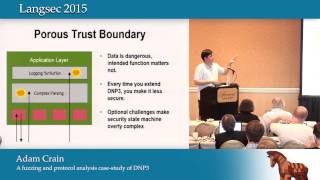
A Fuzzing and Protocol Analysis Case-Study of DNP3
Explores vulnerabilities in DNP3, a key SCADA protocol for power systems, revealing design flaws and implementation gaps. Discusses fuzzing results, CVEs, and analyzes the protocol's security addendum.

Dark Matter - Driven By Data
Explore data-driven cybersecurity challenges and solutions with expert Dan Geer in this IEEE symposium keynote, addressing the complexities of modern digital threats and defenses.
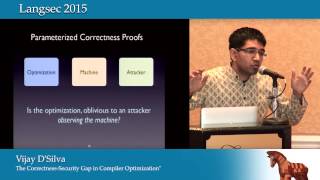
The Correctness-Security Gap in Compiler Optimization
Explores how compiler optimizations can preserve functionality but violate security guarantees, proposing research to identify and mitigate security errors introduced during optimization.
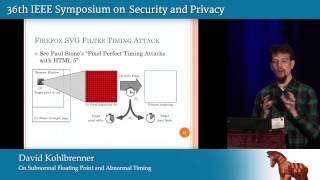
On Subnormal Floating Point and Abnormal Timing
Explores timing vulnerabilities in x86 floating-point operations, demonstrating practical attacks on Firefox and a privacy-focused database. Introduces a constant-time math library as a potential mitigation.
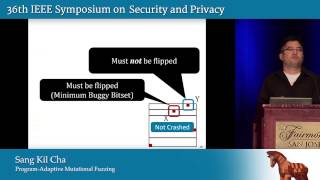
Program-Adaptive Mutational Fuzzing
Innovative algorithm maximizes bug detection in black-box mutational fuzzing by leveraging symbolic analysis to optimize mutation ratios, resulting in 38.6% more bugs found across 8 applications.
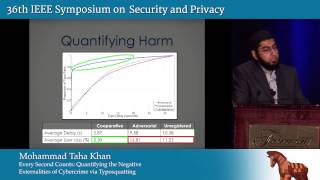
Every Second Counts - Quantifying the Negative Externalities of Cybercrime via Typosquatting
Quantifying harm from typosquatting using intent inference. New metrics and methodology reveal average time cost to users and traffic loss for legitimate sites. Some typosquatters unexpectedly improve latency.
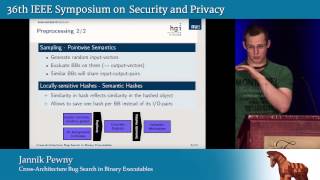
Cross-Architecture Bug Search in Binary Executables
Innovative method for identifying vulnerabilities across different CPU architectures using bug signatures and semantic analysis of binary code, enabling effective security assessments of closed-source software.
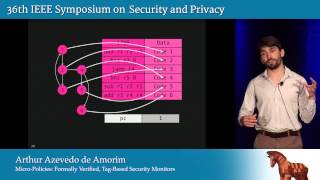
Micro-Policies - Formally Verified, Tag-Based Security Monitors
Explore formally verified tag-based security monitors for low-level policies. Learn about dynamic sealing, compartmentalization, control-flow integrity, and memory safety implementation.