Changing Applications for Dynamic Secrets - Tutorial
Learn to architect applications for dynamic secret management, minimizing downtime during credential changes. Explore patterns for retrieving and reloading secrets across various environments, including VMs and Kubernetes.
Delivering Secure and Compliant Software Components with OCM and GitOps
Explore Open Component Model and GitOps for secure, compliant software delivery. Learn to automate deployment, enhance supply chain security, and manage artifacts in high-security environments.
Automate Secret Rotation in Kubernetes - Then Get Out of the Way
Learn to automate secret rotation in Kubernetes, understand various solutions, and implement safe, reliable practices. Gain insights on monitoring infrastructure and exploring alternatives to Kubernetes secrets.
Preparing for Constant Change With Quantum Agility
Explore quantum computing's impact on encryption, new quantum-resistant standards, and strategies for rapid adaptation of cryptographic tools without major infrastructure changes.
How to Backdoor the Linux Kernel and Fail - Security Measures in Kernel Development
Explore potential Linux kernel backdoor methods and existing security measures. Investigate weak points in the trust chain and learn about kernel release protection strategies.
HotBPF++ - A More Powerful Memory Protection for the Linux Kernel
Explore HotBPF++, an advanced Linux kernel memory protection system. Learn about its automatic deployment, on-the-fly enabling, and lightweight design for preventing and detecting various memory corruptions beyond heap exploitation.
Controlling Script Execution in Linux - Security Mechanisms and Challenges
Explore kernel-managed script execution control in Linux, addressing challenges and implementation approaches for a consistent global policy.
Verifiable End-to-End Secure OCI Native Machines
Explore a secure toolchain for verifiable workloads using signed OCI images, ensuring tamper-proof boot processes and authenticated communication with hosts.
Enforcing Runtime Integrity with Maat
Explore Maat: an open-source framework for runtime integrity measurement in Linux systems, enabling continuous security checks and malware detection throughout system execution.
Hypervisor-Enforced Kernel Integrity for Linux with KVM
Explore hypervisor-enforced kernel integrity for Linux using KVM. Learn about advanced protection mechanisms against kernel vulnerabilities and their implementation through virtualization.
systemd and TPM2 Features in Linux - Current State and Future Developments
Explore systemd's TPM2 features for enhanced Linux security, including disk unlocking, PCR policies, and system credentials, with insights on future developments and implementation challenges.
Linux Security Module (LSM) Maintainers Panel Discussion
Panel discussion on recent Linux Security Module developments, featuring insights from key maintainers on significant security advancements in LSMs and the Linux Kernel, with audience Q&A.
ChatGPT, Stable Diffusion, and the Future of Open Source AI
Explore the impact of generative AI on open source ethics, data usage, and individual rights, with insights from a leading AI scientist on the future of this technology.
Livepatch in Userspace Based on Uprobe
Explore userspace livepatch techniques for CVE and bug fixes, covering compiler modifications, patch generation, process recognition, and code injection using Uprobe.
Building a Secure By-Design Pipeline with an Open Source Stack
Explore open-source tools and strategies for implementing a secure-by-design pipeline, enhancing software development practices and strengthening overall cybersecurity posture.
A Checklist for Security from Container to Kubernetes - An End-to-End Overview
Comprehensive overview of container and Kubernetes security, covering lifecycle, supply chain, infrastructure, features, and potential attacks. Practical insights for robust cloud-native security implementation.
What We Learned Dissecting the World's Most Popular Containers
Explore insights from analyzing popular containers, covering size, complexity, package landscape, and security vulnerabilities to enhance container management and optimization strategies.
Exploring Runtime Security and Forensics Using eBPF
Discover how eBPF enhances runtime security and forensic analysis, offering advanced threat detection and system monitoring capabilities for improved cybersecurity.
Unravelling How Firmware Interacts with the Linux Subsystem
Explore the intricate relationship between firmware and the Linux subsystem, gaining insights into their interaction and its implications for system performance and functionality.
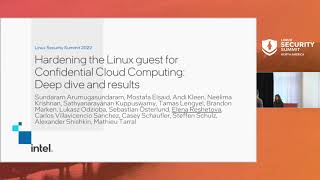
Hardening Linux for Confidential Cloud Computing - Deep Dive and Results
Explore techniques for hardening Linux guest systems in confidential cloud computing environments, focusing on security mechanisms, kernel subsystem treatments, and results from fuzzing and code audits.
Improving Container Security with System Call Interception
Explore advanced container security using system call interception, focusing on unprivileged containers, selective action monitoring, and practical applications in LXD.