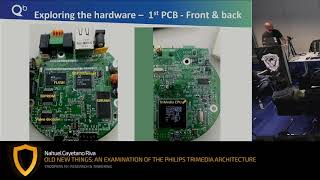
Old New Things - An Examination of the Philips TriMedia Architecture
Explore the Philips TriMedia architecture, examining its history, features, and potential vulnerabilities through firmware analysis and hardware exploration.

ZombieLoad - Leaking Data on Intel CPUs
Explore ZombieLoad, a critical Intel CPU vulnerability. Learn about its mechanics, implications for data security, and potential exploits through demonstrations and insights.
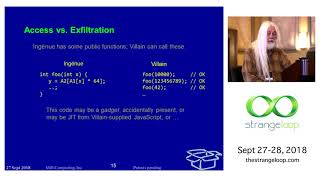
Mill vs. Spectre - Performance and Security
Explore CPU architecture vulnerabilities, focusing on Meltdown and Spectre attacks. Learn about the Mill architecture's unique approach to performance and security without hardware speculation.
One Glitch to Rule Them All - Fault Injection Attacks Against the AMD Secure Processor
Explore fault injection attacks on AMD's Secure Processor, revealing vulnerabilities in CPU security and discussing implications for system integrity and trust.
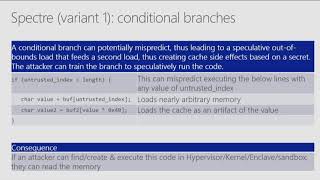
Wrangling with the Ghost - An Inside Story of Mitigating Speculative Execution Side Channel Vulnerabilities
Explore Microsoft's approach to mitigating speculative execution vulnerabilities, including research, collaboration, and industry-wide efforts. Learn about Spectre, Meltdown, and strategies for robust security measures.
GPU Programming with Modern C++
Explore GPU programming with modern C++, covering parallelism fundamentals, heterogeneous computing, and SYCL for GPU dispatch. Learn to optimize performance and leverage multi-core architectures effectively.
Maximizing Workload's Performance With Smarter Runtimes
Explore innovative container runtime solutions for maximizing workload performance and resource utilization, focusing on CPU, memory, caches, and I/O optimizations in Kubernetes environments.
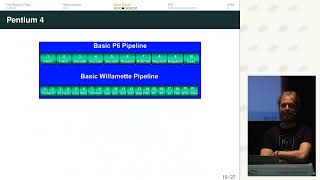
The Chip Show - How Not To Design a CPU
Humorvoller Rückblick auf fragwürdige Entscheidungen und interessante Irrwege in der CPU-Entwicklung. Manöverkritik mit der Weisheit der Nachbetrachtung und Potenzial zum Lernen.
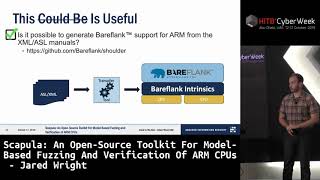
An Open-Source Toolkit for Model-Based Fuzzing of ARM CPUs
Explore model-based fuzzing for ARM CPUs using machine-parsable reference manuals. Learn about Scapula, an open-source tool for detecting specification violations in ARM-based platforms.
Multi-Architecture Container Images - Why Bother, and How To
Explore multi-architecture container images: their importance, how registries handle them, and techniques for building cross-platform containers to ensure software compatibility across diverse CPU architectures.
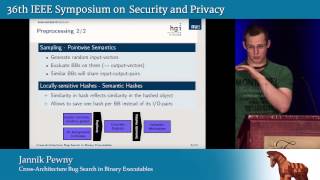
Cross-Architecture Bug Search in Binary Executables
Innovative method for identifying vulnerabilities across different CPU architectures using bug signatures and semantic analysis of binary code, enabling effective security assessments of closed-source software.
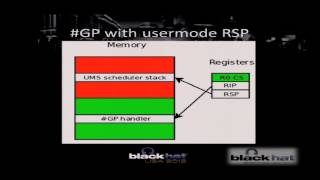
A Stitch in Time Saves Nine - A Case of Multiple Operating System Vulnerability
Explore CPU vulnerabilities and their exploitation across multiple operating systems. Learn about the "sysret" instruction flaw, its impact, and mitigation strategies for system security.
Out-of-Order Execution - What Can It Do for Me?
Explore out-of-order execution in CPUs, its advantages, limitations, and techniques to leverage it in C/C++ programs for improved performance and efficiency.
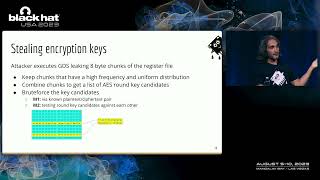
Single Instruction Multiple Data Leaks in Cutting-edge CPUs - AKA Downfall
Unveiling Downfall attacks: new transient execution vulnerabilities in Intel CPUs. Exploits Gather instruction to leak data across security boundaries, defeating previous defenses and necessitating critical hardware fixes.

What UNIX Cost Us
Exploring UNIX's impact, limitations, and alternatives, this talk challenges conventional wisdom and examines what could have been done differently in operating system design.
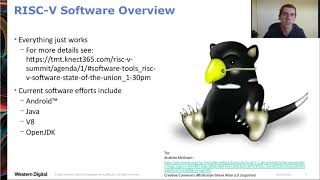
Open ISAs - RISC-V, OpenPOWER, etc
Explore the growth and potential of open CPU architectures like RISC-V and OpenPOWER, discussing recent developments, available hardware, and their importance for the future of open source computing.
CPU-Friendly Code
Explore CPU architecture, cache locality, branch prediction, and OS concepts to optimize code performance and efficiency beyond Big-O notation.
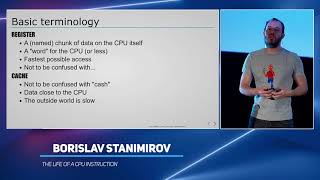
The Life of a CPU Instruction
Explore the journey of a CPU instruction through modern processor architecture, covering out-of-order execution, caching, and branch prediction in this informative talk.
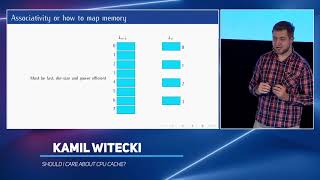
Should I Care About CPU Cache?
Explore CPU cache basics, its impact on performance, and optimization techniques. Learn to measure and improve cache usage for efficient programming.
Your CPU Is Binary
Explore the potential evolution of CPUs from binary to ternary logic, discussing historical context, current limitations, and future implications for software development and programming languages.

Implementing Fast Calendar Algorithms - Speeding Date
Optimizing calendar algorithms for modern CPUs: strength reduction, data dependency breaking, and historical insights. Faster implementations for leap year checks and last day of month calculations.