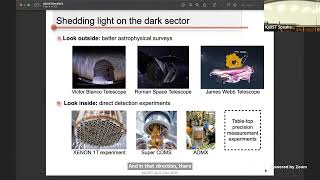
Searching for Dark Matter and Dark Energy with Mechanical Systems
Explore groundbreaking research on detecting dark matter and dark energy using mechanical systems, examining innovative detection methods and experimental approaches in quantum physics.
Quantum Gravity Experiments: A Biased Overview of Recent Developments
Explore cutting-edge experimental approaches to testing quantum behavior in gravity, from tabletop Newton interaction studies to gravitational radiation field measurements and holographic noise searches.
Quantum Gravity: From General Relativity to Loop Quantum Gravity
Delve into the fascinating intersection of General Relativity and quantum mechanics, exploring black holes, the early universe, and the quest to understand quantum gravity through Loop Quantum Gravity theory.
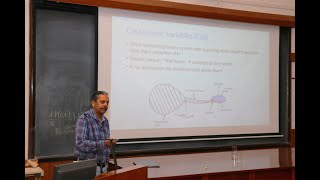
X-ray View of Cataclysmic Variable Stars: Binary Systems and X-ray Emissions
Explore the fascinating world of cataclysmic variable stars through X-ray observations, focusing on binary systems with white dwarfs and the unique characteristics of asynchronous polars.
Multi-messenger Astronomy: Progress and Problems in Exploring the Dynamic Sky
Explore the dynamic universe through multi-messenger astronomy, examining cosmic rays, neutrinos, photons, and gravitational waves to understand astrophysical phenomena and recent research developments.
Peering into the Early Universe - Observing Cosmic History Through High-Precision Measurements
Explore high-precision astronomical techniques and custom telescope designs used to study crucial epochs of the early Universe, overcoming observational challenges to reveal our cosmic origins.

Seeing the High Energy Universe - Understanding Cosmic Rays and Neutrino Detection
Explore high-energy cosmic phenomena, from cosmic rays to neutrinos, and discover cutting-edge detection methods and astronomical observations in this comprehensive physics lecture.
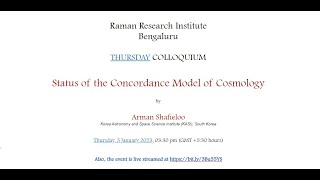
Status of the Concordance Model of Cosmology - Current Tensions and Future Directions
Explore the current state of cosmological models, examining tensions in observations, potential solutions, and future directions in astronomical surveys with Prof. Shafieloo's expert analysis.
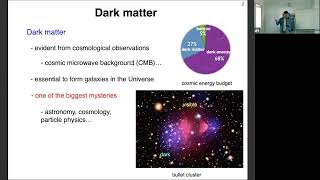
Current Status of Self-Interacting Dark Matter
Explore the latest findings on self-interacting dark matter, examining velocity-dependent cross sections and their implications for dark matter halos across different cosmic scales.
Atomic Hydrogen in Galaxies Nine Billion Years Ago
Explore the groundbreaking detection of atomic hydrogen in ancient galaxies, tracing 30 years of research that reveals how galaxies evolved through gas-to-star conversion 9 billion years ago.
Telescopes on the Moon: The Next Decades - Exploring Space Through Lunar Observatories
Explore groundbreaking astronomical possibilities as lunar-based telescopes revolutionize our understanding of dark ages cosmology, early universe radiation, and exoplanet discoveries in unprecedented detail.

How Earth Moves
Explore Earth's complex movements, from daily rotation to cosmic travel, and their impact on time, seasons, and our place in the universe. Uncover fascinating celestial phenomena and calendar intricacies.
MIGHTEE-HI - The Relation Between the HI Gas in Galaxies and the Cosmic Web - Madalina Tudorache
Explores the relationship between neutral hydrogen gas in galaxies and the cosmic web, discussing observations, data sources, and implications for galaxy formation and evolution.
Formation of Thin and Thick Discs of Galaxies - Sukyoung Yi (Yonsei)
Explore galaxy disc formation, evolution, and structure through simulations and observations, examining factors like cosmic web influence, mergers, and stellar populations.
How Cosmological Filaments Reset the Formation of Disc Galaxies - Florent Renaud
Explore how cosmic filaments influence disc galaxy formation, examining the interplay between the cosmic web and galaxy evolution across time and its implications for cosmology.
Cold Streams in the Hot CGM of High Z Galaxies - Han Aung
Explore cold streams in hot CGM of high-redshift galaxies, their properties, and implications for galaxy formation. Gain insights into cosmic web evolution and its impact on early universe structures.
Tracking Halo Orbits and Their Mass Evolution Around Large-Scale Filaments - Hannah Jhee
Explore halo orbits and mass evolution around cosmic filaments, examining their dynamics, virialization, and impact on galaxy formation across cosmic time.
The Energy Minimisation Principle - Linking Protohalo Shapes to Anisotropic Infall - Marcello Musso
Explores the Energy Minimisation Principle in cosmology, linking protohalo shapes to anisotropic infall and discussing its implications for galaxy formation, cosmic web evolution, and large-scale structure.
New Appreciation of the Role of Shocks in Nova Eruptions - Jeno Sokoloski
Explore new insights into nova eruptions, focusing on the role of shocks in gamma-ray production, dust formation, and light curve behavior. Learn about recent observations and their implications for our understanding of these stellar events.
Gas-Embedded Binaries - A Link Between Stars, Black Holes and Gravitational Waves - Lucio Mayer
Explore the connection between gas-embedded binaries, stellar evolution, and gravitational waves. Gain insights into supermassive black holes and merging binaries in this comprehensive lecture.
What is Love? New Physics at the State of the Art with Spins - Michèle Levi
Explore gravitational wave modeling and its impact on physics, connecting field theory, relativity, and scattering amplitudes. Learn about emerging tools and techniques for next-gen experiments.