Are Supermassive Black Holes Primordial?
Explore the origins of supermassive black holes, their potential primordial nature, and challenges in explaining their existence through early universe models and observational constraints.
Gravitational Waves as a Probe of the Early Universe
Explore gravitational waves as a probe of the early Universe, covering search status, stochastic background evidence, data analysis challenges, and new high-frequency detection ideas.
Summer Students' Final Presentations - Part 1
Explore cutting-edge physics research through student presentations on Hamiltonian Monte Carlo simulations, fundamental constants, and more.
Numerical Relativity in Effective Field Theories of Gravity
Explore gravitational-wave astronomy and its implications for testing General Relativity, focusing on waveform predictions, higher curvature corrections, and numerical simulations in effective field theories of gravity.
New Developments on Asymptotically Leaky Boundaries
Explore new developments in asymptotically leaky boundaries, focusing on recent research and ongoing work in Carrollian physics and holography.
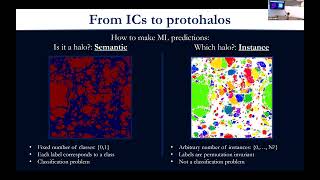
Machine Learning Applications in Cosmology - Past, Present, and Future
Explore the evolution and impact of machine learning in cosmological research, from historical applications to cutting-edge developments and future possibilities in astronomical studies.
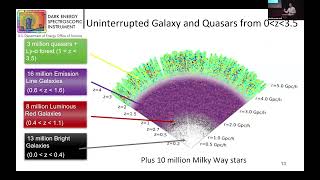
Cosmology from the First Year DESI BAO Measurements
Explore groundbreaking findings from DESI's first-year measurements of baryon acoustic oscillations, examining implications for dark energy, neutrino mass, and the Hubble Constant tension.
Pulsar Timing Arrays, Massive Black Holes, and a Surprisingly Loud Gravitational Wave Background
Explore groundbreaking discoveries in gravitational wave detection using pulsar timing arrays and their connection to supermassive black holes in this theoretical physics presentation.
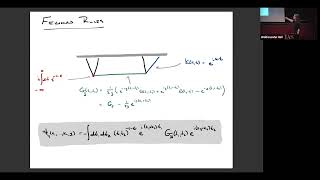
Kinematic Flow and Differential Equations for Cosmological Correlators
Explore advanced mathematical concepts in cosmological correlators, focusing on kinematic flow and differential equations through fundamental physics principles and theoretical frameworks.
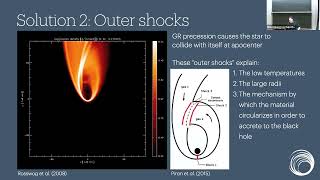
Stars Disrupted, Destroyed and Coalesed: Investigating Supernovae and Stellar Events
Explore groundbreaking research on stellar phenomena including supernovae, tidal disruption events, and neutron star mergers, examining their impact on understanding cosmic evolution and fundamental physics.
Design and Development of the James Webb Space Telescope
Delve into the engineering marvel of the James Webb Space Telescope with NASA's Astrophysics Director, exploring its groundbreaking design, deployment challenges, and revolutionary impact on our understanding of the universe.
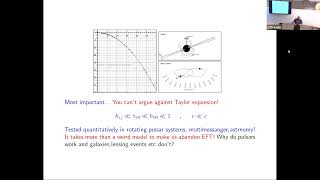
Non-local Effective Field Theory in General Relativity
Delve into non-local effective field theory applications in general relativity, exploring advanced theoretical physics concepts and their implications for gravitational phenomena.
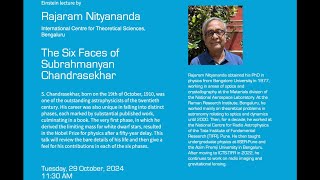
The Six Faces of Subrahmanyan Chandrasekhar
Explore the remarkable scientific journey of S. Chandrasekhar through six distinct research phases, from his groundbreaking work on white dwarf stars to his later contributions in astrophysics.
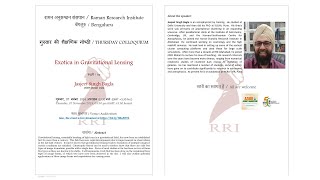
Exotica in Gravitational Lensing
Explore the fascinating phenomena of gravitational lensing and its exotic manifestations through advanced theoretical concepts and real-world astronomical observations.
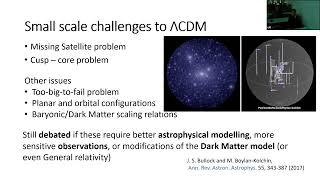
Coherent and Incoherent Dynamics of Fuzzy Dark Matter
Delve into the physics of Fuzzy Dark Matter, exploring its relationship with Bose-Einstein condensates, soliton formation, and implications for galactic structure through advanced theoretical analysis.

Terra: Un habitat unico nel cosmo | Giovanni Covone | TEDxUNINA Federico II
Siamo soli nell'universo? L'astrofisico Giovanni Covone esplora il delicato legame tra vita e stelle, dai miti antichi alle scoperte moderne di esopianeti. Rivela perché la Terra può essere sia ordinaria che straordinaria— una casa fragile e unica nel vasto cosmo. Giovanni Covone è un astrofisico ch

Why we measure the universe | Professor Wendy Freedman | TEDxChicago
Astronomer Wendy Freedman, at the University of Chicago, shares humanity's quest to measure the expanding universe, revealing an exciting scientific mystery: our measurements don't match. Drawing from decades leading major observatories and the Giant Magellan Telescope project, she explains how the

Svet medzi galaxiami a pavučina, ktorá ich prepája | Norbert Werner | TEDxTurcianskeTeplice
V priestore medzi galaxiami sa nachádza neviditeľná štruktúra, ktorá formuje celý vesmír. Norbert Werner nás zavedie do kozmickej pavučiny a ukáže, ako štúdium týchto obrovských vzdialeností mení naše chápanie vesmíru aj nášho miesta v ňom. Norbert Werner is an award-winning astrophysicist who studi

A láthatatlan univerzum feltérképezése | András Kovács | TEDxDanubia
Az emberiség által valaha rajzolt legnagyobb térkép nem a Földről készül, hanem az egész belátható univerzumról. Az ESA Euclid űrteleszkóp hat év alatt térképezi majd fel a galaxisok kozmikus hálózatát, hogy láthatóvá tegye azt is, ami eddig rejtve maradt: az univerzum 95%-át kitöltő sötét anyagot é

All’ombra della galassia | Stefano Giovanardi | TEDxFoggia
Siamo figli delle stelle e dobbiamo essere i custodi della Terra, prendercene cura. Al TEDxFoggia “The Age of Care” Stefano Giovanardi ci presenta la volta celeste come lo specchio per l’umanità che ci aiuta a capire chi siamo. Stefano Giovanardi, laureato in astronomia all'Università di Bologna,

Işınlanmak Orucu Bozar mı? | Selçuk Topal | TEDxVizyon Koleji Youth
Astrofizikçi & Bilim İletişimcisi Lisans ve yüksek lisans öğrenimini Ankara Üniversitesi Astronomi ve Uzay Bilimleri Bölümü’nde tamamladı. Oxford Üniversitesi Astrofizik Bölümü’nde doktora derecesini almıştır. Dış galaksilerde moleküler gaz gözlem ve analizi, gaz kinematiği ve galaksi evrimi a