
The Science of the Man from the 9 Dimensions
Explore the universe's origins, from the Big Bang to cosmic inflation, and delve into superstring theory's quest for a unified understanding of physics across nine dimensions.
Spacetime, Quantum Mechanics and Positive Geometry by Nima Arkani Hamed
Explore the intersection of spacetime, quantum mechanics, and positive geometry, delving into scattering amplitudes, the mystery of time, and emergent phenomena in theoretical physics.
Quantum Field Theory as the Language of Physics by Nathan Seiberg
Explore quantum field theory's role as the universal language of physics, its applications, limitations, and potential reformulation in this insightful talk by Nathan Seiberg.
Cosmological Simulations by R. Angulo
Explore cosmological simulations in this lecture, covering key concepts, techniques, and applications in modern cosmology research for understanding the universe's structure and evolution.
Does Math Reveal Reality?
Explore the profound connection between mathematics and physical reality with leading thinkers. Delve into whether math is a human invention or an intrinsic part of the universe's fabric.
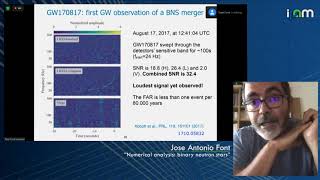
Numerical Analysis - Binary Neutron Stars - IPAM at UCLA
Explore numerical modeling of binary neutron star mergers, covering hydrodynamics, MHD equations, and simulation methods. Learn about gravitational waves, gamma-ray bursts, and r-process elements.
Introduction to Theory and Numerics of Partial Differential Equations - Lecture 1
Explore fundamental concepts and numerical techniques for solving partial differential equations, essential for modeling complex physical phenomena in gravitational-wave astronomy and astrophysics.
Building the Universe with Mathematics
Explore how mathematics can design our universe, from numbers to multidimensional concepts. Discover the progression of ideas that shape existence, including geometry, algebra, infinity, and relativity.
Mysterious Numbers - Unlocking the Secrets of the Universe
Explore extraordinary numbers in physics with Tony Padilla, uncovering fundamental truths about black holes, holographic reality, and the cosmological constant through unusually big, small, and infinite numbers.
Numbers, the Universe and Complexity Beyond Us - Data Structures Math Foundations 177
Explore the limits of mathematical notation, the philosophy of numbers, and the physical constraints of our universe in representing extremely large quantities and complex mathematical concepts.
Introduction to Theory and Numerics of Partial Differential Equations - Lecture 4
Explore advanced concepts in partial differential equations, focusing on theory and numerical methods for solving complex mathematical problems in physics and engineering.
A Sharp Isoperimetric-Type Inequality for Lorentzian Spaces Satisfying Time-Like Ricci Curvature Lower Bounds
Explore sharp isoperimetric-type inequalities in Lorentzian spaces with time-like Ricci curvature bounds, including applications to black holes and cosmological space-times.
Learning Theory-Informed Priors for Bayesian Inference - A Case Study with Early Dark Energy
Explore novel methods for learning theory-informed priors in Bayesian inference using normalizing flows, with applications to early dark energy models in cosmology.
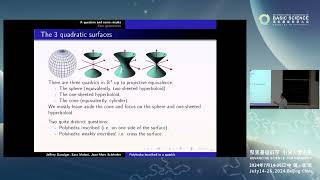
Polyhedra with Vertices on a Quadric
Explore combinatorial types of polyhedra with vertices on quadrics, from Steiner's 1832 question to recent findings using ideal polyhedra in various geometries.
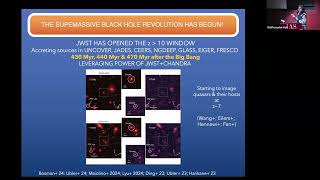
New Insights into the First Supermassive Black Holes in the Universe
Explore groundbreaking discoveries about supermassive black holes, from their formation and growth to their cosmic influence, featuring latest findings from JWST, NANOGrav, and computational advances.
Decoding the Physics of the Early Universe Through Primordial Black Holes, Dark Matter and GWs
Explore the complex physics of primordial black holes, their role in universe reheating, dark matter production, and gravitational waves through advanced theoretical concepts and recent observational data.

Is There a Theory of Everything? - Great Mysteries of Physics
Explore the quest for physics' holy grail - a unified theory connecting quantum and cosmic scales - through expert discussions on its necessity, feasibility, and implications for science.

Is the Universe Finely-Tuned for Life? - Episode 2
Explore the fascinating question of cosmic fine-tuning with physicists Paul Davies and Fred Adams as they examine whether the universe's physical constants are precisely calibrated for life to exist.
Changing Science by Asking Big Questions
Explore how curiosity-driven scientific inquiry and asking fundamental questions can revolutionize our understanding of time, consciousness, and the universe's deepest mysteries.
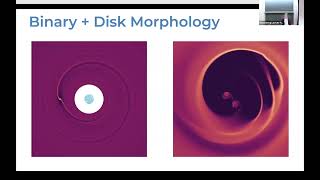
Accreting Binaries: From Brown Dwarfs to Major Mergers
Explore the dynamics of binary systems across cosmic scales, from molecular cloud collapse to galactic mergers, focusing on circumbinary accretion and black hole binary evolution in various environments.
Quantum Sensors Based on Matter-Waves
Explore cutting-edge matter-wave interferometry and its applications in precision metrology, from testing Einstein's equivalence principle to detecting gravitational waves in groundbreaking experiments.