Emergent Metric Space-Time and Early Universe Cosmology from the BFSS Matrix Model
Explore emergent space-time and early universe cosmology from the BFSS matrix model, examining thermal fluctuations and cosmological perturbations without inflation.
C^0-Inextendibility of FLRW Spacetimes Without Particle Horizons - Mathematical Relativity
Explore C^0-inextendibility of FLRW spacetimes without particle horizons, focusing on positive and negative spatial sectional curvature cases and scale factor implications.
A Quiescent Regime for Big Bang Formation
Explore stable big bang formation in general relativity, covering recent results and a new condition for big bang formation in Einstein-non-linear scalar field settings.
Mathematical General Relativity: Seventy-Two Years After Yvonne Bruhat's Foundational Acta Paper
Explore key achievements in mathematical general relativity since Y.C Bruhat's foundational Acta paper, reviewing 72 years of progress in the field.
Memory Effect and Carroll Symmetry for Gravitational Waves
Explore gravitational wave detection through particle displacement, integrating geodesic equations using plane wave isometries and Carroll group symmetry to determine particle trajectories.
Formation of Quiescent Big Bang Singularities
Explore general relativity's big bang singularities, recent stability results, and a new condition for big bang formation in Einstein-non-linear scalar field settings.
Festina Lente and Branes in Quantum Gravity
Explore universal bounds on brane tension in de Sitter space using the Festina Lente conjecture, cosmic censorship, and charged black hole evolution in quantum gravity.
Quintessence: From String Theory to Observations and Back
Explore quintessence in string theory and its observational implications, bridging theoretical concepts with empirical evidence in cosmology.
Primordial Stochastic Gravitational Wave Backgrounds in Multi-field Inflation
Explore stochastic gravitational wave backgrounds in multi-field inflation, examining frequency profiles and potential visibility in LISA, unlocking insights into early universe processes.
What if String Theory Has a de Sitter Excited State?
Explore the concept of de Sitter space as an excited state in string theory, examining its implications and differences from traditional coherent states.
What if String Theory Has a de Sitter Excited State?
Explore the concept of de Sitter space as an excited state in string theory, examining its implications and differences from traditional coherent states.
Biocosmology: Lessons from Biology on Physics of the Continuum
Explore biocosmology and its insights from biology for understanding physics of the continuum with astrophysicist Marina Cortês.
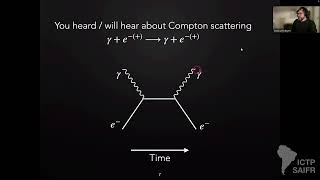
Fundamental Physics: Gamma-Ray Absorption and Axion-Like Particles - Class 1
Explore fundamental physics concepts in gamma-ray astronomy, including pair production, extragalactic background light, and axion-like particles. Gain insights into cutting-edge research and theoretical models.
Interpreting Deep Neural Networks Towards Trustworthiness
Explore methods for interpreting neural networks, including contextual decomposition and adaptive wavelet distillation, to enhance model trustworthiness and performance.
First Light: Revealing the Early Universe
Explore the early universe with Prof. Lintott as he answers questions on light constancy, galaxy composition, and cutting-edge theories about cosmic origins in this engaging Q&A session.
Machine Learning for Gravitational Wave Astronomy
Explore machine learning applications in gravitational wave astronomy, focusing on advanced detection and analysis techniques for cosmic phenomena.
Minicourse on Cosmological Phase Transitions and Gravitational Waves - Class 2
Explore cosmological phase transitions and gravitational waves, focusing on advanced concepts and their implications for our understanding of the early universe.
Minicourse on Cosmological Phase Transitions and Gravitational Waves - Class 1
Explore cosmological phase transitions and gravitational waves in this comprehensive minicourse, focusing on fundamental concepts and their implications for early universe physics.
Diving into the Details of Continuous Wave-Searches and Prospects for the Future
Explore continuous wave-searches in gravitational wave astronomy, examining current techniques and future prospects for detecting long-duration signals from rotating neutron stars.
Fundamental Physics and Cosmology with High-Energy Cosmic Particles
Explore fundamental physics and cosmology through high-energy cosmic particles, delving into cutting-edge research and its implications for our understanding of the universe.
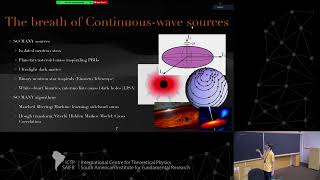
Probing Neutron Stars and Dark Matter with Continuous Gravitational Waves
Explore neutron stars and dark matter through continuous gravitational waves, uncovering insights into fundamental physics and cosmic phenomena.